

Results 1 to 1 of 1
Thread Information
Users Browsing this Thread
There are currently 1 users browsing this thread. (0 members and 1 guests)
 LinkBack URL
 About LinkBacks
-
11-02-2026, 07:34 PM #1Senior Member


- Join Date
- Aug 2018
- Posts
- 99,253
Migrants turn to deadly Pacific sea route as US land border controls tighten
Latin Times
51.3K Followers
Migrants turn to deadly Pacific sea route as US land border controls tighten
Story by Clara Espinoza
• 6h • 5 min read
The Briefing:
- Migrants are paying up to $10,000 to cross the Pacific Ocean on overloaded wooden pangas from Baja California to San Diego — a route experts call significantly more lethal than any overland path.
- The unprecedented tightening of land border controls under the current U.S. administration has confirmed the "balloon effect": fewer total border crossers, but those who attempt entry are choosing far more dangerous routes.
- The Jalisco New Generation Cartel (CJNG) has seized control of the maritime corridor, operating a vertically integrated network from inland recruitment centers all the way to cargo container shipments into the Port of Long Beach.
With swells reaching six feet and no life jackets on board, dozens of migrants launch into the Pacific Ocean each night aboard wooden pangas off the coast of Baja California, hoping to reach San Diego. The crossing can cost up to $10,000 — and can cost them their lives.
What the Numbers Reveal
Roberto B. Domínguez Jr., acting deputy chief of U.S. Customs and Border Protection, confirmed at a press conference that officers are seeing "more people on pangas" as enforcement pressure on land increases. "The metropolitan San Diego and Tijuana area is considered one of the most problematic zones due to the high number of illegal crossings," he said. "What we are seeing, as we close down the border, build more of the wall, deploy National Guard troops, we're seeing more traffic in the maritime environment."
Meanwhile, total southern border arrests tell a parallel story. Internal CBP data show Border Patrol agents arrested fewer than 99,000 people at the southern border in fiscal year 2026 — the lowest annual total in at least 59 years and an 88% decline from the peak years of the previous administration. Fewer people are attempting the crossing overall, but those who do are taking on greater physical risk than ever before.
 Related video: They feared cartels in Mexico - but the highway became the real danger (Eamon & Bec)
Eamon & Bec
They feared cartels in Mexico - but the highway became the real danger
America into Mexico and
The human cost is documented in the water itself. In May 2025, at least three people died when a panga capsized roughly 35 miles north of the border. In November 2025, four migrants drowned when a wooden skiff broke apart in stormy seas near Imperial Beach. A federal judge in San Diego previously sentenced a boat captain to 18 years in prison after his overloaded vessel killed three people in the surf. Bodies that disappear in open water are rarely recovered, which means official tallies almost certainly undercount the true toll.
The Routes and the Price
The most documented corridor runs from Tijuana or Ensenada toward the beaches of San Diego County. The border barrier extends more than 60 meters into the ocean, and migrants attempt to round it by swimming or by boat. A maritime crossing can cost up to $10,000, compared to roughly $8,000 for an overland route — a premium smugglers justify by promising to bypass the military checkpoints and roadblocks saturating northern Mexican highways.
The voyages happen at night, in wooden pangas where between 10 and 25 people are packed without safety equipment, many of them unable to swim. CBP officials confirm that "smugglers sometimes have to navigate waves up to 12 feet high" in vessels never designed for open ocean. The agency says smugglers "don't adhere to boating safety standards" and regularly overload their boats to maximize profit.
The Cartel Takes Control
An October 2026 report from Times of San Diego reveals that the Jalisco New Generation Cartel has deployed a strategy of vertical integration across human trafficking routes, including the Pacific maritime corridor. The organization operates from recruitment points in states like Veracruz and Puebla, moves migrants along secondary routes that bypass military controls, and in higher-paying cases, ships people directly into the Port of Long Beach inside cargo containers.
Tactical and intelligence analysts cited in the report estimate the CJNG's human trafficking operations generate more than 300 million pesos per month, reflecting both the volume of people transiting Mexican territory daily and the cartel's ability to impose fees, tolls, and forced logistics services at every stage of the journey. The cartel's arrival neutralized or absorbed local smuggling groups that previously operated independently, imposing unified command over transit corridors from the moment migrants set foot on Mexican soil.
The extortion does not end at landfall. Activists in Tijuana consulted by Telemundo report that traffickers hold migrants or threaten to report their location to authorities unless additional payments are made once they reach U.S. soil.
A Crisis Expanding Beyond the Pacific
The migratory pressure is also reshaping routes across the Atlantic and the Caribbean. Ecuador, which historically concentrated its migration flows through the Darién Gap, diversified its corridors in 2026: Mexican authorities identified new air-based networks that connect with overland coyote networks, while the Dominican Republic consolidated its role as a maritime transit point toward Puerto Rico. In September 2026, prosecutors in Cañar province were actively investigating five Ecuadorians who disappeared during a crossing near the Bahamas.
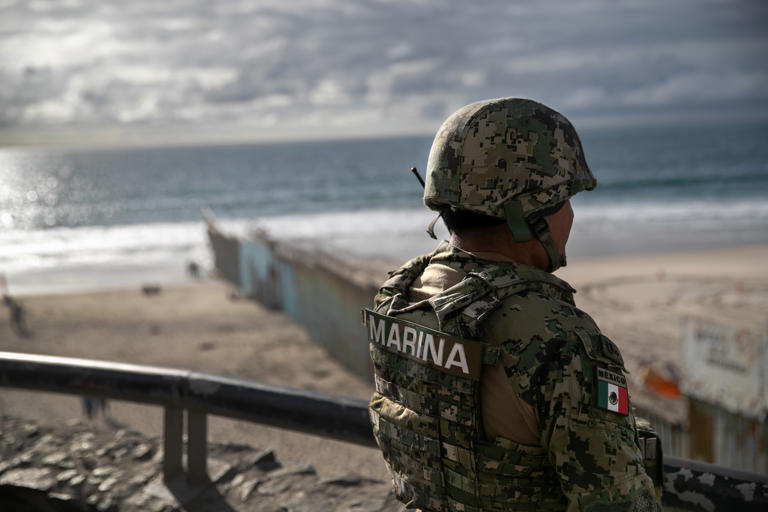
A Mexican security officer monitors the border fence in Tijuana, Mexico, as authorities maintain surveillance along the boundary separating the two countries. Photo by John Moore/Getty Images© Photo by John Moore/Getty Images
The Official Response and Its Limits
The Homeland Security Task Force Southeast is deploying patrols across the Straits of Florida, the Windward Passage, and the Mona Passage, with an explicit policy: any migrant intercepted at sea will be repatriated without access to asylum procedures. On October 31, the U.S. Embassy in Tegucigalpa issued a blunt new warning: "Do not believe the lies of human traffickers. If you attempt to enter illegally, you will be deported."
The Balloon Effect and Its Human Cost
Migration analysts have long warned about what they call the "balloon effect": every time one route is reinforced, the migratory flow does not disappear — it compresses and re-emerges through another point, almost always a more dangerous one. The 2026 data confirm the pattern with statistical precision. Irregular migrant processing in Mexico fell dramatically in the first months of the year. The Darién is nearly empty. But the Pacific has never been more crowded.
"Since crossing between ports of entry is no longer a possibility, people are now looking for very dangerous ways to enter the United States, which includes maritime crossings," said Pedro Ríos, director of the American Friends Service Committee's U.S.-Mexico border program.
Related Articles
- Mexico Truckers Win Four Dialogue Tables After Shutting Down Half the Country, but the Real Fight Is Just Beginning
- Treasury Targets Sinaloa Cartel Network, Exposing Political Ties and a Tijuana Money Exchange
- "Mexico Is Nobody's Piñata": Sheinbaum's Rebuke of Rubio Explained
- Toxic Air Confirmed Over Tijuana River. Can a Trade Deal Finally Force a Fix?
Migrants turn to deadly Pacific sea route as US land border controls tighten
If you're gonna fight, fight like you're the third monkey on the ramp to Noah's Ark... and brother its starting to rain. Join our efforts to Secure America's Borders and End Illegal Immigration by Joining ALIPAC's E-Mail Alerts network (CLICK HERE)



 Reply With Quote
Similar Threads
-
United Nations declares US-Mexico border the deadliest land migrant route in the worl
By Scott-in-FL in forum illegal immigration News Stories & ReportsReplies: 1Last Post: 09-13-2023, 12:30 PM -
EU moves to tighten border controls in Schengen zone
By JohnDoe2 in forum illegal immigration News Stories & ReportsReplies: 1Last Post: 05-04-2011, 02:17 PM -
As US Land Borders Tighten, Drug Smugglers Fly
By JohnDoe2 in forum illegal immigration News Stories & ReportsReplies: 2Last Post: 04-29-2011, 06:24 PM -
Improvements at Land Border Push Smugglers West, to Pacific
By zeezil in forum illegal immigration News Stories & ReportsReplies: 2Last Post: 03-16-2008, 11:33 AM -
US to tighten border controls by 2008
By butterbean in forum illegal immigration News Stories & ReportsReplies: 1Last Post: 04-05-2005, 12:43 PM


Schiff Bill Would Make Taxpayers Pay For Migrants' Housing, Food...
11-16-2026, 08:40 PM in General Discussion