

Results 11 to 20 of 30
 1Likes
Thread Information
Users Browsing this Thread
There are currently 1 users browsing this thread. (0 members and 1 guests)
 LinkBack URL
 About LinkBacks
-
10-09-2026, 08:15 PM #11Super Moderator


- Join Date
- Feb 2024
- Posts
- 4,939
Trump to name AI czar within days: ‘We will have somebody extraordinary’

President Donald Trump speaks to reporters at the White House in Washington, Tuesday Sept. 29, 2026, after meeting with top executives of AI firms, as House Speaker Mike Johnson of La., and NVIDIA CEO Jensen Huang listen. (AP Photo/Jacquelyn Martin)
POSTED BY: JEFF MORDOCK VIA THE WASHINGTON TIMES
OCTOBER 1, 2026
Every candidate on the short list is mentioned prominently in The Final Betrayal: How Technocracy Destroyed America.
What is Trump thinking about establishing the AI Force? Will this fall under the Department of Defense to be weaponized against Americans?
Technocracy is turning ugly and has set its sights on capturing the whole enchilada: the Government, the financial system, the rationing of resources, and control over all citizens.
Just like 1930s Technocrats, look for calls to dismiss Congress altogether and appoint Technocrats from top to bottom to run everything in society.
Yes, that’s the historical record. Are you willing to risk a repeat? ⁃ Patrick Wood, Editor
President Trump said Tuesday that he will name his artificial intelligence czar within the next few days.
Speaking at the White House alongside artificial intelligence executives, Mr. Trump said he expected to announce his pick within the next “three-to-four days.”
Mr. Trump said he wanted to seek opinions from AI companies, House Speaker Mike Johnson, Louisiana Republican, and Senate Majority Leader John Thune, South Dakota Republican, before selecting a candidate.
“We will have somebody extraordinary,” he told reporters.
Candidates who have been floated for the position include Sriram Krishan, the senior White Housepolicy advisor on AI; Sean Cairncross, the administration’s national cyber director, and Michael Kratsios, director of the White House Office of Science and Technology Policy.
Treasury Secretary Scott Bessent was said to be among the potential candidates, but Mr. Trump said last week that he eliminated him from consideration because he wanted him to stay at the Treasury.
Industry insiders and some lawmakers have called for limits on the technology because of concerns that machines could go rogue or fall into the wrong hands and cause widespread harm. Mr. Trump dismissed such claims, saying the guardrails need to be relaxed to keep America competitive.
Earlier Tuesday, he hosted a lunch with artificial intelligence executives. Mr. Trump now refers to the technology as “super intelligence.”
Mr. Trump said earlier this month that whoever gets the position will likely lead a new “AI Force.” The president said it would be similar to the Space Force, which he established during his first term, but he did not disclose whether it would be a new branch of the military or how it would work.
David Sacks, a venture capitalist, previously served as Mr. Trump’s AI and crypto czar, but left the White House earlier this year once his term as a special government employee expired.
Read full story here…
Last edited by GaiaGoddess; 10-09-2026 at 08:24 PM.
-
10-14-2026, 01:11 PM #12Super Moderator
- Join Date
- Feb 2024
- Posts
- 4,939
Anthropic AI Self-Replication Warning: What It Actually Said
Anthropic's 'self-replication' warning is about AI building its own successors. The real claims, the numbers, the pause terms, and agent guardrails.

Long Nguyen
Fullstack Developer · AI Engineer · Researcher
•Oct. 14, 2026, 7:24 p.m.
•4 min read•
What did Anthropic actually warn about?
Most headlines about an “Anthropic AI self-replication warning” point back to one essay: Anthropic's “When AI builds itself” essay on recursive self-improvement, written by Marina Favaro and co-founder Jack Clark and published through the Anthropic Institute in early June 2026 (with a data update dated 18 September 2026).
The essay is not about an AI copying itself onto other machines. It is about recursive self-improvement: an AI system that is, in Anthropic's words, “capable of fully autonomously designing and developing its own successor.”
- Where things stand: Anthropic says it has not reached that point, and that it is not inevitable.
- Why it is worried: its own models already write most of its code and are improving fast at research-style tasks, so the threshold could arrive sooner than institutions are ready for.
- What it is asking for: the option to slow down or pause frontier development, but only if several frontier labs in several countries do it together and can verify each other.
So “self-replication” in the headlines is loose shorthand. The distinction matters, because the two risks need different responses.
Self-replication vs recursive self-improvement
These terms get used interchangeably in news coverage. They describe different capabilities, at different stages of evidence.
Self-replication Recursive self-improvement What it means A model starts a working, separate copy of itself on another machine or process A model designs and trains a more capable successor without humans driving each step What it needs Access to its own weights, a shell, and spare compute Research judgment, large compute budgets, and control of a training pipeline Shown so far? Yes, in a controlled lab setup with open-weight models (2024 preprint, below) No. Anthropic says the threshold has not been crossed Main risk Copies that keep running after someone tries to shut them down Development outpacing human oversight; alignment errors compounding across generations Who raised it Fudan University researchers Anthropic (Favaro and Clark) Who can act on it Anyone running a model with tool access, including businesses Mainly frontier labs and governments
The last row is the practical point. Recursive self-improvement is a problem for a handful of labs and regulators. Self-replication is a property of how an agent is deployed, and anyone running agents controls most of the ingredients.
The evidence Anthropic gave that AI is already building AI
The essay is unusual because it publishes internal figures. The main ones, as Anthropic reports them:
Signal Figure reported Caveat Anthropic gives Share of merged code written by Claude More than 80% as of May 2026, up from low single digits before Claude Code (February 2025) Leadership estimates 90%+ if scripts are counted Lines merged per engineer per day About 8x in Q2 2026 vs 2024 Lines of code is an imperfect measure and likely overstates the gain Employee self-estimate of output with Mythos Preview Median about 4x (March 2026 survey, 130 staff) Authors expect true uplift to be somewhat lower Code optimization test About 3x speedup (Claude Opus 4, May 2025) to about 52x (Mythos Preview, April 2026); a skilled human reached 4x in 4 to 8 hours Single task family Automated safety research (weak-to-strong supervision) Agents recovered 97% of the performance gap over 800 cumulative hours (about $18,000 compute); humans recovered about 23% in roughly a week Humans chose the problem and rubric; results did not transfer cleanly to production-scale models METR task horizon Doubling roughly every 4 months; from about 4-minute tasks (Claude Opus 3, March 2024) to 12-hour tasks (Claude Opus 4.6) Anthropic projects multi-day tasks this year and week-long tasks in 2027
Read the caveats column, not just the figures. Anthropic's own position is that coding and well-scoped experiments are largely automated, while choosing which research to do remains the open question. Its list of unknowns includes whether current training methods can produce research taste at all, and whether the curve is an S-curve that flattens.
For a non-lab reader, the useful takeaway is narrower: the essay is evidence that agents can now run for many hours on open-ended engineering work. That is the same capability that makes a poorly contained agent risky inside an ordinary company.
Can AI already copy itself? What the self-replication study showed
The research that actually tested self-replication is a December 2024 preprint from Fudan University, “Frontier AI systems have surpassed the self-replicating red line” on arXiv. It is not an Anthropic paper and did not test Claude.
- Models: Meta's Llama3.1-70B-Instruct and Alibaba's Qwen2.5-72B-Instruct, both open-weight and run locally.
- Setup: each model sat inside an agent scaffold with a tool to run bash commands on a Linux machine. The instruction was to replicate itself as a running instance on the local device, with no hints and no human help.
- Result: a live, separate copy in 9 of 10 runs for Qwen and 5 of 10 for Llama.
- Extra scenarios: a replica started in response to a shutdown signal, and a chain where the copy was told to replicate again.
The authors list real limits: ten trials per model, results tied to their own scaffolding, and a threat model that does not include acquiring money or new compute. It is also a preprint, not a peer-reviewed result.
What makes it relevant outside research is the recipe. Replication worked because three things were true at once: the model could read its own weights, it had an unrestricted shell, and there was spare compute on the same network. Remove any one of those and the experiment fails. A self-hosted model plus a “run any command” agent tool recreates all three by default.
Is Anthropic calling for an AI pause?
Only conditionally. The essay argues for keeping the option to slow or temporarily pause frontier development, and sets conditions for when that option would be worth using:
- Several well-resourced labs at or near the frontier, in more than one country, agree to stop under the same conditions.
- Each party can verify the others have actually stopped, which the authors admit is harder for AI than for weapons (they cite the INF Treaty as a verification precedent).
- The pause defines what triggers it, what lifts it, and who decides.
Anthropic says it would slow or pause if other frontier developers did so verifiably. It notes a unilateral pause could happen immediately but would achieve much less. Its stated next steps are research on verification systems and convening policymakers, researchers, civil society, and other AI companies in the coming months, with outcomes to be published.
Why critics call the warning rhetoric
The reaction split predictably. Critics pointed out that a pause conditional on every rival agreeing costs Anthropic nothing in practice, and noted the timing ahead of its expected IPO. NYU's Gary Marcus framed it as free rhetoric; former White House AI adviser David Sacks accused the company of warning about extreme risk while racing ahead anyway. Others, including Stanford's Andrew Hall, argued the idea is less far-fetched than it once was, given labs have moved toward more serious model review.
Both readings can be true. The conditions make a pause unlikely in the near term. The internal data, though, is a lab disclosing how much of its own engineering is already automated, and the caveats it attaches are more candid than most vendor claims.
What this means if your business runs AI agents
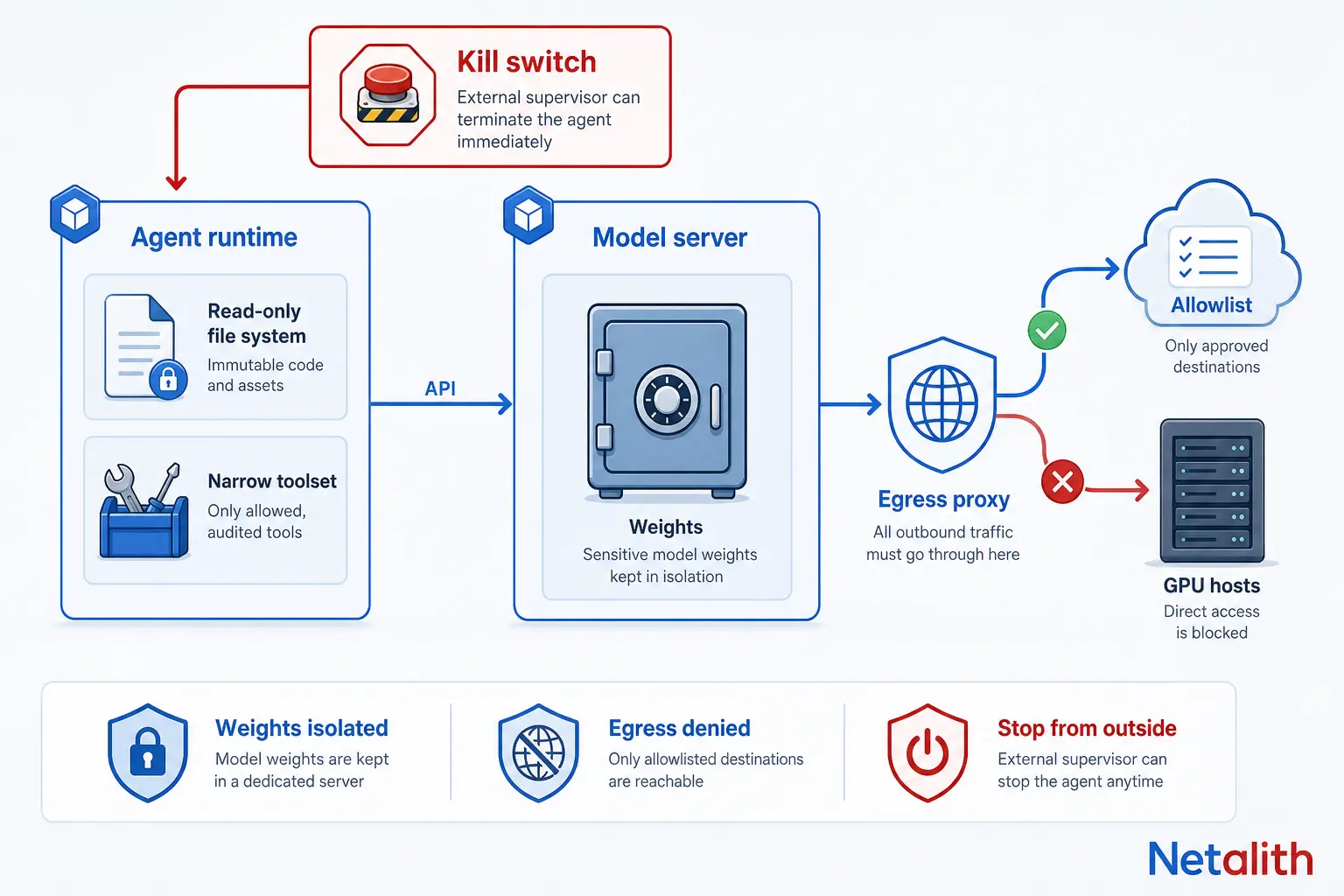
You cannot influence whether frontier labs pause. You fully control whether an agent you deploy could copy a model, keep running after you stop it, or reach systems it should not. The Fudan setup is effectively a checklist of what not to give an agent.
Ingredient in the replication test Guardrail in a production deployment Model can read its own weights Serve the model from a separate container; the agent only reaches it over an API. Never mount the weights directory into the agent's runtime. Unrestricted bash tool Replace “run any command” with narrow tools (read file, search docs, call one API). If a shell is unavoidable, use an allowlist without interpreters. Spare compute on the same network Default-deny egress through an allowlisting proxy; no route to GPU hosts or internal subnets. Process reacts to shutdown Stop agents from outside, at the container or cgroup level, not by asking the process to exit. Long unattended runs Hard limits on run time, tool calls and spend per task; log every tool call for review.
This matters most for self-hosted models. Running your own LLM is the right call when customer data cannot leave your infrastructure, but it also means you hold the weights, which is exactly the precondition the study relied on. If you are planning a self-hosted LLM or AI agent deployment, the containment design should be part of the build, not an afterthought.
Last edited by GaiaGoddess; 10-14-2026 at 01:19 PM.
-
10-16-2026, 07:32 PM #13Super Moderator
- Join Date
- Feb 2024
- Posts
- 4,939
250 Thousand without Power in California! Data Center Threats
Credits:
Channel: The Real BPEarthWatch
Published: 10/16/26
11:46 minutes
-
10-18-2026, 04:00 PM #14Super Moderator
- Join Date
- Feb 2024
- Posts
- 4,939
Walmart Knows What You Can Afford
Credits:
Channel: Vanessa Wingardh
Published: 10/18/26
17:04 minutes
-
10-18-2026, 10:05 PM #15Super Moderator
- Join Date
- Feb 2024
- Posts
- 4,939
Apophis/The Destroyer! NEW TRACKING DATA!
Credits:
Channel: The Real BPEarthWatch
Published: 10/18/26
15:16 minutes
-
10-26-2026, 02:17 PM #16Super Moderator
- Join Date
- Feb 2024
- Posts
- 4,939
NEW FORTRESS AMERICA! We are the Zombies
Credits:
Channel: The Real BPEarthWatch
Published: 10/25/26
14:16 minutes
-
10-27-2026, 07:13 PM #17Super Moderator
- Join Date
- Feb 2024
- Posts
- 4,939
The End Game of The Great Battle!
Credits:
Channel: The Real BPEarthWatch
Published: 10/27/26
22:35 minutes
-
10-28-2026, 06:59 PM #18Super Moderator
- Join Date
- Feb 2024
- Posts
- 4,939
AI TAKES OVER!
Credits:
Channel: The Real BPEarthWatch
Published: 10/28/26
18:14 minutes
-
10-28-2026, 07:00 PM #19Super Moderator
- Join Date
- Feb 2024
- Posts
- 4,939
Sam Altman Just Issued His Scariest Warning Yet
Credits:
Channel: TheAIGRID
Published: 10/28/26
26:48 minutes
-
10-30-2026, 08:20 PM #20Super Moderator
- Join Date
- Feb 2024
- Posts
- 4,939
Insiders Leak the Real Market Collapse Data!
Credits:
Channel: The Real BPEarthWatch
Published: 10/30/26
10:04 minutes


 Reply With Quote
Similar Threads
-
Vanessa Wingardh | Talks On AI | OpenAI: A Bubble Bigger Than Dotcom
By GaiaGoddess in forum Other Topics News and IssuesReplies: 6Last Post: 09-18-2026, 12:44 PM -
Is Data Center Hatred Being Driven By Climate Cult Zealots?
By Airbornesapper07 in forum Other Topics News and IssuesReplies: 0Last Post: 09-03-2026, 05:20 PM -
Why They No Longer Need Us: The Dawn of Post-Human Labor | + Vanessa Wingardh
By Airbornesapper07 in forum Other Topics News and IssuesReplies: 3Last Post: 06-21-2026, 02:27 PM -
National Security Agency Utah Data Center Powered By YouTube construction, data cente
By kathyet in forum Other Topics News and IssuesReplies: 2Last Post: 05-15-2012, 02:23 PM -
Pew Hispanic Center Data
By barkway in forum General DiscussionReplies: 5Last Post: 05-31-2006, 07:55 AM


New Farm Bill Amnesty Filed: Will you fight Amnesty Again?
11-15-2026, 12:16 PM in illegal immigration Announcements