

Results 1 to 1 of 1
Thread Information
Users Browsing this Thread
There are currently 1 users browsing this thread. (0 members and 1 guests)
 LinkBack URL
 About LinkBacks
-
11-05-2026, 08:04 AM #1Senior Member


- Join Date
- Aug 2018
- Posts
- 99,267
With Democrats taking Congress, Mexico resets its USMCA strategy for a new Washington
Latin Times
51.3K Followers
With Democrats taking Congress, Mexico resets its USMCA strategy for a new Washington equation
Story by Clara Espinoza
• 7h • 4 min read
With Democrats taking Congress, Mexico resets its USMCA strategy for a new Washington equation
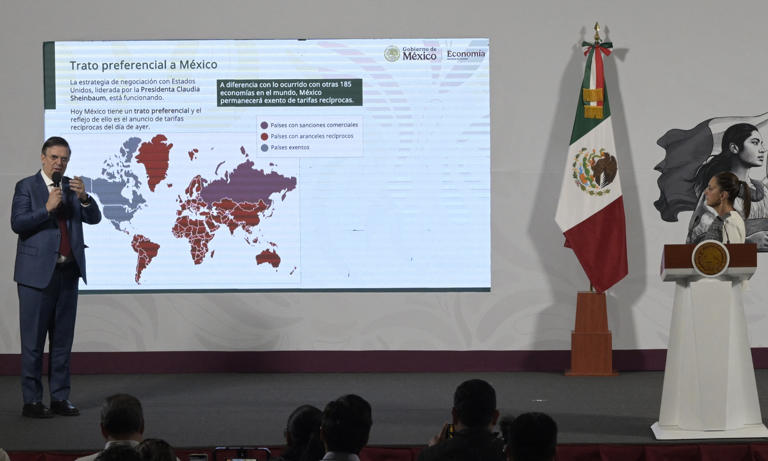
Mexico's President Claudia Sheinbaum (R) listens to her Economy Minister Marcelo Ebrard during her daily press conference at Palacio Nacional in Mexico City on April 3, 2025. Mexican President Claudia Sheinbaum on Thursday welcomed her country being excluded from the list of nations targeted in US President Donald Trump's latest round of tariffs.© Photo by Alfredo ESTRELLA / AFP) (Photo by ALFREDO ESTRELLA/AFP via Getty Images
The Briefing:
- Democrats won control of both the House and the Senate in Tuesday's midterm elections, shifting Washington's political balance for the final two years of Trump's presidency.
- The USMCA was not renewed at its July 1 mandatory review; the U.S. decision not to extend the pact automatically triggered annual reviews through 2036 — but left the agreement in force.
- Canada has been absent from USMCA negotiations since its bilateral talks with Washington collapsed on August 22, leaving Mexico as the sole active partner at the table.
Mexico woke up Wednesday to a remapped Washington and to a single certainty its trade negotiators have held all year: the conversations with the United States continue. Democrats won control of Congress in the November 3 midterm elections, flipping seats across deep-red and battleground states to seize both chambers and deliver a sweeping repudiation of President Donald Trump's agenda. For Mexico City, the result reshapes the political terrain in Washington without fundamentally altering the trade equation.
The shift is real, but its reach is limited. The tariffs that most directly affect Mexico are not set by Congress; they derive from the terms of the USMCA and from executive authorities that the president wields unilaterally. Goods that meet the agreement's rules of origin continue to enter the United States duty-free, while non-compliant goods face an additional 10 percent levy. Trump retains his primary trade leverage regardless of who occupies Capitol Hill.
The Window That Closed Without a Deal
For weeks, Mexico had been pressing to close a bilateral agreement before November 3. President Claudia Sheinbaum confirmed in late October that both governments were actively assessing whether a deal was feasible ahead of the midterms. That window has now closed without a formal announcement — but not without measurable progress.
 Related video: A Democrat Congress: Bet on deals and disputes with Trump, says analyst (Reuters)
Reuters
A Democrat Congress: Bet on deals and disputes with Trump, says analyst
Sheinbaum acknowledged that while significant forward movement had been made, no agreement had been reached on the issues Mexico considers most critical: relief from Section 232 tariffs on steel, aluminum, and automobiles. At the same time, she noted that many of the non-tariff barriers Washington had identified were already being resolved, and she emphasized that all progress had been achieved without compromising Mexican sovereignty.
As a marker of how intensively the two sides had been engaging in the final weeks, U.S. Commerce Secretary Howard Lutnick held a virtual meeting with Sheinbaum to assess the state of play — a call that had originally been planned as an in-person visit to Mexico City before weather grounded Lutnick's flight on September 9. Economy Secretary Marcelo Ebrard, who was present for the exchange, described it as "cordial" and said it would prove highly useful to the ongoing process. Ebrard has led Mexico's technical track in Washington, maintaining steady contact with both Lutnick and U.S. Trade Representative Jamieson Greer.
Mexico, the Only Partner Left at the USMCA Table
When U.S.-Canada talks broke down on August 22, Mexico found itself in an unusual position: the last active partner in what was designed as a trilateral agreement. Canada has been absent from negotiations since that Friday collapse, leaving Mexico to manage a bilateral track that now carries record $872.83 billion in annual goods commerce — the equivalent of roughly $2.4 billion crossing the border every single day.
That figure is not incidental. Mexico has ranked as the United States' top goods trading partner for three consecutive years. With approximately 80 percent of its exports flowing north, there is no commercial alternative capable of absorbing even a fraction of that volume. Sheinbaum's approach has been to draw a sharp contrast with Canada's posture: cooperate rather than confront. While Ottawa has escalated its trade conflict with Washington into a cycle of retaliatory tariffs and import bans covering alcohol, dairy, and motorcycles, Mexico has pursued a quieter, incremental strategy built on resolving specific objections and banking goodwill with the White House.
What the New Congress Can and Cannot Do
The Democratic takeover of Congress introduces new dynamics, though the tools available to lawmakers remain largely indirect. The incoming Congress will be able to request information, oversee the administration's negotiating positions, and weigh in on whether specific modifications require legislative approval — but it will not sit at the bargaining table. Experts at UNAM's Center for Research on North America have noted that Mexico will need to maintain active ties with both Democrats and Republicans, whatever the composition of any given chamber.
What Greer told the Senate Finance Committee in July remained the administration's clearest public roadmap: secure interim bilateral arrangements with Mexico and Canada before the end of 2026, addressing both trade and non-trade barriers; then tackle the more structurally complex issues — automotive content rules, labor standards — in 2027 with Congress's formal involvement. That sequencing has not changed. A Democratic Congress may add scrutiny and potentially complicate passage of any deal that requires ratification, but it does not remove Trump's executive authority over tariffs.
The Horizon: 2027 as the Year of Reckoning
Much of the trade architecture Trump has built rests on executive powers that do not require prior congressional approval. For the businesses operating across the Mexico-U.S. border, the information that will matter most through 2027 is the trajectory of these negotiations: which tariffs move, under what conditions, and what the access rules will look like for the sectors most exposed to uncertainty.
Sheinbaum has made clear that the process will continue independent of any electoral outcome. The arithmetic is straightforward: with 80 percent of Mexican exports dependent on a single market, there is no room to pause. The new Congress changes who occupies certain oversight positions in Washington. The urgency for Mexico — and the core of its negotiating calculus — does not change with them.
Related Articles
- "Mexico Is Nobody's Piñata": Sheinbaum's Rebuke of Rubio Explained
- Hispanic Voters Could Hand Democrats Control of Congress on Election Day
- Panama Offers Neutral Ground for U.S.-Cuba Talks as Diplomatic Progress Stalls in 2026
- Mexico Truckers Win Four Dialogue Tables After Shutting Down Half the Country, but the Real Fight Is Just Beginning
- What Peru's Upgraded $32.6 Billion China Pact Means for Copper, E-Commerce, and SMEs
With Democrats taking Congress, Mexico resets its USMCA strategy for a new Washington equation
If you're gonna fight, fight like you're the third monkey on the ramp to Noah's Ark... and brother its starting to rain. Join our efforts to Secure America's Borders and End Illegal Immigration by Joining ALIPAC's E-Mail Alerts network (CLICK HERE)



 Reply With Quote
Similar Threads
-
Trump signals USMCA deal with Mexico and Canada could expire, in latest trade war neg
By Airbornesapper07 in forum General DiscussionReplies: 0Last Post: 06-11-2026, 04:03 PM -
Ep 3805b - Midterm Strategy Emerges, Trump Is Taking Down The [DS] Entire Corrupt Tem
By Airbornesapper07 in forum Other Topics News and IssuesReplies: 0Last Post: 12-29-2025, 06:46 PM -
UPDATE 1-Mexico asks Texas to halt costly cargo inspections; will file USMCA complain
By Beezer in forum illegal immigration News Stories & ReportsReplies: 1Last Post: 05-15-2023, 02:42 PM -
The Democrats'Alien Voting Strategy |real reason why Democrats want more immigrants
By Airbornesapper07 in forum General DiscussionReplies: 0Last Post: 05-22-2019, 04:59 AM -
Obama's Cloward-Piven Strategy Taking Longer Than Expected
By AirborneSapper7 in forum Other Topics News and IssuesReplies: 3Last Post: 05-02-2013, 03:52 AM


NSA classified network goes down; cause remains unclear
11-17-2026, 02:48 PM in General Discussion