

Results 1 to 2 of 2
Thread Information
Users Browsing this Thread
There are currently 1 users browsing this thread. (0 members and 1 guests)
 LinkBack URL
 About LinkBacks
Threaded View


-
07-16-2014, 03:32 PM #2Senior Member


- Join Date
- Aug 2008
- Location
- PARADISE (San Diego)
- Posts
- 99,038
Key Senate panel backs A-10 fleet
12 hours ago • By David Wichner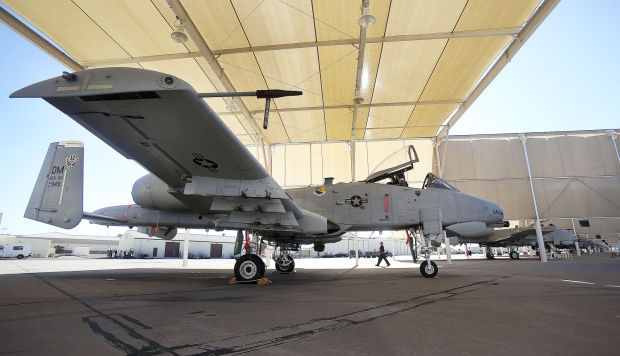
Mike Christy / Arizona Daily StarThe A-10’s future could rest on the months-long deliberations of a congressional conference committee. The Pentagon wants to phase out the single-mission aircraft, 83 of which are based in Tucson.
A key Senate subcommittee has approved a 2015 defense budget bill that would save the A-10 “Warthog” — a mainstay of Davis-Monthan Air Force Base — from the budget ax.
On Tuesday, the Senate Appropriations defense subcommittee issued a markup of the fiscal 2015 defense bill that calls for $549 billion in spending, including $338 million to maintain the fleet of A-10 Thunderbolt II close-air-support jets.
The full Senate Appropriations Committee is expected to consider the defense bill on Thursday. A defense appropriations bill passed by the House in June provides no money for A-10 operations but includes language prohibiting the Pentagon from spending any money to retire the fleet.
Arizona Sen. John McCain cheered the development, remarking that it would be “irresponsible and potentially deadly” to mothball the A-10 before fielding a suitable and operational replacement.
The Pentagon has proposed phasing out the nation’s fleet of about 300 A-10s, including 83 at D-M, by 2019 to save some $4 billion, arguing it can’t afford to keep the single-mission plane. The Air Force says the job of close air support will ultimately fall to multirole aircraft such as the F-35 Lightning II fighter.
But McCain and other critics say other planes can’t match the A-10’s close-support prowess and contend that the F-35 — which is still undergoing operational testing — is far from ready to assume that role.
The F-35 fleet was recently grounded after one of the stealth fighters in Florida had a serious engine fire before takeoff, and the fleet received only limited flight clearance on Tuesday.
“Recent challenges in other Air Force planes that perform air support missions have only strengthened my belief that now is not the time to retire the A-10, the best close-air-support weapon in our nation’s arsenal,” McCain said.
Besides the appropriations bills, versions of the 2015 National Defense Authorization Act adopted by the Senate Armed Services Committee and the full House would save the A-10 for a year.
The A-10 has garnered strong bipartisan support in the House from members including Rep. Ron Barber, a Tucson Democrat, and Rep. Kelly Ayotte, R-N.H.
But the A-10 is still far from safe.
The final defense appropriations bill will be hammered out in a conference committee process that will likely take months, and the Obama administration has threatened to veto any legislation that won’t meet the Pentagon’s budget-cutting requirements.
Overall, the Senate panel’s defense bill provides $489.6 billion for base operations and $59.7 billion in overseas war funding. The total of $549.3 billion is down from $572 billion appropriated for fiscal 2014 and is about $1.4 billion less than the Pentagon’s request.
The legislation adds money for a variety of programs not included in the Pentagon’s budget request, including $82 million to continue production of the Navy’s Tomahawk cruise missile, which is made by Tucson-based Raytheon Missile Systems.
The Pentagon had proposed a halt to Tomahawk production, saying the roughly 4,000 missiles in inventory would be enough until a next-generation cruise missile is developed.
But Raytheon and congressional critics say a production hiatus would halt production and supply lines that are not easily restarted, even as the next missile is still in the planning stage.
Other additions in the Senate subcommittee’s defense spending bill above the Pentagon’s request include $1.9 billion for readiness and base sustainment and $848.7 million for the modernization of the aircraft carrier USS George Washington.
The Senate panel also backed the Israeli government’s request for $621.6 million for missile defense programs — a move that could benefit Raytheon. That amount includes $351 million for the Iron Dome system, which has been credited with intercepting many of the unguided rockets fired into Israel recently by Palestinian militants in the Gaza Strip.
Congressional leaders want the Iron Dome’s interceptors to be co-produced in the U.S., and Israel is expected to issue a co-production plan with Raytheon. Raytheon already is working with Israel’s Rafael Advanced Defense Systems to develop the interceptor for another Israeli missile-defense system, known as David’s Sling.
To offset the added appropriations, the Senate subcommittee’s bill proposes 517 specific cuts to programs and redirects about $11.7 billion in those savings to higher priorities.
Reductions include $6.6 billion in “excess prior year, unobligated funding and forward financing”; and billions more in cuts based on such things as program schedule delays, unwarranted cost growth, poor contractor performance, and unnecessary program growth or duplication.
http://tucson.com/business/local/key...1f3bdd1f6.html
NO AMNESTY
Don't reward the criminal actions of millions of illegal aliens by giving them citizenship.
Sign in and post comments here.
Please support our fight against illegal immigration by joining ALIPAC's email alerts here https://eepurl.com/cktGTn


 Reply With Quote
Similar Threads
-
Air Force seeks bids for next generation stealth bomber
By JohnDoe2 in forum Other Topics News and IssuesReplies: 1Last Post: 07-14-2014, 11:46 PM -
U.S. Air Force sticks to $550 million target for new bomber
By JohnDoe2 in forum Other Topics News and IssuesReplies: 0Last Post: 03-11-2014, 09:05 PM -
Air Force to F-22 Raptor stealth fighter Pilots: Get Used to Coughing Fits
By AirborneSapper7 in forum Other Topics News and IssuesReplies: 0Last Post: 03-02-2013, 06:00 AM -
Syrian Insurgents Force Prisoner to Become a Suicide Bomber
By AirborneSapper7 in forum Other Topics News and IssuesReplies: 2Last Post: 08-28-2012, 02:40 AM -
Stealth task force on Puerto Rican statehood moving bill for
By AirborneSapper7 in forum Other Topics News and IssuesReplies: 2Last Post: 05-30-2010, 06:58 PM


Ceuta, Where people caught between borders find themselves...
08-17-2026, 05:21 PM in Videos about Illegal Immigration, refugee programs, globalism, & socialism