

Results 1 to 7 of 7
Thread Information
Users Browsing this Thread
There are currently 1 users browsing this thread. (0 members and 1 guests)
 LinkBack URL
 About LinkBacks
-
12-31-2006, 07:11 AM #1Senior Member


- Join Date
- Aug 2006
- Posts
- 5,262
Better education will fix jobs situation? Don't count on it
We are constantly being told that America's job loss is due to, and can be fixed by, education. American workers are supposedly not educated and if we fix our system and turn out better qualities of workers, then the tide will turn back to us. But one country has already tried that, and it is not a magic cure if the jobs aren't there to start with.
http://www.latimes.com/business/la-fi-c ... 3111.story
Jobs scarce for China's graduates
Each year millions of new degree holders vie for few openings. Some blame official policy.
By Mitchell Landsberg, Times Staff Writer
3:07 AM PST, December 28, 2006
BEIJING — For the better part of a 20-hour journey, Yu Meng had slept as the train jostled and rolled across the north of China.
A broad-faced, cheerful 26-year-old graduate student in chemistry, she had come from remote Gansu province to attend a job fair in the capital. Now, still bundled in a knee-length brown parka, a clutch of resumes in her hand, she was trying to elbow her way to the front of a recruiting booth — one of hundreds sprawled across the vast interior of the capital's China International Exhibition Center.
ADVERTISEMENT
Around her swirled thousands of other recent and upcoming college graduates from all over China, all competing for a limited pool of jobs. It was a graduate's nightmare that mirrored a national problem: too many people, too few jobs.
Figures vary, but the size of China's higher education system appears to have at least quadrupled in the last decade as the nation has pushed relentlessly toward building a modern economy. Next spring, Chinese colleges and universities expect a record 4.95 million graduates, up 820,000 from this year.
More than a million of them will wind up jobless, according to estimates. The glut is leading students and colleges to what might be considered acts of desperation.
In Guangzhou recently, 286 graduates and post-graduates competed for 11 positions as street cleaners, according to the official New China News Agency. The city hired one candidate with a PhD, four with master's degrees and six with bachelor's degrees.
"Given the already grave employment situation in the country … the employment pressure on university graduates will be obvious," Wang Xuming, a spokesman for the Ministry of Education, said at a recent news conference.
All of which is causing an air of concern among students.
The dilemma facing Chinese students is hardly unique. Through the ebb and flow of the business cycle, American college students have long been accustomed to the idea that a degree doesn't necessarily guarantee them a job — at least not right away. But in a country where, not so long ago, the communist state guaranteed everyone employment, however lousy, it is a new and unsettling reality.
"People's hopes are very gloomy — all of us job seekers," said Zhao Xiaojuan, a 22-year-old who is about to graduate with a degree in English from the Hubei University of Technology in Tienjin. "If you're lucky, maybe you have a chance to be interviewed." Zhao aspires to work as a translator or executive assistant in a multinational company.
Some employers and economists, however, say the problem is one of rising expectations. It's not that there are no jobs available, it's that students are holding out for the good ones. They should be more patient, this line of thinking goes, and willing to settle for something less than their dream job at first.
"A college education is a long-term investment," said Tang Min, the chief China economist for the Asian Development Bank. "You have to think about your lifetime."
Tang, who wrote a report in 1998 calling for a major expansion of the Chinese higher educational system, has been criticized as the architect of the current glut. He says he has no regrets, even when faced with a recent report saying that two-thirds of last year's college graduates are earning less than $250 a month. That, he said, is double what a high school graduate can expect to earn in China, and the gap is almost certain to grow as graduates climb the career ladder.
"What I tell those young people is, 'Don't worry. You'll not regret having gone to college…. Wait 10 years, and then compare yourself to those people who didn't go to college,' " Tang said.
Several universities have recently added golf to their curriculums in hopes of turning out graduates who have what it takes to schmooze prospective employers in a country where golf is a fairly new executive pursuit. Xiamen University in southeastern China even made the sport mandatory for freshmen in some degree programs.
Some say what is needed are more students with skills that match the job market. Employers say students are often not qualified for the available job openings and blame the university system for failing to adapt to the nation's new economy.
"They teach you a lot of theory," said Phoebe Li, human resources manager for Intouch Software in Beijing, a growing software developer. "They don't put it much into practice."
Partly in response to those critics, the government recently announced a major initiative to increase vocational education over the next five years.
In the meantime, the students at the job fair had neither shop classes nor nine irons to give them a leg up. They had to rely on resumes and sheer grit.
When Yu Meng reached the front of the Administration of Environmental Protection booth, she faced the recruiter. He was looking for chemists.
"Do you hire graduates fresh out of school?" Yu asked.
"We like to have people with work experience," he replied. Seeing her face fall, he quickly added, "But that doesn't mean we don't consider fresh graduates."
"Would you please take a look at my resume?" she asked. She slipped it in front of him. He gave it a cursory glance, his mouth twisting in disapproval.
"You have a chemistry major," he said, "but you don't have any experience in environmental protection."
In the end, he agreed to keep the resume but didn't leave Yu with a lot of hope.
"I'm pretty worried," she said afterward, standing in an aisle between booths while a sea of anxious job seekers parted around her. "There are a lot of positions on the job market. The problem is, we have way too many graduates."
*
--------------------------------------------------------------------------------
mitchell.landsberg@latimes.comJoin our efforts to Secure America's Borders and End Illegal Immigration by Joining ALIPAC's E-Mail Alerts network (CLICK HERE)
-
12-31-2006, 07:31 AM #2Senior Member
- Join Date
- Apr 2006
- Location
- florida
- Posts
- 1,726
I've seen this picture already in Brazil . Everybody is university graduated and there are no jobs to people who graduates.
The salary is so low that a non graduated can earn more if he/she has experience,
Even the medicine doctors make such a low wage, they start selling sandwiches on the beaches.
This is the model of the developed countries, they advertise if you graduate you make more money but it's a lie.
-
12-31-2006, 08:19 AM #3Senior Member

- Join Date
- Jan 2006
- Posts
- 1,726
Early on, during the mass firings (in favor of India's Bangalore based workers and India's H-1B visa holders here) Americans were told by economists not to worry. They were told to simply transition to Nano-technology and be "protected" from globalism.
The mainstream media managed to fool the public.
According to India Times, the nano-technology profession belongs to Tata of Bangalore. According to publications in India, by the year 2010, Tata will have 10 million India based employees as replacements for that many [fired] Americans.


Tata isn't the only body shop doing that, there's a long list, led by Wiprospectramind, Infosys, Accenture, IBM (of India), Sat'yam, HCL, and others who cash in on the demise of fired Americans.
To top it all off, is Carly Fiorina's infamous proclamation:

"No American has a God Given Right to a Job!"
Carly Fiorina, former CEO of Hewlett Packard.
Americans were fired by the hundreds of thousands and replaced by
foreign nationals (H-1Bs and Bangalore domociled).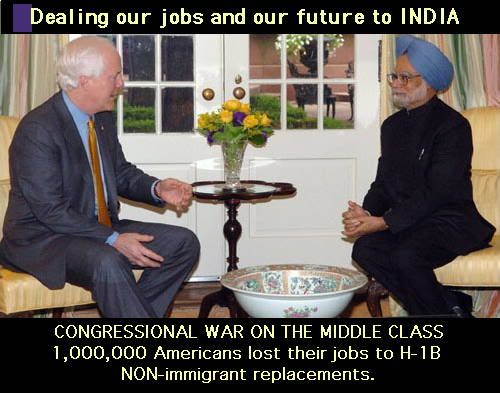
What part of "We don't owe our jobs to India" are you unable to understand, Senator?
-
12-31-2006, 10:25 AM #4Senior Member

- Join Date
- Jun 2005
- Location
- Kentucky
- Posts
- 3,118
I believe no amount of education will prevent our business owners from outsourcing our jobs.
Bush, Bill Gates, etc., keep saying American's need more education, but they know they will outsource those jobs too.
I have a friend in Fla., that has 2 daughters. She wants them to not only go to college but get some kind of vocational training too.
It's a shame the elitists, the think tanks, and the globalists think they are so smart, but they have ruined not only America, but other countries too.Do not vote for Party this year, vote for America and American workers!
-
12-31-2006, 11:09 AM #5Senior Member
- Join Date
- Aug 2006
- Posts
- 5,262
And here is where the immigration issue really starts to pinch. Back in 2001 when I got laid off, there were people with Masters degrees competing for any work whatsoever, even bench tech jobs. Now, the Masters is the new bachelors and I just got passed over for promotion by a young guy who has 10 years in my workplace to my 5, but not a graduate degree. (yes I am planning a job hunt this spring). Many people tried to drop back and take up vocational careers, only to find them filled with - guess who - younger 'immigrants'. There is truly no place to go. If you are too general, you are rejected for lack of industry-specific experience. If you are extremely experienced, once the outsourcers target your niche, you are thrown into a labor pool where most of your experience is not relevant wherever you apply. If you are over 40, most of your global competition is younger. If you have a degree, so do they, probably more recent than you.
Join our efforts to Secure America's Borders and End Illegal Immigration by Joining ALIPAC's E-Mail Alerts network (CLICK HERE)
-
12-31-2006, 11:51 AM #6Senior Member
- Join Date
- Dec 2006
- Posts
- 938
Well if corporations would refuse to hire these ones from India and elsewhere they would go home where they belong. Or no they will just stay here illegally while Washington looks the other way of course.
-
12-31-2006, 03:20 PM #7Banned
- Join Date
- May 2006
- Location
- Texas
- Posts
- 3,663
I have a problem with these sorts of complaints, and I will explain why. We make the decision every day, as a matter of convenience, to hand large portions of this country over to corporations, then we moan when they don't treat us as we think they should. Where do they get that sort of power?
I remember arguing locally against tax breaks for a corporation that wanted to move into my area. I was virtually a lone voice against tax abatement for that corporation, as my fellow citizens were so desperate for the perceived benefits of having that business move into the area.
Given a choice between buying products made by large corporations on foreign soil or buying products made by small American companies, I am one of the few people I know who will ALWAYS buy the product from the American company. I'll even give you some examples. I have (currently)six guitars that were hand-built here in the US by the owners of their respective companies, and each of these is at least a $2000 piece of work. Same with amplifiers and effects. I have a collection of handmade knives, mostly from my immediate area. Most of my boots are handmade by local (Texas) bootmakers. The list goes on and on. I support small companies run by owner/operators. Our own products are made right here in Dallas. We design them here and we build them here. We aren't going to bring in people on visas to work because we are part of this community and we realize that our actions affect the community.
For my own part, I have worked for exactly one large corporation, and that didn't last long. Why people want to work for some behemoth corporation, in which he or she is seen as just a cog in the works and where "corporate culture" dictates that a slip of the tongue can have you blackballed for political incorrectness, is entirely beyond me.
We control what these corporations can get away with, because we Americans are the single largest market in the world. We could easily punish these companies by refusing to buy their crap or use their services, but we act like the slaves rather than the masters. We allow these bastards to dictate terms and we even give them a free tax ride at our own personal expense. We go to them, hat in hand, and beg for work. Once they deign to actually hire us, we tread on eggshells so that we can fit our behavior into their ideas of what that behavior should be. When we act like slaves or serfs, why should we be surprised when they treat us like slaves or serfs.
In short, Americans moaning about the hiring practices of the big corporations is like a battered wife moaning about her weekly bruises. Yeah, I've used that analogy before, but it is an apt one. The corporations owe us little (except for their existence, which is a public privilege) and we owe them NOTHING. Corporations operate under certain privileges and immunities, such as limited liability, and for that they should be taxed and regulated. But they have so many Americans hooked on their job offerings and their cheesy products that it is they who dictate terms and manage to slough off their taxes on any community "lucky" enough to have them operate within its borders. Hey, if they can pull that off because the communities are that stupid, I guess I should say more power to them.


 Reply With Quote

Only 48 hours left to save ALIPAC!
06-28-2026, 01:18 PM in illegal immigration Announcements