

Results 1 to 1 of 1
Thread Information
Users Browsing this Thread
There are currently 1 users browsing this thread. (0 members and 1 guests)
 LinkBack URL
 About LinkBacks
-
05-21-2026, 08:38 PM #1Senior Member


- Join Date
- Aug 2018
- Posts
- 92,527
Everybody Is Talking About The Cost Of Gasoline–-Soon The Cost of Food
Everybody Is Talking About The Cost Of Gasoline – Soon Everybody Will Be Talking About The Cost Of Food
May 21, 2026 by Michael
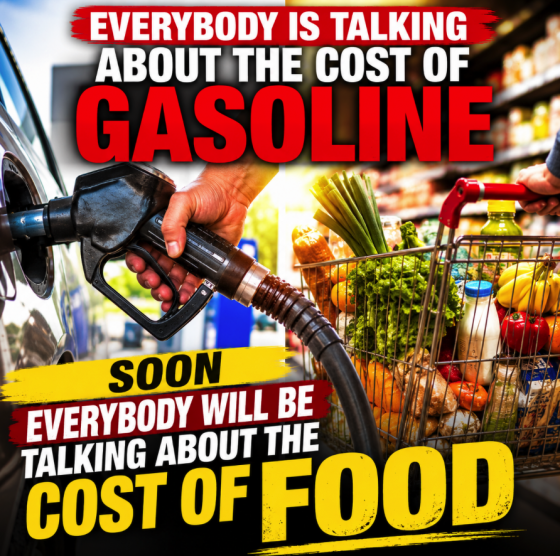
For most people, the price of gasoline is the most obvious consequence of the war in the Middle East. As I write this article, the average price of a gallon of gasoline in the United States is $4.56. Of course in some parts of the country consumers are paying much more than that. This is a big story, and the truth is that gasoline prices are going to go even higher in the months ahead. But if you think that the price of gasoline is bad, just wait until you see what eventually happens to food prices. The price of diesel has been rising even faster than the price of regular gasoline, and fertilizer prices have been absolutely skyrocketing. Those costs will get passed along to the rest of us. It is just a matter of time. Meanwhile, our farmers are dealing with drought conditions that are unprecedented and now a “Super El Niño” is coming.
What all of this means is that food prices will rise to very painful levels.
So even though everyone is complaining about rising gasoline prices at the moment, one prominent economist is warning that “the next story is food”…The cost of food in the U.S. appears poised to rise sharply alongside oil prices, as war-related supply disruptions put pressure on the companies and farmers who keep the country’s shelves stocked.Can you imagine what would happen if food prices were to rise another 50 percent from current levels?
“The big story right now is oil,” economist Justin Wolfers told MS NOW on Tuesday. “The next story is food.”
Oil prices have risen over 50 percent since the conflict began on February 28, pushing gas prices to a nationwide average of over $4.50 for the first time since 2022.
Over the past year, many of the most common items that Americans purchase at the grocery store have already become much more expensive…When compared to the same time last year, fruits and vegetables have seen some of the biggest price hikes. Tomatoes are 40% more expensive now than they were this time last year. Bad growing weather, tariffs, and rising fuel prices have all contributed to the huge change in tomato prices, reports the New York Times.
Coffee, another imported product, is 19% more expensive than it was last spring.
You’re also likely seeing inflated prices at the butcher counter. Meat is up 9% overall, but beef has grown even more expensive. Ground beef is about 15% pricier, beef roasts are 18% more, and steak is up 16%.
We can blame the war with Iran for the recent price hikes that we have been experiencing, because the war has made diesel much more expensive.
And diesel is used to transport most of what we eat…What’s contributing to the price spikes? Fuel prices have soared while the Iran war prevents cargo ships from passing through the Strait of Hormuz, a vital corridor for global oil supplies. Diesel fuel powers fishing boats, tractors and the trucks that ship 83% of U.S. agricultural products.In addition, fertilizer prices have gone absolutely haywire, and those costs will be passed along to us once harvest season arrives.
Just as you’re paying more at the pump, so are truckers who transport goods all around the country. Some vendors and suppliers are adding fuel surcharges to make up for the increased cost of transporting and delivering their goods.
The solution to this crisis would be for the Strait of Hormuz to reopen.
But Iran isn’t willing to do that.
Instead, Iran intends to make the status quo in the Strait of Hormuz permanent…Iran and Oman are actively discussing a permanent security mechanism for the Strait of Hormuz. Iran is pushing to institutionalize and normalize a transit fee or toll on commercial shipping vessels navigating the narrow waterway. According to an Iranian diplomatic envoy, the proposed system is designed to secure the long-term positioning of Iran and Oman as the primary regulators of the strait, effectively transforming a temporary leverage point from the recent military conflict into a permanent sovereign right.
To formalize its grip, Iran’s newly established Persian Gulf Straits Authority began applying conditional rules and hefty transit tolls, in some cases exceeding one million dollars per vessel, while granting selective exemptions to friendly nations like Russia or China. By engaging Oman, which shares territorial jurisdiction over the Strait, Iran is seeking to build a coalition that validates these tolls under the guise of funding localized maritime security.
The US maintains an opposing view on the matter, viewing the permanent toll as a non-negotiable barrier to reaching a sustainable peace deal. Under the United Nations Convention on the Law of the Sea, international straits are governed by transit passage protocols that guarantee the uninterrupted flow of global commercial shipping, a principle the US insists must be restored without conditions.
This is one of the reasons why there is not going to be an agreement to end the war.
U.S. Secretary of State Marco Rubio just warned that what Iran is attempting to do with the Strait of Hormuz “will make a diplomatic deal impossible”…“A toll collection system in the Strait of Hormuz will make a diplomatic deal impossible.”If the Strait of Hormuz remains closed, a global inflation crisis is guaranteed.
“We are very disappointed with NATO allies, we will discuss the issue of troop deployment at the upcoming meeting.”
And on top of everything else, now a “Super El Niño” is rapidly approaching.
We are being warned that it could potentially be the most powerful “Super El Niño” in recorded history…Scientists have warned that an imminent ‘super El Niño’ could be even more powerful than a previous event which caused over 50 million deaths.If the Super El Niño of 1877-1878 killed 50 million people when the global population was just a fraction of what it is today, what would an even more powerful Super El Niño do?
The 1877 El Niño was one of the most severe climate events in recorded history, triggering a global humanitarian disaster known as The Great Famine.
Climate reconstructions suggest water temperatures in a key region of the Pacific Ocean rose by 2.7°C (4.86°F), which caused disruption to rainfall patterns around the world.
An associate professor at Washington State University is telling us that “multiyear droughts similar to those in the 1870s could happen again”…Estimates indicate the resulting scarcity of food and disease outbreaks killed up to four per cent of the Earth’s population at the time.Worldwide food production was already going to be way down this year due to the global fertilizer crisis.
That would be the equivalent of at least 250 million people if it happened today.
Now, forecasts suggest water temperatures could potentially exceed 3°C (5.4°F) above average later this year – making the upcoming super El Niño even more powerful than the one nearly 150 years ago.
‘Simultaneous multiyear droughts similar to those in the 1870s could happen again,’ Deepti Singh, associate professor at Washington State University, told the Washington Post.
Now an immensely powerful “Super El Niño” is being added to the equation.
What do you think that all of this is going to do to food prices?
Needless to say, the answer is obvious.
We are in far more trouble than most people realize, but for now most of the population just continues to party.
Michael’s new book entitled “10 Prophetic Events That Are Coming Next” is available in paperback and for the Kindle on Amazon.com, and you can subscribe to his Substack newsletter at michaeltsnyder.substack.com.
Everybody Is Talking About The Cost Of Gasoline - Soon Everybody Will Be Talking About The Cost Of Food
If you're gonna fight, fight like you're the third monkey on the ramp to Noah's Ark... and brother its starting to rain. Join our efforts to Secure America's Borders and End Illegal Immigration by Joining ALIPAC's E-Mail Alerts network (CLICK HERE)


 Reply With Quote
Similar Threads
-
Diane Feinstein Back In The Day Talking About Illegal Immigration & The Cost Of It.
By Newmexican in forum Videos about Illegal Immigration, refugee programs, globalism, & socialismReplies: 0Last Post: 01-11-2018, 09:03 AM -
Cost of border wall is less than cost of services for illegals: report
By Jean in forum illegal immigration News Stories & ReportsReplies: 0Last Post: 02-16-2017, 03:18 PM -
Want to Cut the Cost of Gasoline? Let the Deportations Begin
By zeezil in forum illegal immigration News Stories & ReportsReplies: 3Last Post: 06-24-2008, 07:07 PM -
The REAL cost of inflation: The Mail's Cost of Living Index
By AirborneSapper7 in forum Other Topics News and IssuesReplies: 0Last Post: 04-18-2008, 03:42 PM -
Crude oil cost pushes up gasoline prices
By jp_48504 in forum Other Topics News and IssuesReplies: 1Last Post: 07-15-2006, 12:18 AM


Elected Democrats Hold Rally Against Illegal Alien Bill
05-22-2026, 01:14 PM in General Discussion