

Results 1 to 6 of 6
Thread Information
Users Browsing this Thread
There are currently 1 users browsing this thread. (0 members and 1 guests)
 LinkBack URL
 About LinkBacks
-
10-13-2010, 11:22 PM #1Senior Member


- Join Date
- May 2007
- Location
- South West Florida (Behind friendly lines but still in Occupied Territory)
- Posts
- 117,087
Global Currency Market Chaos Sends Gold Soaring
Global Currency Market Chaos Sends Gold Soaring
Commodities / Gold and Silver 2010 Oct 13, 2010 - 05:11 PM
By: Mike_Shedlock
Commodities
Emerging market economies are under increasing stress as a result of the horrendous economic policies of the Fed.
In order to prevent unwanted strengthening of their currencies, Emerging Asia sets up controls to curb capital inflows http://www.ibtimes.com/articles/70987/2 ... ppines.htm
Thailand announced on Tuesday that it will impose a 15 percent withholding tax on interest and capital gains made by foreign investors on Thai bonds, accentuating the emerging economies' drive to put in place regulatory controls to curb capital inflows that contribute to a surge in currencies.
A persistent low interest rate regime in the developed world is pushing global investors to tap into the high-yielding markets, leading to currency worries in most of emerging Asia.
Export-dependent economies like Japan, China and Brazil have been in a race to rein in their currencies of late as huge amounts of money flowed from anemic western economies to their systems. China has maintained a tight leash on the yuan to ensure their export competitiveness, while Japan intervened in the markets to stem the yen's gains. Brazil last week raised a tax on foreign portfolio inflows into bonds and some other financial instruments to 4 percent to contain the rise of its real currency.
Traders believe South Korea has intervened repeatedly in the currency markets to rein in the won. In the Philippines, government officials have said the rise of the peso is a matter of concern.
Analysts say the afflicted Asian countries are addressing the problem in three ways.
In countries like South Korea, Australia, the Philippines and Indonesia policy rate hikes are either being scaled-back or delayed. "Less monetary tightening in Asia will help to contain interest rate differentials, thereby reducing the incentive for capital inflows," say the analysts.
Secondly, currency market intervention has increased and foreign reserves are going up, providing the countries a cover against further shocks in the financial system.
The third route, the analysts say, is the imposition of capital controls.
"For now the restrictions are mild and targeted toward speculative inflows. This will probably stay the focus. Draconian measures were introduced in Thailand in late 2006 but these are widely-recognized across Asia as having been a disaster."
Japan's Vows Decisive FX Moves
It's not just emerging markets feeling huge stress as Japan's Noda vows decisive FX moves after G7 meeting http://www.reuters.com/article/idUSTRE69B03E20101012?
Japanese Finance Minister Yoshihiko Noda said on Tuesday that Japan will continue to take decisive steps against excessive currency moves, including intervention, helping the dollar to recover further from a 15-year low against the yen.
Noda's reiteration of Japan's currency stance highlighted the risk of another round of intervention to weaken the yen after Japan weathered a flurry of weekend Group of Seven and IMF meetings with no overt criticism of last month's yen selling -- its first in six years.
Forex Market In State of Disarray
Rosenberg discussed Forex stress in Tuesday's Lunch with Dave. https://ems.gluskinsheff.net/Articles/L ... 101210.pdf
Meanwhile, the foreign exchange market is in a state of disarray and while everyone gazes at every nuance coming out of the Fed, a really big story is unfolding in this increasingly unstable currency backdrop. Thailand, following in Brazil’s footsteps, imposed a 15% tax on foreigner bond income. The Korean won is falling from its lofty heights on FX intervention concerns. The BoJ has already aggressively moved twice in the past month to weaken the yen to no avail — Japanese consumer confidence was released overnight and it fell for the third month in a row in September — as has been the case with the Swiss National Bank, which has tried with futility to weaken the Swiss franc.
China is printing money at nearly a 20% annual rate to prevent a yuan appreciation even in the face of intense global efforts to encourage the country to strengthen the unit. (The last thing China wants to do is buckle to U.S. pressure like Japan did following the 1985 Plaza Accord, which strengthened the yen and sent the country into a 25-year deflationary stagnation period.)
The Bank of England is talking about QE as well … these beggar-thy-neighbour money printing exercises to stimulate local economic conditions increasingly look like a zero-sum-game. Only the euro has held steadfast because Trichet refuses to cut interest rates or embark on quantitative easing — though the fiscal problems in the periphery are worrisome and will continue to cloud the future of the currency; however, don’t worry, owners of German bunds think they will ultimately get repaid in D-marks.
Of course, gold could be the only asset class that makes sense here. If the bond market is right then we get deflation and gold is a hedge against the uncertainty such an environment would entail. If the equity market is right, then we get gobs of liquidity out of the Fed and then we go off to a new reflationary credit cycle — gold benefits here too. And, if the commodity complex is right, then we are heading towards a new inflationary cycle and of course gold is a classic way to play this scenario. So in response to Mr. Tepper, it’s not the equity market that is in position for a win-win, it is the precious metals market. Gold is hugely overbought right now and long overdue for a corrective phase, which will likely pose yet another great buying opportunity.
Life Imitates Art
I received an interesting email from reader "Jack B" regarding capital controls.
Jack writes ...
Hello Mish
I recall reading last week that Brazil had imposed limits on incoming capital. Now Thailand has imposed a tax on interest and capital gains made by foreign investors to Thailand.
The reason I find this so fascinating is it is an eerie example of life imitating Hollywood. In the 1983 wall street movie "Rollover," there's a great scene in which an older "statesman of Wall Street warns a young upstart that, "...first you'll see a lot of jawboning by the president, and that won't work. Then, they'll take to selling gold, and that won't work. (BIS has already done this) And then you'll see capital controls!
And that will be the end. Then you'll see a Depression that makes the thirties look like a Kindergarten!"
Bernanke & Co are just continuing the ol' Greenspan PUT: always and everywhere, coddle the Wall Street fraternity. Well, if that is the Chairman's wish, fine; but the entire global economy is at risk.
Please keep up the excellent coverage of our post-WW II-like global economy!
Jack
Message of Gold
Gold is up another $25 today and has been on a tear ever since late 2008.
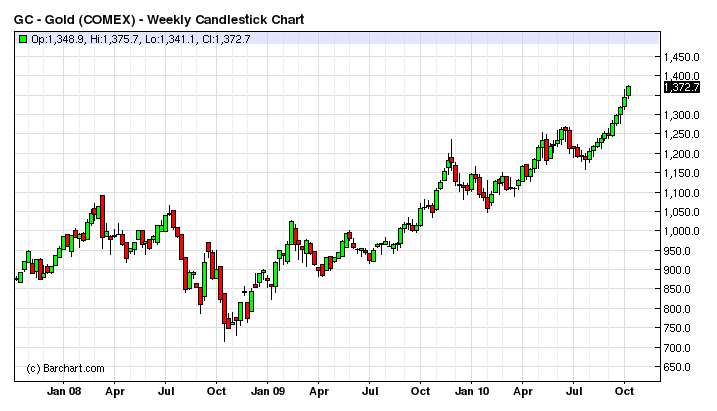
By now it should be obvious to everyone (including Prechter), that gold is acting like a currency for the simple reason that gold is money. Gold is performing well in these conditions because it should.
For more about why Gold is Money, please see ...
* Why does fiat money seemingly work? http://globaleconomicanalysis.blogspot. ... -work.html
* Misconceptions about Gold http://globaleconomicanalysis.blogspot. ... -gold.html
By the way, those articles were penned under the name "Trotsky" who is also my friend "HB", who now has his own fine blog on Austrian economics: Acting Man
As money, one should expect gold to perform well against all the other currencies that every country is in a mad race to debase.
Finally, please note that Gold is not rising because of inflation in the US, but rather because of the Fed's foolish attempt to defeat deflation. For more on this line of thinking, please see Inflation Expectation Noise http://www.marketoracle.co.uk/Article23313.html
Because all the central banks have joined in on competitive currency debasement, gold is rising in terms of every fiat currency, again, just as one should expect.
By Mike "Mish" Shedlock
http://globaleconomicanalysis.blogspot.com
http://www.marketoracle.co.uk/Article23481.htmlJoin our efforts to Secure America's Borders and End Illegal Immigration by Joining ALIPAC's E-Mail Alerts network (CLICK HERE)
-
10-13-2010, 11:24 PM #2Senior Member
- Join Date
- May 2007
- Location
- South West Florida (Behind friendly lines but still in Occupied Territory)
- Posts
- 117,087
Gold Near Parabolic on Hopes of QE2 Starting in November
Commodities / Gold and Silver 2010 Oct 13, 2010 - 05:02 PM
By: Ned_W_Schmidt
We want QE II on 3 November. No, we demand that the U.S. Federal Reserve announce QE II, quantitative easing second act, on that day. We want confirmation. No, we demand confirmation that Keynesian economics is both intellectually bankrupt and a complete failure!
For those living outside of the U.S., on 2 November the most important U.S. election since 1932 will take place. On that day, U.S. voters may repudiate the Keynesian liberal model of government. For nearly 80 years Keynesian liberals have been on a path of wealth confiscation and destruction not seen since the Mongol hordes unleashed their terror across Asia and Europe. On 2 November we may, hopefully, witness the beginning of the death of Keynesianism. If not, we still have Gold.
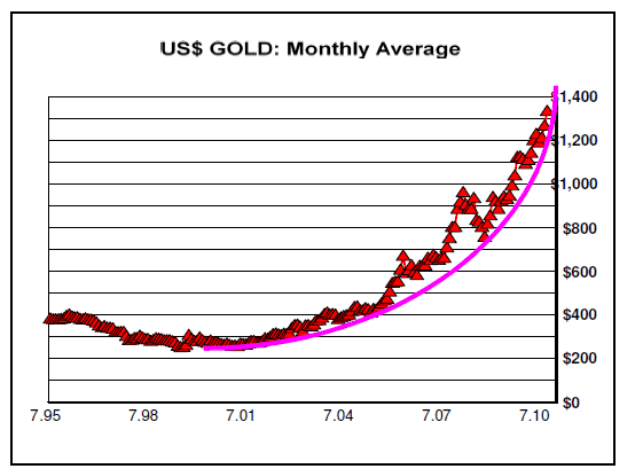
With $Gold in a clear parabolic movement, perfection is now required. Markets are fully anticipating that QE II will explode onto the scene on 3 November. Federal Reserve is expected, by near all market participants, to begin a massive second round of liquidity injections into the U.S. financial system. This action is universally expected to crush the U.S. dollar, and send $Gold into the stratosphere. Nonsensical forecasts for $Gold are the primary byproduct of these expectations, with the latest being a ridiculous one of $8,000.
QE II is widely forecast to arrive on 3 November, at the conclusion of the FOMC meeting. However, events of the day before may prevent that from happening. Lost in the forecasting is that the U.S. will hold elections for Congress on 2 November. While the polls generally suggest a crushing defeat for the minions of the Obama Regime, we can safely make only one good forecast for 3 November. Most likely consequence of the U.S. election is that on 3 November Washington will awake to political turmoil.
Certainly we can reasonably expect that the full results of that election will not be known on the following day, 3 November. And some are already giving the Federal Reserve an indication of what they might expect with the new Congress. A nominee to the Board of the Federal Reserve is being held up in the Senate. The next U.S. Congress will be openly hostile to the ongoing mismanagement of U.S. monetary policy. We know it, and so does the Federal Reserve.
Given politics of the day, expectations that the FOMC would announce a policy that, one, acknowledges the complete failure of Keynesian economics, two, confirms expectations of the Great Obama Recession II coming in January, and, three, could lead to a massive depreciation of the U.S. dollar is quite unlikely. With the parabolic formation in $Gold well extended, considerable disappointment on 3 November could reign in the Gold markets.
Parabolic formations are not kind to disappointment. With FRB Vice Chairman Janet Yellen attempting to dampen expectations, AP Business Wire on 12 Oct, disappointment on 3 November is increasingly likely. As a consequence of that possibility, downside risk for $Gold out of the parabolic formation must be considered. Downside risk out of the parabolic is to US$675.
Given the dismal history of hedge funds, following them into the Gold markets at this time seems unwise. Perhaps the only investors that should be buying at this time are EU-based investors due to the massive over valuation of the Euro. For most though, buying is an activity better deferred to a time when frivolous forecasts of $8,000 Gold are not being tossed about.
By Ned W Schmidt CFA, CEBS
http://www.marketoracle.co.uk/Article23480.htmlJoin our efforts to Secure America's Borders and End Illegal Immigration by Joining ALIPAC's E-Mail Alerts network (CLICK HERE)
-
10-13-2010, 11:26 PM #3Senior Member
- Join Date
- May 2007
- Location
- South West Florida (Behind friendly lines but still in Occupied Territory)
- Posts
- 117,087
Gold Nears USD and Sterling Highs as Washington Denies "Global Currency War"
Commodities / Gold and Silver 2010 Oct 13, 2010 - 07:57 AM
By: Adrian_Ash
THE PRICE OF GOLD stalled $3 shy of last week's all-time Dollar record in London trade on Wednesday morning, peaking above $1361 an ounce as the US currency fell and global stock markets rose sharply.
Gold priced in Sterling rose within 1.3% of June's record peak at £870 per ounce.
Eurozone investors wanting to buy gold saw it hold in the upper-end of the last nine weeks' trading range at €31,300 per kilo.
Over in Asia, Tuesday's lack of Indian and Chinese demand had been reversed according to wholesale dealers, with speculative buying noted on the electronic Globex platform after Beijing said China's crude oil imports rose 35% last month from Sept. 2009, hitting a new record of 5.67 million barrels per day.
US crude oil futures jumped back towards $83 per barrel. European equity markets added well over 1%.
Trading-room rumors meantime said Egypt has become at least the 14th central bank to start selling its own currency in a bid to depress its value on the forex market.
"If the inflows are lumpy and volatile, or if they disrupt the macroeconomic situation, we will [also] intervene," said Reserve Bank of India chief Duvvuri Subbarao this morning.
US Treasury secretary Tim Geithner said Tuesday he sees "No risk" of a global currency war – the term used last month by the Brazilian finance minister to describe the rash of naked interventions in the forex market by central banks worldwide.
In the last fortnight alone, believes Simon Derrick at Bank of New York Mellon, purchases of US Dollars by South Korea, Malaysia, Indonesia, Thailand and Taiwan have seen them accumulate foreign exchange reserves at up to six times their previous pace, collectively buying $28.74 billion according to IFR Markets.
"Despite this, the South Korean Won has climbed 5.7% against the Dollar since the start of September," the Financial Times notes, "while the Malaysian Ringgit has gained 1.3% and the Thai Baht 4.3%.
"China has allowed the Renminbi to rise by 2% against the Dollar since the beginning of last month."
Back in gold bullion, "The second round of quantitative easing from the US Fed " – widely expected at $500bn to $2 trillion from the start of Nov. – "has been priced in for the past few weeks," reckons Marwan Shakarchi at Swiss refiner MKS's Finance division.
"The market is now on the look-out for stimulating news."
Minutes from the Federal Reserve's latest meeting, released Tuesday, showed policy-makers voicing growing concerns over rising unemployment and weakening inflation in the US economy, plus an increased willingness to start targeting absolute price levels rather than a particular rate of inflation.
Five voting members of the Fed committee actively support quantitative easing, says a note from analysts at RBS, while another five "will vote with the chairman", Ben Bernanke.
Only one member – Thomas Hoenig, president of Kansas Fed – looks likely to vote against QEII at the forthcoming November meeting.
"The market is priced for the Fed to be pretty aggressive," agrees Steve Barrow, chief currency strategist at Standard Bank. But "the upshot" of QEII "is likely to be further weakness for the Dollar and further falls in bond yields...[perhaps] by leaving the total indeterminate and, instead, announcing a monthly, or quarterly, buying program.
"[The Fed] will only stop this when it deems the policy is no longer necessary."
Swiss bank UBS also expects the Fed to announce monthly targets for its QEII asset purchases, perhaps between $35 billion and $65bn of government Treasury bonds according to chief metals strategist Dr. Edel Tully.
"Gold could correct if the Fed's asset purchases are smaller than expected," she cautions, quoted by Dow Jones Newswire, "since gold prices have already risen substantially in anticipation of quantitative easing."
Technical analysis also means "Charts are showing warning signs of a possible consolidation taking place," according to Axel Rudolph at Commerzbank in Luxembourg.
"Put another way, the risks at present outweigh the potential rewards of buying gold at current levels," he adds, in part because "Five and 25-year seasonality shows October to be a month in which the gold price tends to decline."
Turning short-term bullish on the US Dollar, Dr. Marc Faber – the Swiss "über-bear" money manager now based in Thailand, and editor of the Gloom, Boom & Doom Report – agrees there could be a "significant correction" in gold and other commodity prices.
"This would represent a buying opportunity," he advises.
By Adrian Ash
BullionVault.com
http://www.marketoracle.co.uk/Article23469.htmlJoin our efforts to Secure America's Borders and End Illegal Immigration by Joining ALIPAC's E-Mail Alerts network (CLICK HERE)
-
10-13-2010, 11:29 PM #4Senior Member
- Join Date
- May 2007
- Location
- South West Florida (Behind friendly lines but still in Occupied Territory)
- Posts
- 117,087
Gold and Silver Remain Near Nominal Highs - QE2 Leads to Increasing Dollar Concerns
Commodities / Gold and Silver 2010 Oct 13, 2010 - 06:54 AM
By: GoldCore
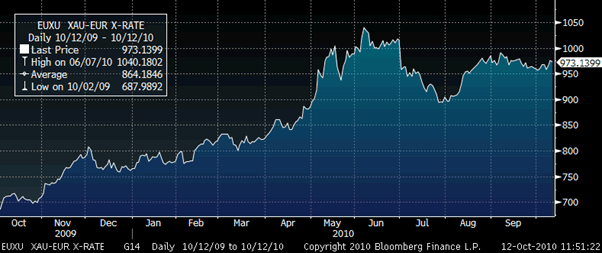
Gold and silver continue to remain robust given the real concerns about the US, Eurozone and global economy. These concerns are creating doubt about the outlook for the dollar, the euro and other fiat currencies due to competitive currency devaluations and currency debasement. Gold has risen to near record nominal highs in British pounds (see chart below) and is less than 1% from a new high in dollars as the dollar has fallen again on QE2 concerns. Despite the recent rise in prices, physical demand remains robust especially in Vietnam, India and Asia.
Gold is currently trading at $1,356.78/oz, €972.18/oz, £856.28/oz.
US Dollar Index - 40 Year (Quarterly).
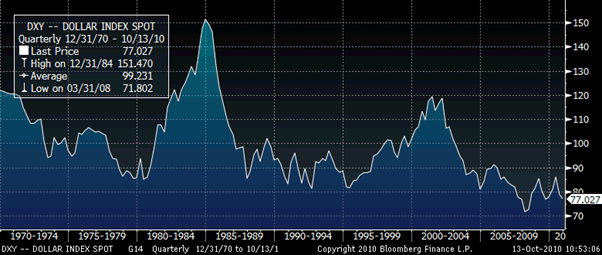
The dollar is looking vulnerable technically with the trend since 2002 remaining down (see chart above). Support at 74.2 and at 71.8 will likely be tested in the coming months as the Federal Reserve embarks on the most radical monetary policy seen in modern history. Below these levels is uncharted technical territory and there would be a risk of sharp dollar selling.
Given the scale of the fiscal challenges facing the Obama administration and the Bernanke Federal Reserve, the trend for the dollar is likely to remain down for the foreseeable future leading to higher gold prices. The dollar has lost 96% of its value since 1913 and fiat currencies throughout history have always reverted to their intrinsic value which is zero. The US must overcome the real macroeconomic, fiscal and monetary challenges facing it - if it does not then the US dollar will in the coming years lose its status as the reserve currency of the world (as did the British pound in the 20th century).
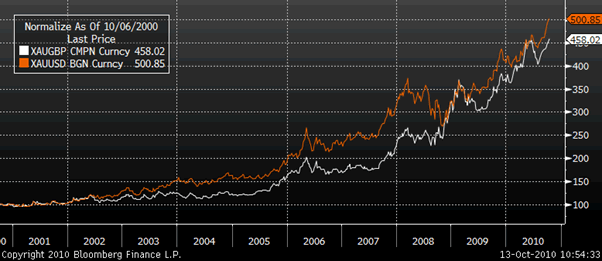
Suggestions that the Federal Reserve sell its gold reserves (unaudited since 1955) were greeted by the market with disdain. The Federal Reserve's gold reserves are some 8,133.5 tonnes which is quite a lot in tonnage terms but is very small in dollar terms with a value of some $340 billion. In the context of the US national debt approaching $14 trillion and annual deficits of over $1.3 trillion, this is very little. Creditor nation central banks such as China, India and Russia, pension funds and high net worths would likely be willing buyers of the Federal Reserve's gold - if the gold was ever sold on the open market. Thus the proposal is another short sighted, short term panacea. It is one which would likely actually make the US monetary situation worse off as it would lead to further concerns about the dollar as the global reserve currency.
Currency concerns are not confined to the dollar and Warren Buffet has voiced concerns about the outlook for the euro overnight.
Silver
Silver is currently trading at $23.50/oz, €16.84/oz and £14.83/oz.
Platinum Group Metals
Platinum is trading at $1,697.00/oz, palladium is at $589/oz and rhodium is at $2,175/oz.
This update can be found on the GoldCore blog here.
Mark O'Byrne
Director
http://www.marketoracle.co.uk/Article23468.htmlJoin our efforts to Secure America's Borders and End Illegal Immigration by Joining ALIPAC's E-Mail Alerts network (CLICK HERE)
-
10-13-2010, 11:34 PM #5Senior Member
- Join Date
- May 2007
- Location
- South West Florida (Behind friendly lines but still in Occupied Territory)
- Posts
- 117,087
Gold Vs U.S. Treasury Bonds, Which Do You Believe?
Commodities / Gold and Silver 2010 Oct 13, 2010 - 03:26 AM
By: Michael_Pento
Commodities
Any psychoanalyst looking at the behavior of investors today would see clear strains of schizophrenia in a comparison between the markets for gold and US Treasuries.
Currently, the 10-year Treasury yield is setting new lows on a daily basis. In the financial models all economists were taught at school, this would be an indication of an economy with low inflation expectations and a strong currency. But the dollar has fallen over 12% since June, and the price of gold continues to hit all-time highs. These results are completely antithetical. Bonds are flashing a warning sign of deflation, while gold and the dollar presage hyperinflation.
During the last period in which the US experienced significant economic stress, the late 70's and early 80's, the markets in gold and Treasuries showed a much higher degree of harmony. At that time, the Fed's extreme depression of interest rates led to rapidly rising inflation, a weakening dollar, and a massive spike in the price of gold. More significantly, yields on Treasuries soared as investors demanded higher rates as compensation for the added inflation risk. In other words, everything made sense.
Beginning in January of 1977, gold began an epic bull market which ended just prior to February of 1980. In that time, the metal soared from $135 per ounce to just under $860 per ounce, and the Dollar Index lost about 20% of its value. Yields on the 10-year Treasury soared from 7.2% in January of 1977 to 12.4% in February of 1980. This occurred in an environment where the Federal Reserve - under Arthur Burns - pursued an inflationary monetary policy. He increased the monetary base from $62 billion to $114 billion in just eight years.
Today, the environment is similar to what the country confronted 30 years ago. Like then, our monetary base has surged - but this time even faster. Instead of merely doubling in eight years as it did under Burns' watch, Alan Greenspan and Ben Bernanke have tripled the base in twelve years (from $621 billion in 2000 to over $2 trillion today). Accordingly, the dollar price of gold has more than quadrupled, from $280 per ounce in 2000 to over $1,300 today. Over that time, the dollar has registered a 35% drop in value. However, in stark contrast to 1980, the yield on the 10-year Treasury note has collapsed from 6.6% in 2000 to less than 2.4% today.
A nation should only be able to enjoy ultra-low interest rates if it has a high savings rate, stable monetary policy, low inflation, and very low levels of debt. The US savings rate, which had been range-bound between 7.5% and 15% during the '60s and '70s, now stands at just 5.8%. And that rate reflects recent belt-tightening in the wake of the credit crunch. The personal savings rate had been negligible and sometimes negative from 1998 thru 2008. Washington's current annual budget deficit is 9% of GDP and the national debt is 93% of GDP. And, of course, the Fed has - in its own words - undertaken "unconventional measures" to push up inflation. Therefore, none of the conditions that should engender low interest rates currently exist.
Clearly both gold and the US dollar agree that Ben Bernanke will be victorious in his quest to foment robust inflation. But Treasury investors seem to believe that despite its current inflationary disposition, the Fed will be able to either: A) hold down interest rates for an extended period or B) withdraw its liquidity before things get out of hand. To take this position, one would have to not only believe that the forex and gold markets have it wrong, but also think that the Fed's printing press will lose its power to depreciate the currency. This is a seriously misguided set of assumptions.
Bernanke asserts that the Fed brought on the Great Depression by allowing the money supply to contract by 30% after the Crash of 1929. He has also written that the Depression relapse of 1937 stemmed from Washington's attempt to balance the budget and raise interest rates. Therefore, I can reasonably assume that he will not stop the presses until inflation has a firm and undeniable grip on the American economy.
Many currently believe that 'Helicopter Ben' has yet to ignite inflation on the ground because the money he dropped from the sky is still stuck in the trees. In other words, the funds are caught in the banking system and not spreading among the populace. Yet, M1 is up 6.2% YoY; and, in the last two months, the compounded annual rate of change in M2 is 7.4%. Although these single-digit increases do not yet indicate runaway inflation, a program of relentless quantitative easing has a conclusion as predictable as driving 100mph around an icy mountain turn. Since the Chairman has shown no will to hit the brakes, you'd have to be mad to ride the yield curve alongside him.
For in-depth analysis of this and other investment topics, subscribe to The Global Investor, Peter Schiff's free newsletter. Click here for more information.
By Michael Pento
Euro Pacific Capital
http://www.europac.net/
http://www.marketoracle.co.uk/Article23459.htmlJoin our efforts to Secure America's Borders and End Illegal Immigration by Joining ALIPAC's E-Mail Alerts network (CLICK HERE)
-
10-13-2010, 11:41 PM #6Senior Member
- Join Date
- May 2007
- Location
- South West Florida (Behind friendly lines but still in Occupied Territory)
- Posts
- 117,087
Gold Bull Market $2,400 Forecast Target Peak By Early 2013
Commodities / Gold and Silver 2010 Oct 13, 2010 - 04:15 AM
By: Joseph_Russo
* Captain's log, trade date 10.07.10 The dawn of the 21st Century continues to produce financial shock waves resulting from a generational abuse of credit, fiat currency systems, and exotic financial derivatives.
* Conceived from a flawed premise of faith-based paper currencies and easy credit, solutions for intractable monetary and fiscal disorders appear limited to the imposition of exponentially more of the same failed remedies that spawned the massive dislocations in the first place.
* The future outcome shall likely conclude that the so-called tools that central banks, powerful elites, and political legislators employed to impose their monopoly-brand of command-and-control mandates to guide economies, are the very tools that led to their collapse and insolvency.
* Charting the price of Gold is one of the best ways to measure the ill effects of such incessant endeavors. Placing 10-20% of one's net worth in physical possession of precious metals is an effective solution to insure against the ongoing and future fallout from the systemic failure that occurred 2008.
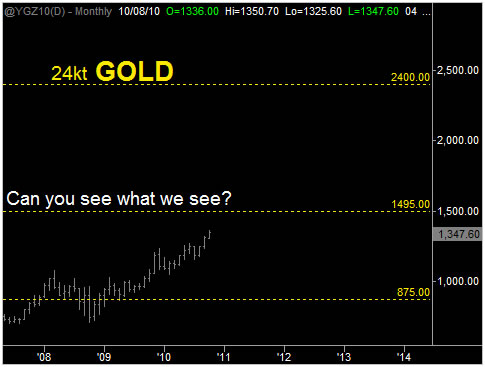
Step into the past:
In November 2005, Elliott Wave Technology launched its charting and forecasting service as Gold was full swing into its fifth year of advancing in a robust bull market. At the time, Gold was trading in the 500-dollar range - up over 100% after registering a 20-year bear market low in 1999. We were long-term bullish then, and we remain so now.
We produced the three charts that follow from an archived back issue of our Near Term Outlook published on October 29, 2008. http://www.elliottwavetechnology.com/products/7.cfm In direct contrast to some of the most notable mainstream Elliott wave authorities, we saw the October 681 low as an incredible buying opportunity vs. the onset of a total deflationary collapse in the Gold price.
Since then, the price of Gold has doubled, yet no one has invited us for an interview on CNBC. That is fine by us, in fact, we like things just the way they are; no fanfare, no beating the drum on dead wave counts, just getting the job done right is all that concerns us.
That said, let us now go back, and review where we stood two years ago.
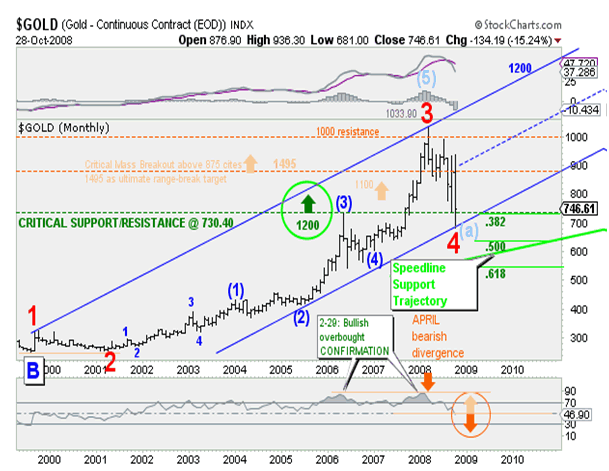
Long-Term Elliott Wave Analysis 10-23-2008 In our last comments on June 10, we stated- "There is good argument that the recent breach of $1000, and print high of 1030, marks the terminal to Primary "3". We are now compelled to give preference to this count as reflected in the charts above.
Chart highlights: Upon the breakout above the 730.40 level in September 2007, we cited an upside price target of 1200. Upon the cross above the 875 level in November 2007, we cited a 1495 upside price target.
October 28, 2008 weekly bars
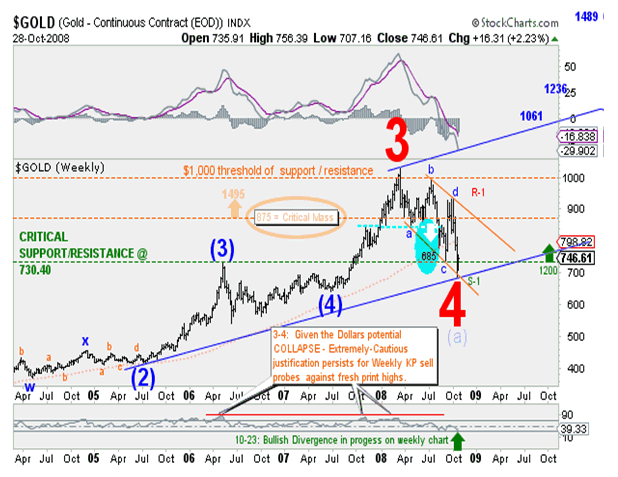
Chart highlights: Following its first print high north of 1000 at the primary 3-wave designation, note the captured downside sell-trigger target of 685 (circled in blue), which booked profits 4-points from the 681 primary degree 4-wave bottom.
October 28, 2008 daily bars
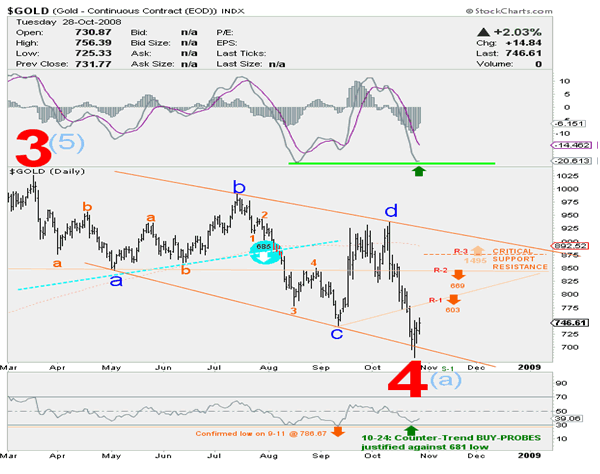
Near-Term Outlook for GOLD 10-28-2008: - Potential clarity amid prospects of a Primary 4 wave down in process of basing- We now view Gold as basing in a primary fourth wave decline. There exists a general 9-year cycling of lows in the Gold market. The last major low was set in 1999, and as such, 2008 provides a period to anticipate another cyclical low point from which Gold may put in another long-term base. The balance of trajectories, targets, point-values, wave-labels, and alternates remain as noted.
Chart highlights: Note the level of detailed accuracy in which we tracked the a-b-c-d-e minor degree expanding wedge and its minute degree subdivisions amid the eight-month decline into the base of the primary 4-wave down.
All told, there is no question that our guidance, forecasting, and interpretations from two years ago were spot on the money.
Back to the future:
Below, we have drafted our latest and most bullish long-term forecast for Gold. Thus far, it maintains adherence to our standing interpretations set forth some five years ago. If the self-anointed masters of our financial universe continue tinkering with their QE toolkits, and policy makers continue to exhibit spineless leadership, do not be surprised if Gold strikes 2400 within the next few years.
Truthfully, we do not wish to see gold trading at 2400 no matter how much physical we may own. Such an outcome would suggest a Zimbabwe-style hyperinflation has taken root. Such an occurrence would likely engender an elongated period of widespread civil unrest.
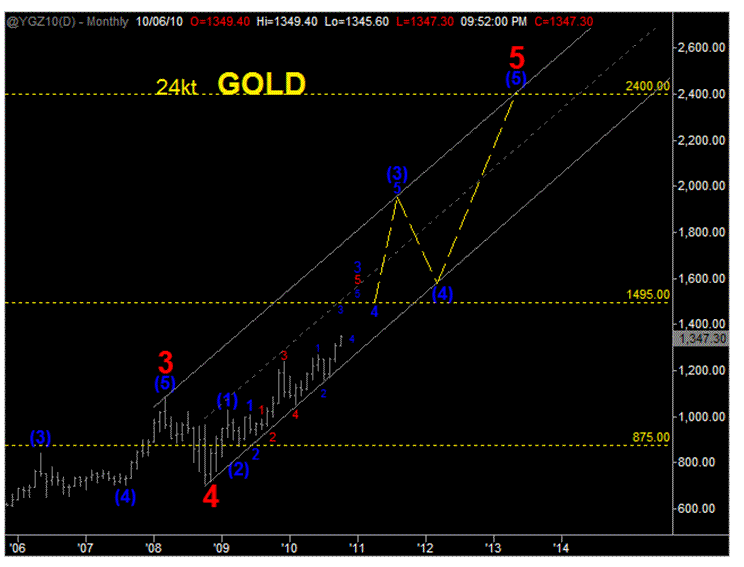
Our client based screen cast publications include coverage of all the major US markets. Each screen cast includes an abundance of charts, details, guidance, as well as access to our proprietary programmed trading systems, which are engaged in the markets amidst every timeframe imaginable. In celebration of our Fibonacci fifth year of service, we are offering a phenomenal 62% first month trial discount to all new subscribers for the balance of 2010. From any of our order pages, enter the Coupon code: NCC-1701 and your first monthly or quarterly charge will reflect the trial discount.
Until then, Trade Better/Invest Smarter
By Joseph Russo
Chief Publisher and Technical Analyst
Elliott Wave Technology
Email Author
http://www.marketoracle.co.uk/Article23462.htmlJoin our efforts to Secure America's Borders and End Illegal Immigration by Joining ALIPAC's E-Mail Alerts network (CLICK HERE)


 Reply With Quote

Trump Administration Kills Protections for Endangered Wildlife...
07-11-2026, 11:37 AM in General Discussion