

Results 1 to 1 of 1
Thread Information
Users Browsing this Thread
There are currently 1 users browsing this thread. (0 members and 1 guests)
 LinkBack URL
 About LinkBacks
Threaded View


-
10-17-2026, 05:23 PM #1Super Moderator


- Join Date
- Feb 2024
- Posts
- 4,699
"Let Them Eat Cake" She Never Said It
Marie Antoinette: The Queen They Had to Destroy Before They Could Kill
233 years after her execution, the revolutionary lies endure. Her final letter reveals a Catholic mother whose dignity survived the hatred of her executioners.
CHRIS JACKSON
October 17, 2026
10 HOURS AGO
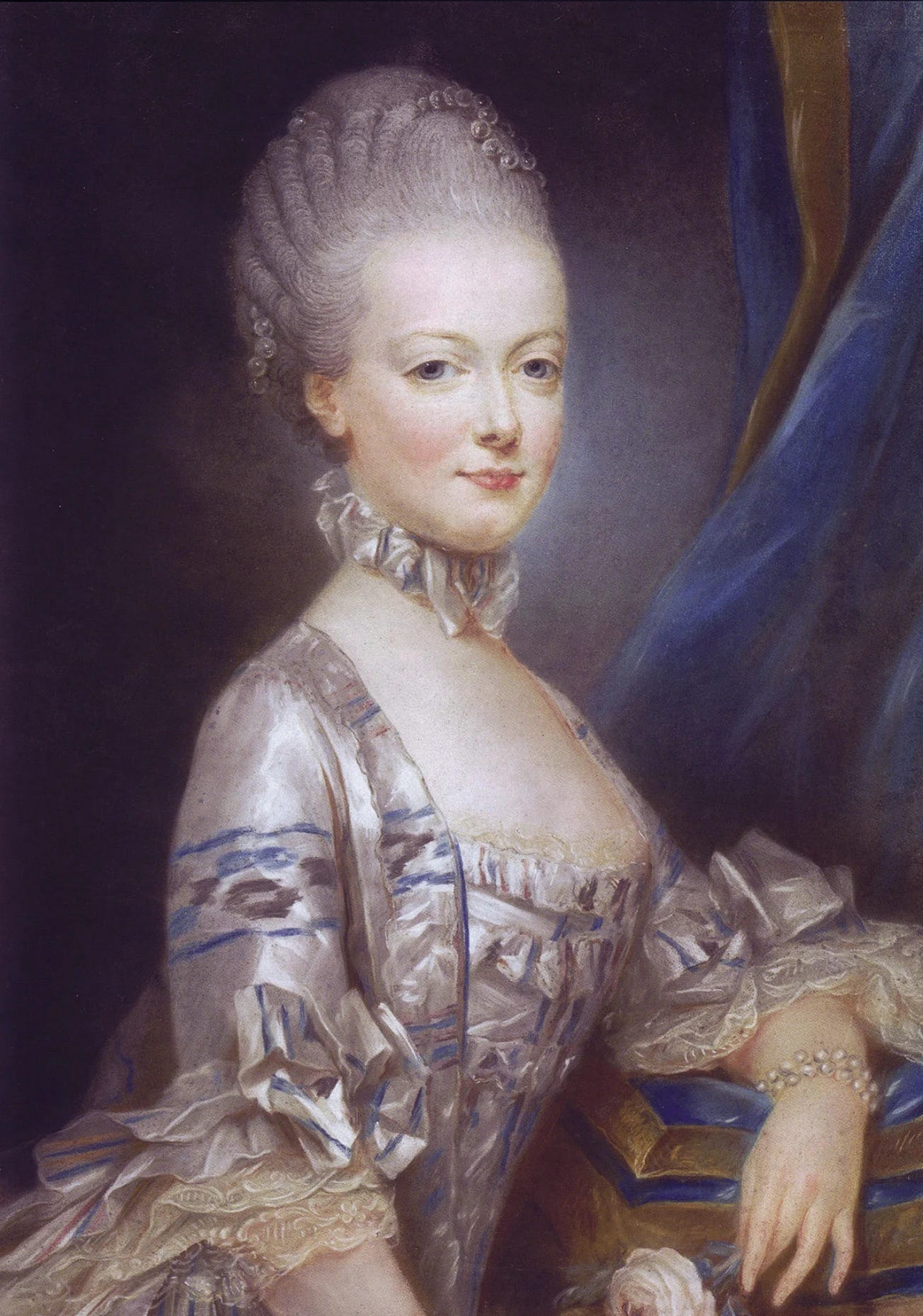
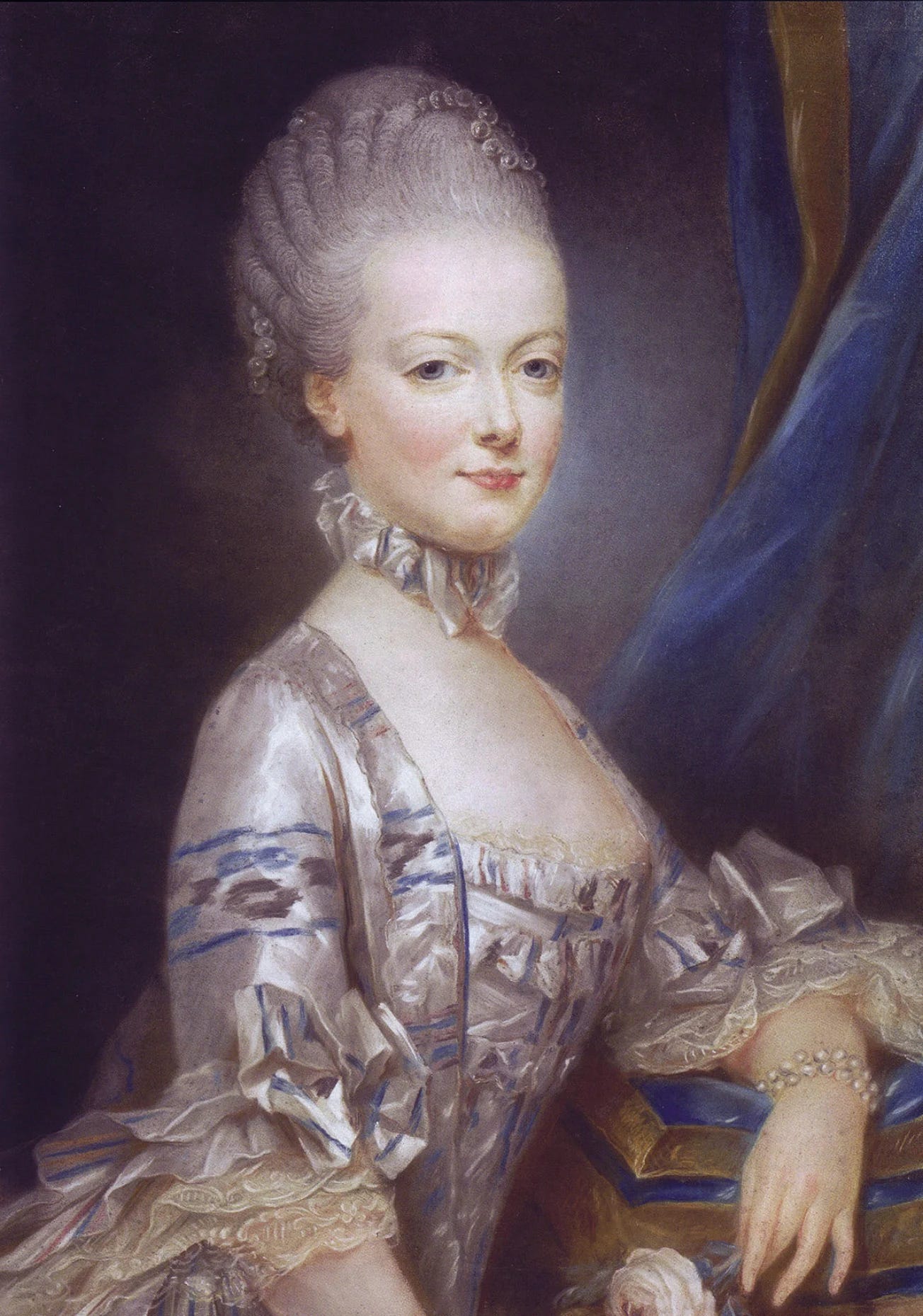
Marie Antoinette, Archduchess of Austria, portrayed by Joseph Ducreux in 1769, shortly before her marriage to the future Louis XVI. Palace of Versailles.
At half past four in the morning on October 16, 1793, a thirty-seven-year-old woman sat in a prison cell in Paris, writing a final letter to her sister-in-law. Her husband had been guillotined nine months earlier. Her children had been taken from her. She had just been condemned to death by a revolutionary tribunal whose proceedings included one of the most disgusting accusations ever directed against a mother.
Within hours, she would be carried through the streets of Paris to the guillotine, her hands bound behind her back, while crowds gathered to watch the execution of a woman they had been taught to despise.
Hiraeth In Exile is a reader-supported publication. To receive new posts and support my work, consider becoming a paid subscriber.She was Marie Antoinette, Queen of France.
And 233 years later, an astonishing number of people still believe the lies told about her.
Ask the average person what he knows about Marie Antoinette and he will probably mention extravagant dresses, lavish parties, enormous spending, and that infamous remark about starving peasants eating cake. Perhaps he remembers a spoiled Austrian princess who cared nothing for the suffering of ordinary Frenchmen and whose execution was an understandable consequence of her own selfishness.
It is a remarkably successful piece of historical character assassination.
The woman who supposedly told starving peasants to eat cake never said any such thing. The queen depicted as a depraved monster was subjected to an organized campaign of obscene libels, sexual slanders, and political caricatures. Her enemies eventually accused her of committing incest with her own eight-year-old son.
And when they finally dragged her before the Revolutionary Tribunal, the outcome was scarcely in doubt.
The French Revolution had already murdered her husband, Louis XVI, on January 21, 1793. It would proceed to destroy much of the Catholic religious order of France, persecute faithful priests, and send thousands of men and women to their deaths in the name of liberty, equality, and fraternity.
Marie Antoinette became one of its most famous victims.
Her story deserves to be rescued from the revolutionary mythology that has obscured it for more than two centuries.
The Austrian Princess Who Became France’s Scapegoat
Marie Antoinette was born in Vienna on November 2, 1755, the daughter of Empress Maria Theresa of Austria and Emperor Francis I.
She was fourteen when she married the future Louis XVI in 1770, a diplomatic union intended to strengthen relations between the Austrian Habsburgs and the French Bourbons.
Consider that age for a moment.
Fourteen.
An adolescent girl was sent from her family and homeland into the elaborate, unforgiving world of Versailles, where her every movement was scrutinized, court etiquette governed the smallest details of daily life, and political factions were eager to exploit the slightest mistake.
She was expected to produce an heir, satisfy the demands of French court society, represent Austrian interests without appearing excessively Austrian, and somehow acquire the political judgment of a seasoned statesman.
She made mistakes. Some were foolish, others costly.
Marie Antoinette enjoyed fashionable clothing, gambling, theatrical entertainments, and the company of a relatively small circle of friends. Her retreat at the Petit Trianon encouraged resentment among courtiers excluded from her private world. Her political judgment could be poor, and her influence over royal appointments occasionally provoked justified criticism.
The Bourbon court was expensive. France’s financial problems were real.
Yet the country’s fiscal crisis had developed over decades, aggravated by war debts, an inequitable tax system, resistance to reform, and the enormous cost of supporting the American Revolution.
Marie Antoinette neither created those structural problems nor possessed the authority to solve them single-handedly.
The queen’s spending became a convenient symbol for a much larger crisis.
And because she was Austrian, she could be portrayed as a foreign enemy operating inside the French monarchy.
The nickname l’Autrichienne became a weapon. Revolutionary propaganda exploited the resemblance between that designation and an obscene French insult.
Her nationality, her sex, her marriage, and her position at court all became material for the campaign against her.
The hatred was already being cultivated years before the monarchy fell.
The Most Famous Words She Never Spoke
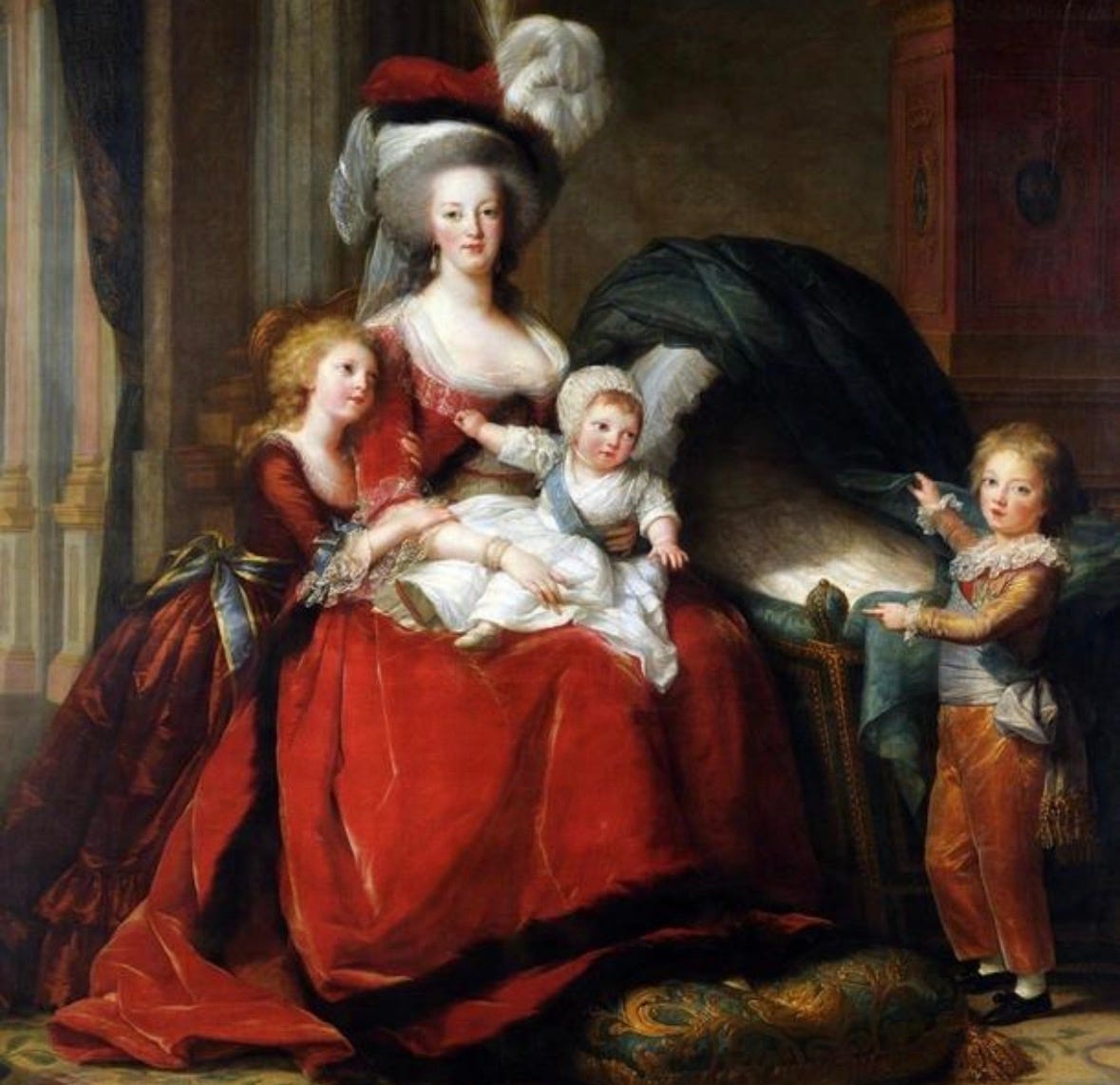
Everybody knows Marie Antoinette said, “Let them eat cake.”
There is one small problem.
She didn’t.
The familiar French expression, Qu’ils mangent de la brioche, appears in Jean-Jacques Rousseau’s Confessions, attributed to an unnamed great princess.
Rousseau wrote the relevant portion of his autobiography when Marie Antoinette was still a child in Austria, years before she arrived at Versailles.
There is no credible contemporary evidence that she ever uttered the remark.
Historian Nancy N. Barker examined the development of this legend in her 1993 study, “Let Them Eat Cake: The Mythical Marie Antoinette and the French Revolution,” published in The Historian. Barker demonstrated how the fictional remark became attached to the queen and helped sustain the popular caricature of a woman indifferent to the suffering of the poor.
The story’s later association with Marie Antoinette was particularly effective because it compressed an entire political accusation into a single memorable sentence.
A starving population begs for bread. A pampered queen suggests cake.
What more does anyone need to know?
Apparently very little, judging by how frequently the anecdote continues to appear in popular discussions of the French Revolution.
It is worth being precise here. The cake story was an older anecdote, and its later attachment to Marie Antoinette cannot simply be treated as a documented slogan circulated by revolutionary leaders in 1789. Its importance lies in the extraordinary durability of the hostile mythology surrounding her.
The lie has become more familiar than the truth.
And how many people who repeat it have ever read a single letter written by the queen herself?
The Pornographers of the Revolution
Long before Marie Antoinette appeared before a revolutionary tribunal, she had been tried and convicted in the popular imagination.
Clandestine pamphlets circulated throughout France depicting the queen as sexually depraved, politically treacherous, and morally corrupt. These publications, known as libelles, frequently combined political attacks with pornography.
The queen was accused of adultery, lesbian relationships, promiscuity, and participation in grotesque sexual adventures. Her relationships with female companions, particularly the Duchess of Polignac, were transformed into lurid fantasies. Political enemies circulated accusations of incest involving members of the royal family.
There was another rather extraordinary hypocrisy in all this. Some of the intellectual currents that helped prepare the Revolution had spent decades attacking the restraints of Christian morality. The Marquis de Sade, who participated in revolutionary political life, carried sexual libertinism to its most revolting extremes. Yet the queen’s enemies discovered a sudden and convenient enthusiasm for sexual virtue whenever an accusation of adultery, lesbianism, or incest could be directed against Marie Antoinette.
Apparently, the old Catholic moral order was an intolerable tyranny, but the manufactured sexual indiscretions of a Catholic queen were sufficient grounds for portraying her as a monster. The contradiction seems to have troubled remarkably few of her persecutors.
The revolutionary factions, of course, differed in their attitudes toward sexual morality. Robespierre cultivated an image of stern republican virtue, while other figures were considerably more libertine. But that makes the exploitation of pornographic calumny against Marie Antoinette all the more revealing. The queen’s supposed depravity was useful to men whose own moral philosophies could scarcely have been more different.
Historians such as Robert Darnton, Lynn Hunt, and Chantal Thomas have examined this literature and its relationship to revolutionary political culture. The allegations were frequently contradictory, sometimes fantastical, and almost invariably degrading. Their purpose was to make the queen contemptible, reducing the wife of Louis XVI to a collection of obscene fantasies that could be circulated, embellished, and repeated until the public scarcely remembered there was a human being behind them.
Her alleged sexuality became evidence of corruption at the heart of the monarchy. The supposed vices of one woman were invoked to discredit an entire political and social order.
And there was no need for every pamphleteer to belong to some centrally directed conspiracy. The surviving literature reveals something more disturbing: a thriving market for the humiliation of a royal woman, fed by political hatred and a public increasingly eager to believe the worst.
By the time the monarchy collapsed, years of slander had done their work. The real Marie Antoinette, with her faults, her virtues, her husband, and her children, had largely disappeared beneath the caricature.
The Revolution would eventually put the queen to death. Its pornographers had already done their best to murder her reputation.
The Diamond Necklace and the Queen Who Never Bought It
Perhaps the most revealing scandal of Marie Antoinette’s reign involved an extravagant diamond necklace.
In 1785, a criminal scheme involving Jeanne de La Motte and Cardinal Louis de Rohan produced one of the most notorious scandals in eighteenth-century France.
The necklace was extraordinarily expensive. Its creators had struggled to find a buyer.
La Motte deceived Cardinal de Rohan into believing that the queen wished to acquire the jewels secretly and that he could restore himself to royal favor by acting as an intermediary.
The scheme involved forged correspondence and even a nighttime impersonation of the queen.
The necklace was obtained and its diamonds dispersed.
Marie Antoinette had neither commissioned the transaction nor authorized the fraud.
Yet the scandal inflicted serious damage upon her reputation.
The public already believed the queen capable of limitless extravagance. The fact that she had been the victim of an elaborate deception did little to overcome that prejudice.
The episode offers a useful lesson about revolutionary mythology.
A scandal can become politically effective even when its central accusation collapses.
Marie Antoinette was innocent of the necklace fraud. Nevertheless, her enemies exploited the affair as further proof of the corruption they had spent years attributing to her.
The details mattered less than the impression left behind.
The October Mob and the End of Versailles
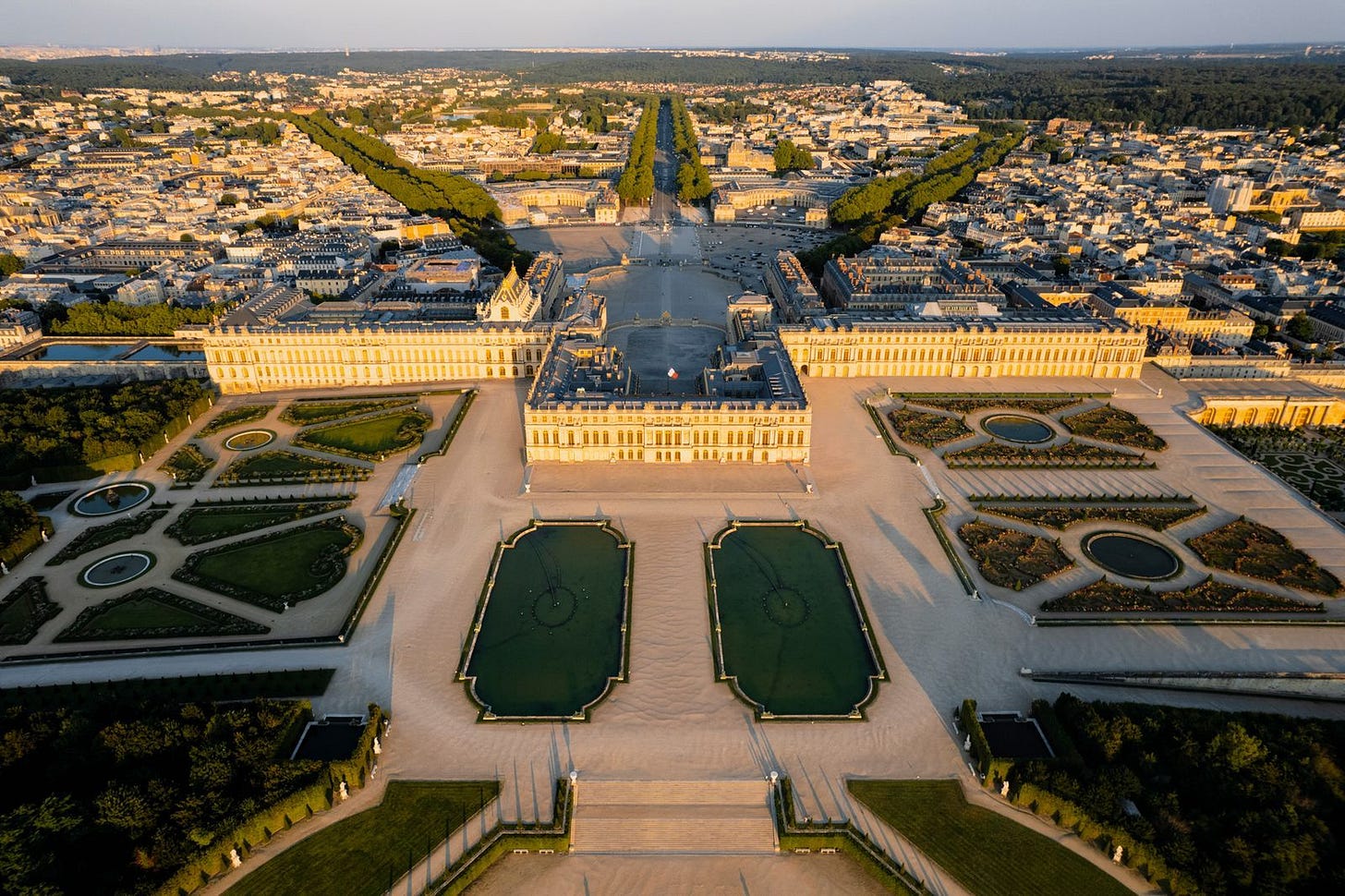
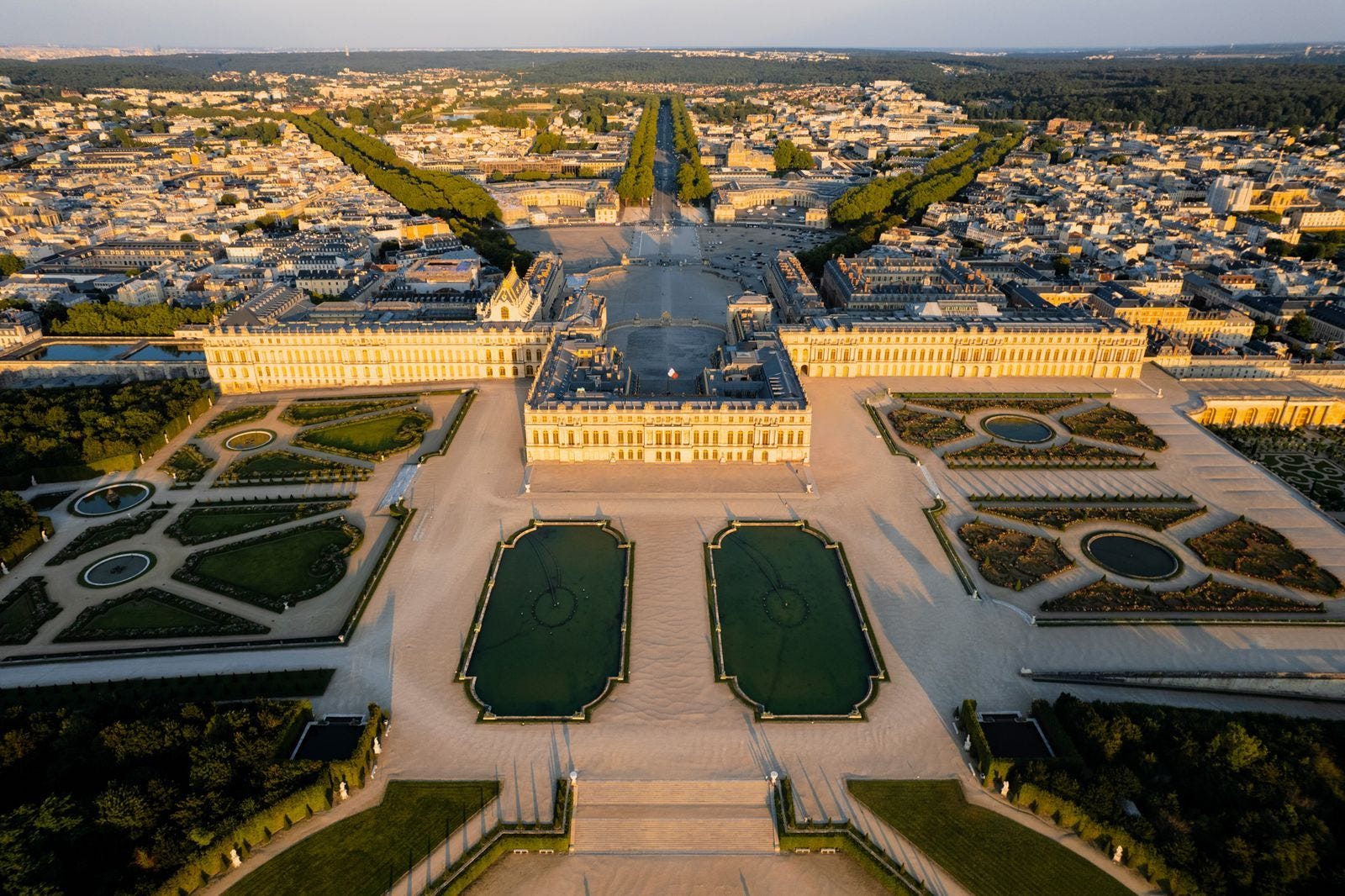
The Palace of Versailles
On October 5, 1789, crowds marched from Paris to Versailles amid severe bread shortages and mounting political unrest.
The following morning, violence erupted at the palace.
Members of the crowd entered the royal apartments. Guards were killed, and Marie Antoinette narrowly escaped.
The king and queen were compelled to leave Versailles and return to Paris, where they would live under increasing revolutionary control at the Tuileries Palace.
It was an unmistakable humiliation of the monarchy.
The royal family had become, in practical terms, prisoners of the Revolution.
Among those who recognized the significance of these events was Edmund Burke, the Anglo-Irish statesman whose Reflections on the Revolution in France appeared in 1790.
Burke was no French Catholic royalist. He was an Anglican politician and a member of the British Parliament.
Yet he understood something that the Revolution’s admirers seemed determined to overlook.
A political movement that claimed to liberate mankind was already demonstrating a frightening appetite for intimidation, humiliation, and bloodshed.
Burke’s account of the October violence emphasized the mortal danger faced by Marie Antoinette when attackers entered her apartments.
He also lamented the destruction of the moral and social restraints that had once surrounded royalty, womanhood, and public honor.
His criticism was especially powerful because it came from outside the French Catholic establishment.
A Protestant statesman could recognize the barbarity being committed against a Catholic queen.
The revolutionaries who proclaimed themselves apostles of enlightenment had rather more difficulty doing so.
The Revolution Turns Against the Church
The persecution of Marie Antoinette cannot be separated from the Revolution’s increasingly ferocious assault upon the Catholic Church.
In 1790, the National Assembly enacted the Civil Constitution of the Clergy, attempting to reorganize the Church in France under the authority of the revolutionary state.
Bishops and priests were required to swear an oath to the new ecclesiastical arrangement.
Many refused.
Their resistance was grounded in the conviction that the state possessed no authority to remake the Church’s spiritual government according to revolutionary political principles.
Pius VI condemned the legislation in 1791.
The consequences were severe.
Faithful priests were removed from their positions, forced into hiding, imprisoned, or driven into exile. Religious communities were suppressed, ecclesiastical property confiscated, and traditional Catholic institutions subjected to systematic disruption.
During the September Massacres of 1792, imprisoned priests were among those slaughtered by revolutionary mobs.
The subsequent Reign of Terror brought still greater persecution.
The Revolution’s attempt to establish a new political order had become inseparable, in the hands of its radical leaders, from an effort to uproot the public authority of the Catholic religion.
This is the context in which the queen’s final declaration of faith must be understood.
By October 1793, fidelity to the Roman Catholic Church could involve serious personal danger. Priests who rejected the revolutionary ecclesiastical settlement risked arrest and death.
Marie Antoinette understood the difference between the Catholic Church and the religious establishment the revolutionary government sought to control.
Her last letter would make that distinction painfully clear.
The Mother They Stripped of Her Children
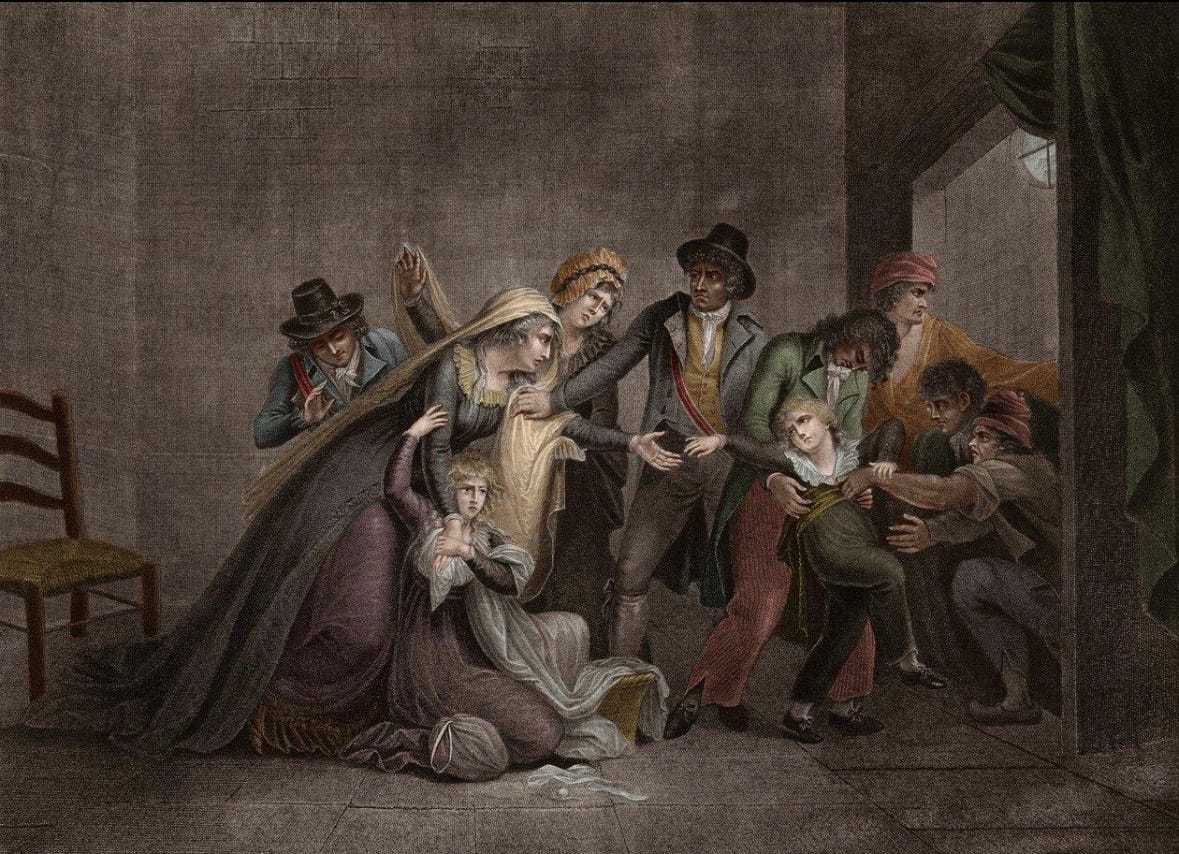
After the monarchy was overthrown in August 1792, the royal family was imprisoned in the Temple.
Louis XVI was executed the following January.
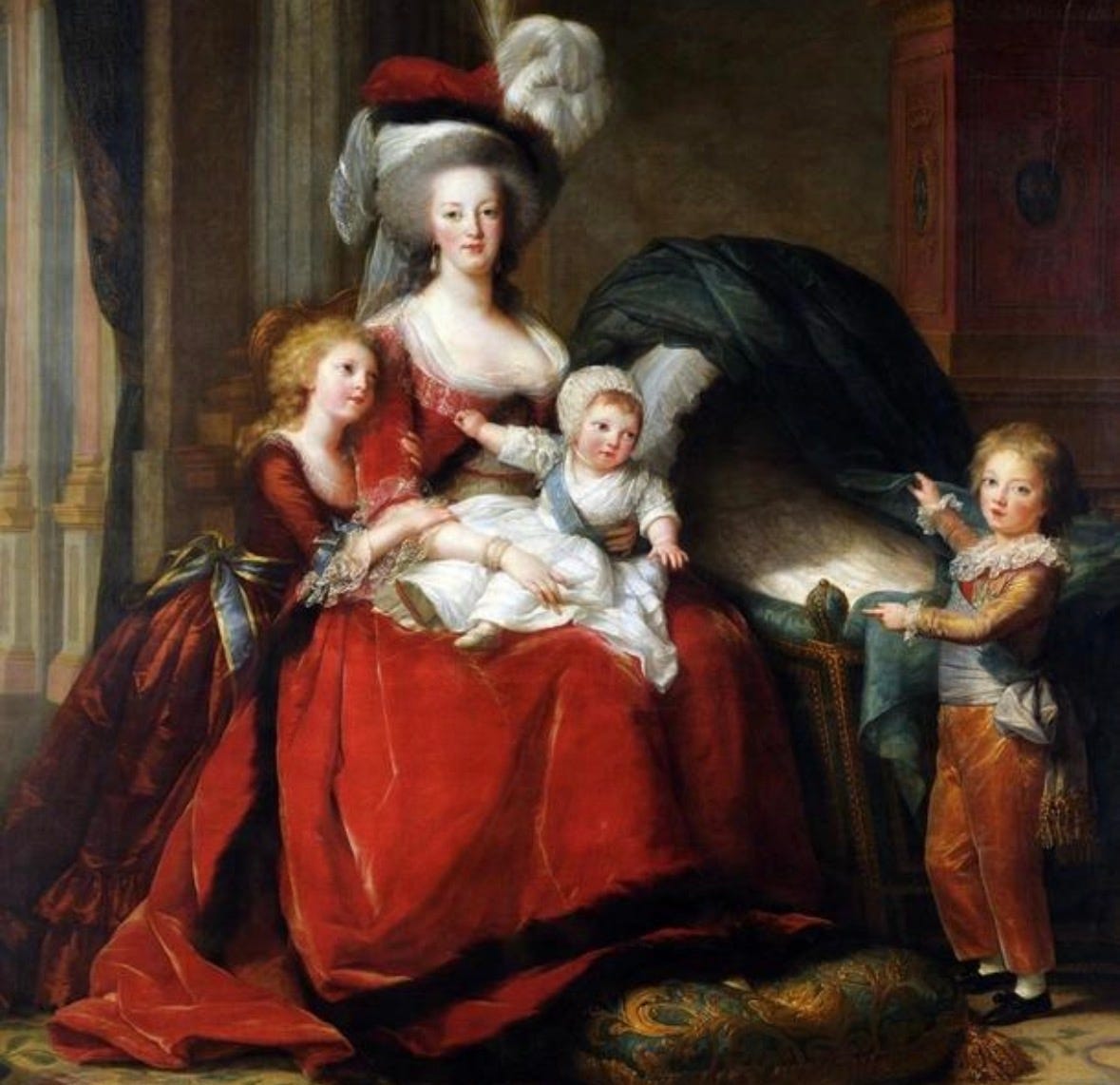
Marie Antoinette remained imprisoned with her daughter Marie-Thérèse, her young son Louis-Charles, and her sister-in-law Madame Élisabeth.
The children were now fatherless.
Their mother could offer them little protection.
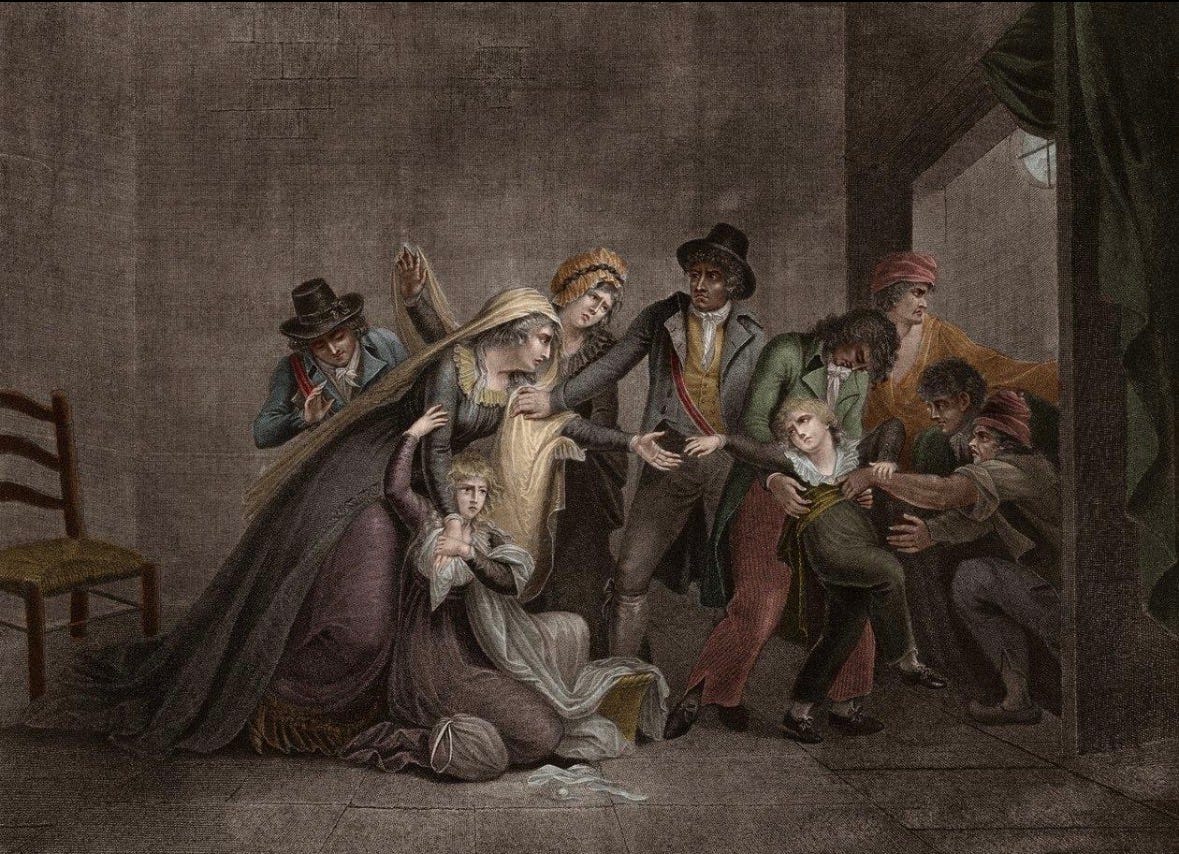
On July 3, 1793, the revolutionary authorities ordered the separation of Louis-Charles from his mother.
He was eight years old.
The boy was placed under the supervision of Antoine Simon, a shoemaker appointed to oversee his revolutionary reeducation.
The separation devastated Marie Antoinette.
She pleaded to retain her son, but the authorities were unmoved.
The child who had once been heir to the French throne became an instrument in the political campaign against his own family.
Under the influence and pressure of his custodians, Louis-Charles was induced to make accusations against his mother and aunt.
Those accusations would eventually be introduced at Marie Antoinette’s trial.
One can scarcely imagine a more calculated cruelty.
The Revolution had killed the boy’s father, imprisoned his mother, and deprived him of the ordinary security of family life.
Now his words under duress were to be used to dishonor the woman who had borne him.
The political significance was obvious.
Destroy the queen’s reputation as a mother, and even the natural sympathy ordinarily extended to a woman facing execution might be weakened.
It was a hideous enterprise.
And the men responsible conducted it while claiming to represent the moral regeneration of humanity.
A Trial That Exposed the Revolution’s Own Depravity
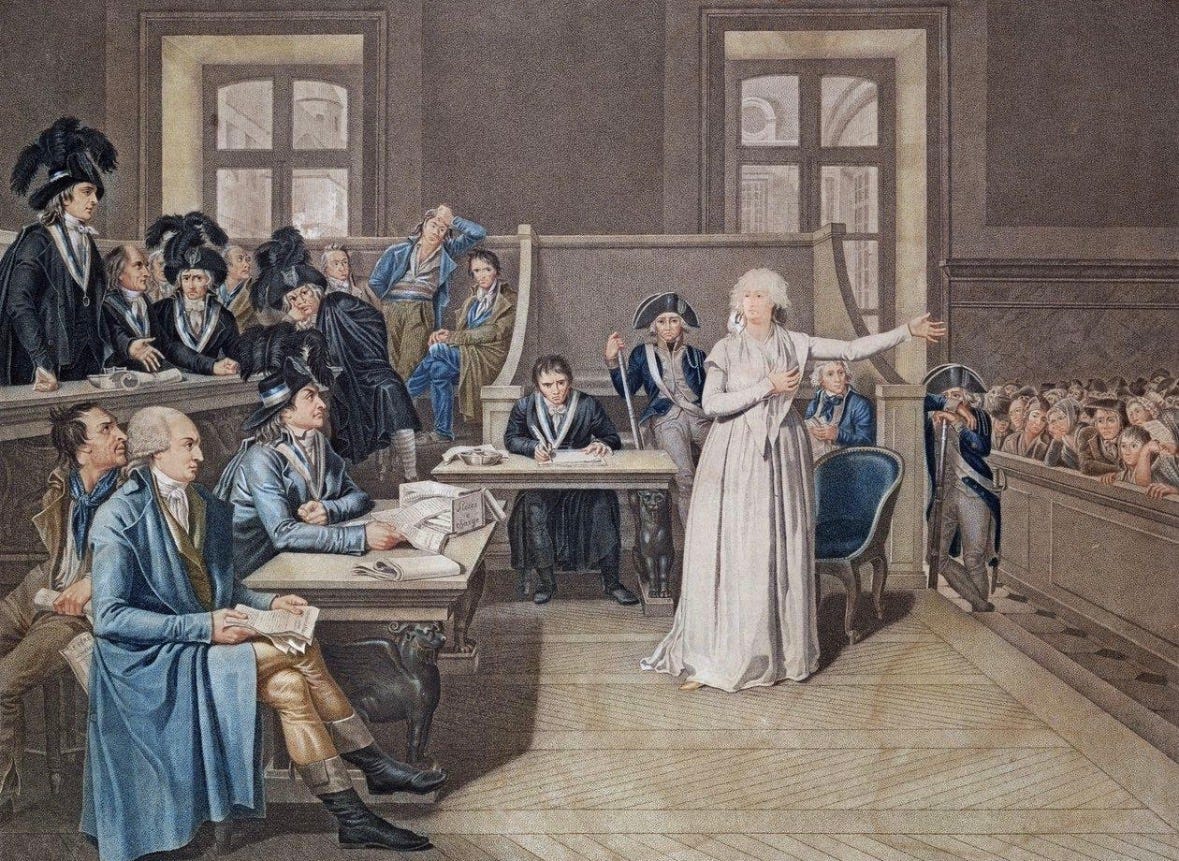
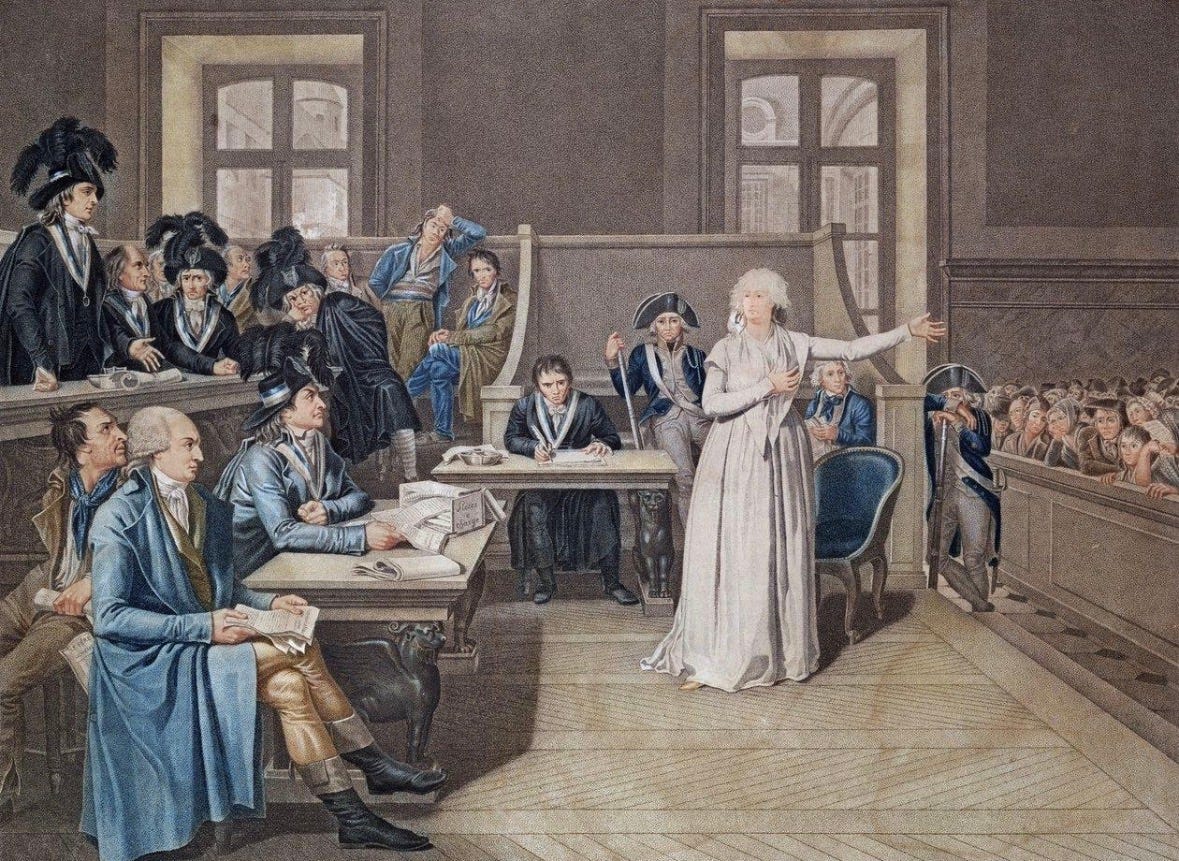
On October 14, 1793, Marie Antoinette appeared before the Revolutionary Tribunal.
She was thirty-seven, exhausted by imprisonment, and suffering from deteriorating health.
Her hair had reportedly turned substantially gray during her captivity.
The charges included financial misconduct, correspondence with foreign enemies, and conspiracy against the security of France.
Some of the political allegations rested upon genuine historical circumstances. Marie Antoinette had communicated with foreign powers and supported efforts to preserve or restore royal authority. Her correspondence with the Austrian diplomat Florimond-Claude, Count of Mercy-Argenteau, and other figures belongs to the documented political history of the Revolution.
She was a queen seeking to preserve a threatened monarchy, and she opposed revolutionary policies that endangered her husband, her children, and the institution to which her family belonged.
The French Ministry of Justice’s own historical account describes the weakness of the prosecution’s evidentiary case. Her lawyers received little time to prepare, and the witnesses offered scant serious proof supporting the sweeping accusations.
The ministry’s account even characterizes her as an accused person whose guilt had effectively been predetermined.
Then came the allegation that revealed the moral character of the proceedings.
Jacques Hébert, one of the Revolution’s most notorious radical journalists, introduced accusations of sexual misconduct involving Marie Antoinette and her young son.
The charge was monstrous.
When initially confronted with it, she remained silent.
Pressed to respond, she appealed to the mothers present in the courtroom, declaring in substance that nature itself recoiled from such an accusation against a mother.
For a moment, the ordinary instincts of humanity seem to have broken through the political atmosphere.
The accusation reportedly stirred sympathy among women who otherwise had little affection for the former queen.
There is a bitter irony here.
The revolutionaries had spent years accusing Marie Antoinette of moral corruption. Yet when the moment arrived to destroy her, they resorted to an accusation so revolting that even some of their own spectators recoiled.
A woman had to defend herself against the suggestion that she had sexually abused her own child.
And the accusers called this justice.
The historical record allows us to distinguish between the queen’s genuine political opposition to the Revolution and the vile personal accusations manufactured to disgrace her.
The former belongs to political history.
The latter belongs among the most shameful episodes of the Terror.
The Catholic Queen and Her Final Profession of Faith
The tribunal condemned Marie Antoinette to death in the early hours of October 16.
She returned to her confinement and asked for writing materials.
At approximately 4:30 a.m., she began a letter addressed to Madame Élisabeth, the sister of Louis XVI.
The document is among the most moving surviving testimonies of the French Revolution.
Its authenticity is well established, and reproductions of the French text survive in historical collections, including material catalogued by the Musée Carnavalet in Paris.
The letter deserves to be read carefully.
Marie Antoinette expresses grief at leaving her children, concern for her sister-in-law, and hope that her son and daughter will remain united in affection.
She asks that her son never seek revenge for the deaths of his parents.
This is an extraordinary request from a woman whose husband had been executed and who was about to suffer the same fate.
She also addresses the terrible accusations involving her son, asking Élisabeth to forgive the child and remember how easily a boy of his age could be manipulated.
Here was a mother, facing execution, worrying about the spiritual and emotional welfare of the child whose coerced accusations had helped humiliate her.
She then makes her final profession of Catholic faith.I die in the Catholic Apostolic and Roman religion, that of my fathers, that in which I was brought up, and which I have always professed.
I die in the Catholic Apostolic and Roman religion, that of my fathers, that in which I was brought up, and which I have always professed. Having no spiritual consolation to look for, not even knowing whether there are still in this place any priests of that religion (and indeed the place where I am would expose them to too much danger if they were to enter it but once), I sincerely implore pardon of God for all the faults which I may have committed during my life. I trust that, in His goodness, He will mercifully accept my last prayers, as well as those which I have for a long time addressed to Him, to receive my soul into His mercy.
I beg pardon of all whom I know, and especially of you, my sister, for all the vexations which, without intending it, I may have caused you. I pardon all my enemies the evils that they have done me. I bid farewell to my aunts and to all my brothers and sisters. I had friends. The idea of being forever separated from them and from all their troubles is one of the greatest sorrows that I suffer in dying. Let them at least know that to my latest moment I thought of them.
Farewell, my good and tender sister. May this letter reach you. Think always of me; I embrace you with all my heart, as I do my poor dear children. My God, how heart-rending it is to leave them forever! Farewell! farewell!
These words deserve to be remembered.
She had lost her husband, her throne, her liberty, and the companionship of her children.
She remained a Catholic.
And she understood that the priests available through the revolutionary authorities might be separated from the legitimate ecclesiastical order to which she remained faithful.
She wrote of her inability to obtain spiritual consolation and of the danger that faithful priests might face if they attempted to visit her.
There is no theatrical defiance in the letter. She asks God to forgive her sins and receive her soul in His mercy.
The queen who had once lived amid the elaborate ceremonies of Versailles now confronted eternity with little more than her faith.
The revolutionary state could condemn her.
It could strip her of every earthly distinction.
It could even prevent her from receiving the spiritual consolation she desired.
Her final profession of faith remained beyond its power.
The Forgiveness Her Executioners Never Deserved
Marie Antoinette’s last letter contains another passage that ought to shame those who continue celebrating her execution as an uncomplicated triumph of justice.
She forgave her enemies.
Consider what that meant.
These were people who had vilified her for years, threatened her family, imprisoned her children, killed her husband, and dragged her through a humiliating public trial.
She had every human reason to hate them.
Instead, she placed her final hours under the demands of the Catholic religion.
Forgiveness is among the hardest commands of Our Lord.
It is easy enough to speak about Christian charity when one’s enemies are distant and one’s own comfort remains secure. Marie Antoinette faced the immediate prospect of death at the hands of men who had already inflicted terrible suffering upon her family.
Her forgiveness deserves to be understood as a genuine act of Christian virtue.
We should also resist the temptation to turn this into an argument that she had somehow become a canonized saint.
The Church has made no such declaration concerning Marie Antoinette.
Her earlier life contained faults, and the historical record gives us no authority to pronounce upon the final state of her soul.
But Catholic history contains many examples of men and women whose spiritual character became clearer through suffering.
The woman who had once enjoyed the glittering pleasures of Versailles was now concerned with repentance, mercy, her children’s souls, and the forgiveness of her enemies.
Whatever judgment one makes about her political conduct, there is something profoundly Catholic about the way she prepared for death.
The Road to the Guillotine
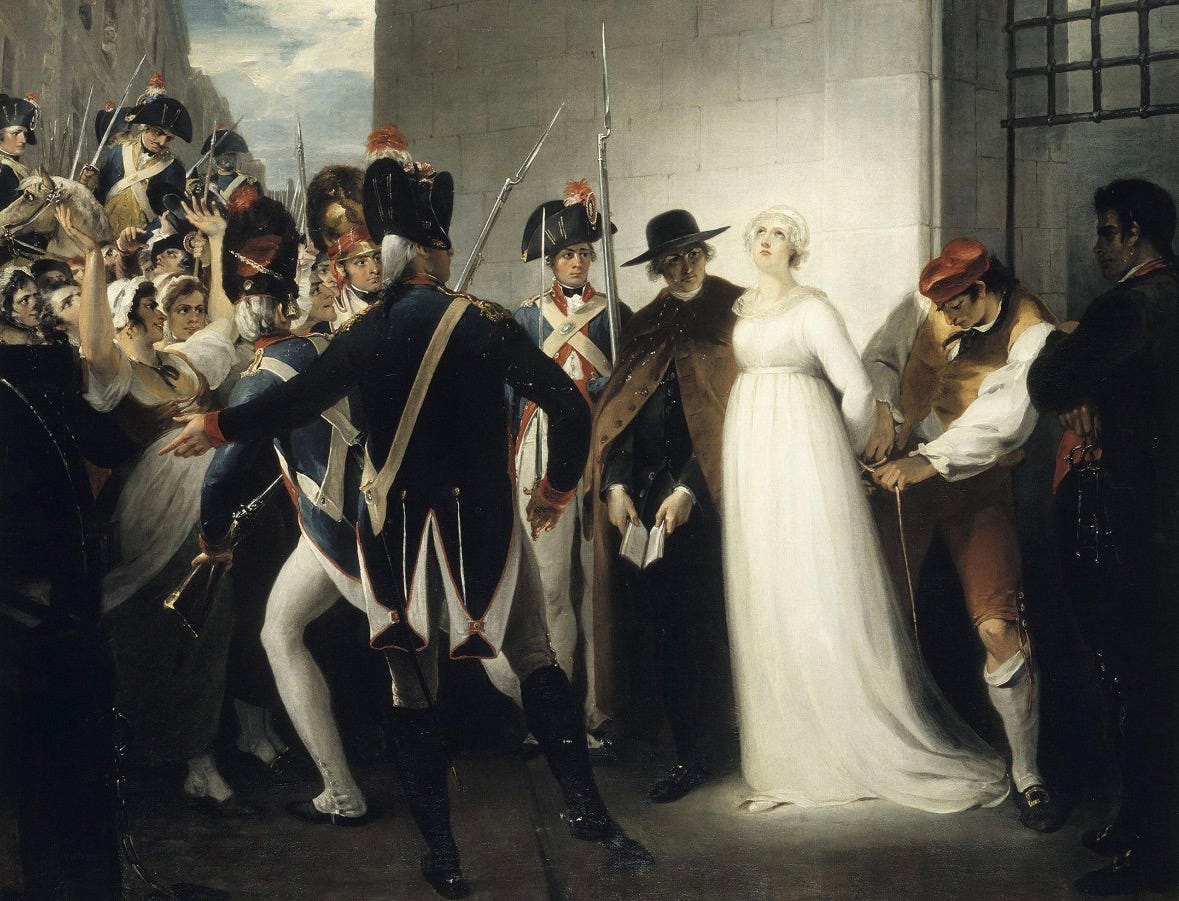
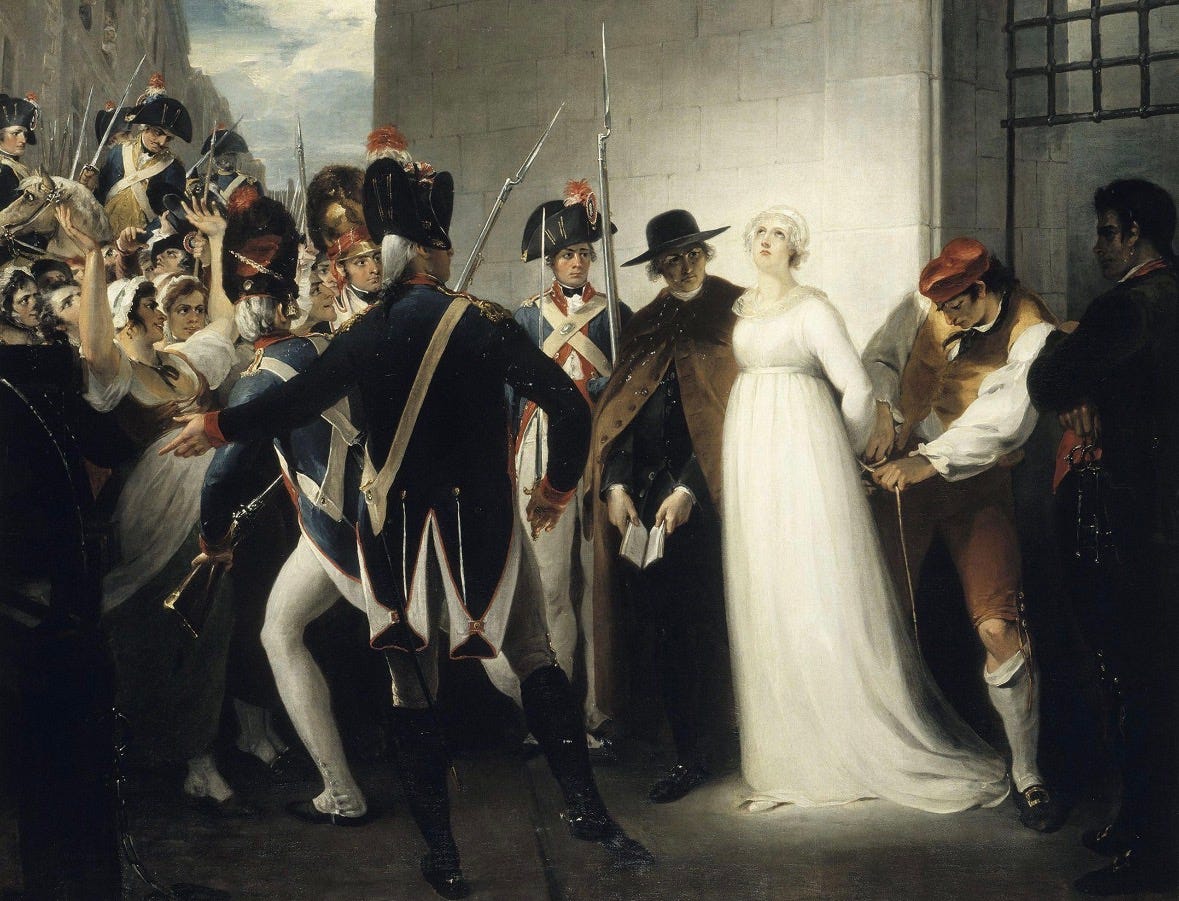
Later that morning, Marie Antoinette was prepared for execution.
Her hair was cut short. Her hands were bound behind her back.
Unlike Louis XVI, who had been taken to his execution in a carriage, she was transported in an open cart.
The distinction was deliberate and humiliating.
The former Queen of France was exposed to the crowds as she traveled through Paris toward the Place de la Révolution, today’s Place de la Concorde.
Accounts of her final journey differ in some details, and the familiar stories surrounding her last moments have accumulated embellishments over time.
One famous anecdote claims that she accidentally stepped on the executioner’s foot and apologized. Although widely repeated, the precise wording is difficult to establish from secure contemporary evidence.
There is no need to improve upon the facts.
A thirty-seven-year-old mother was taken through the streets, condemned by a revolutionary tribunal, and publicly beheaded.
She had already endured the execution of her husband and the loss of her children.
At approximately 12:15 p.m. on October 16, 1793, the blade fell.
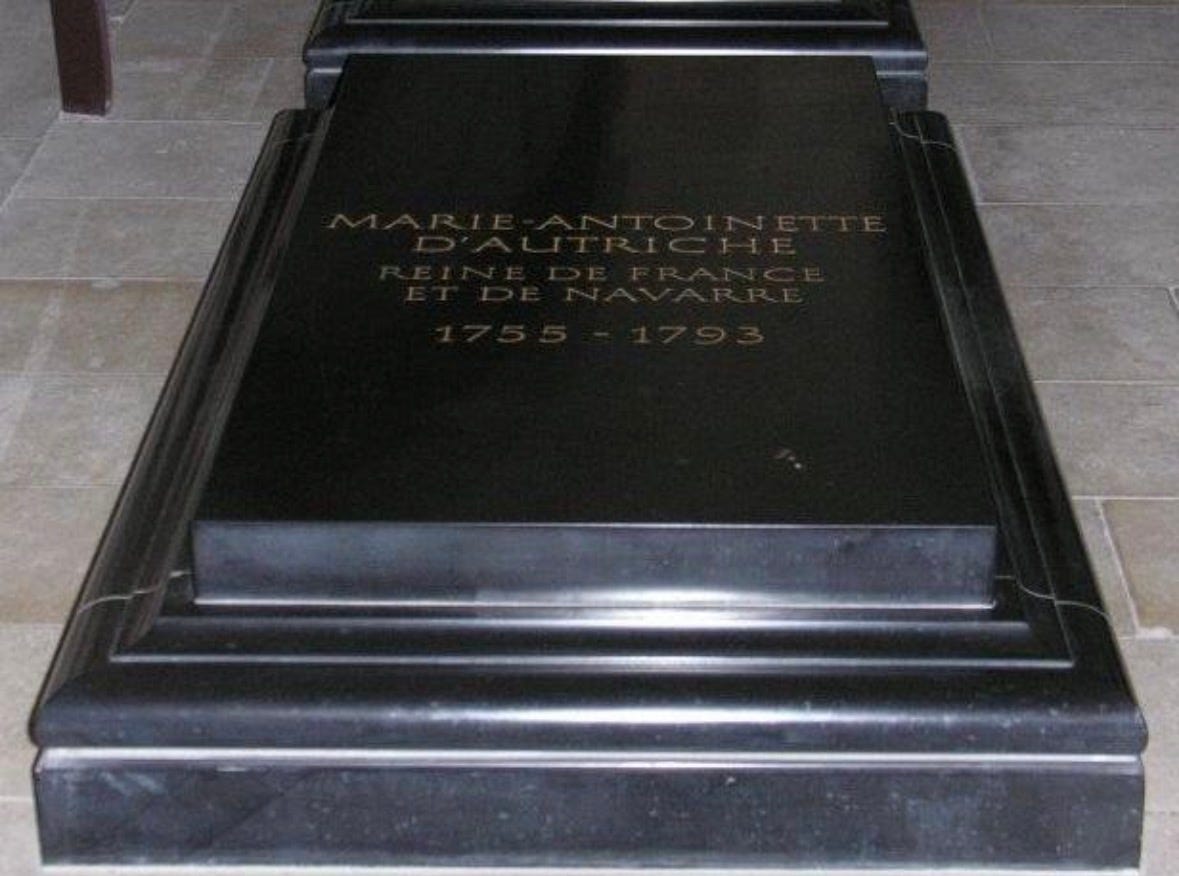
Her remains were buried without royal honors in the cemetery of the Madeleine.
The Revolution had finally achieved what years of propaganda and political agitation had prepared the public to accept.
The queen was dead.
The hatred survived her.
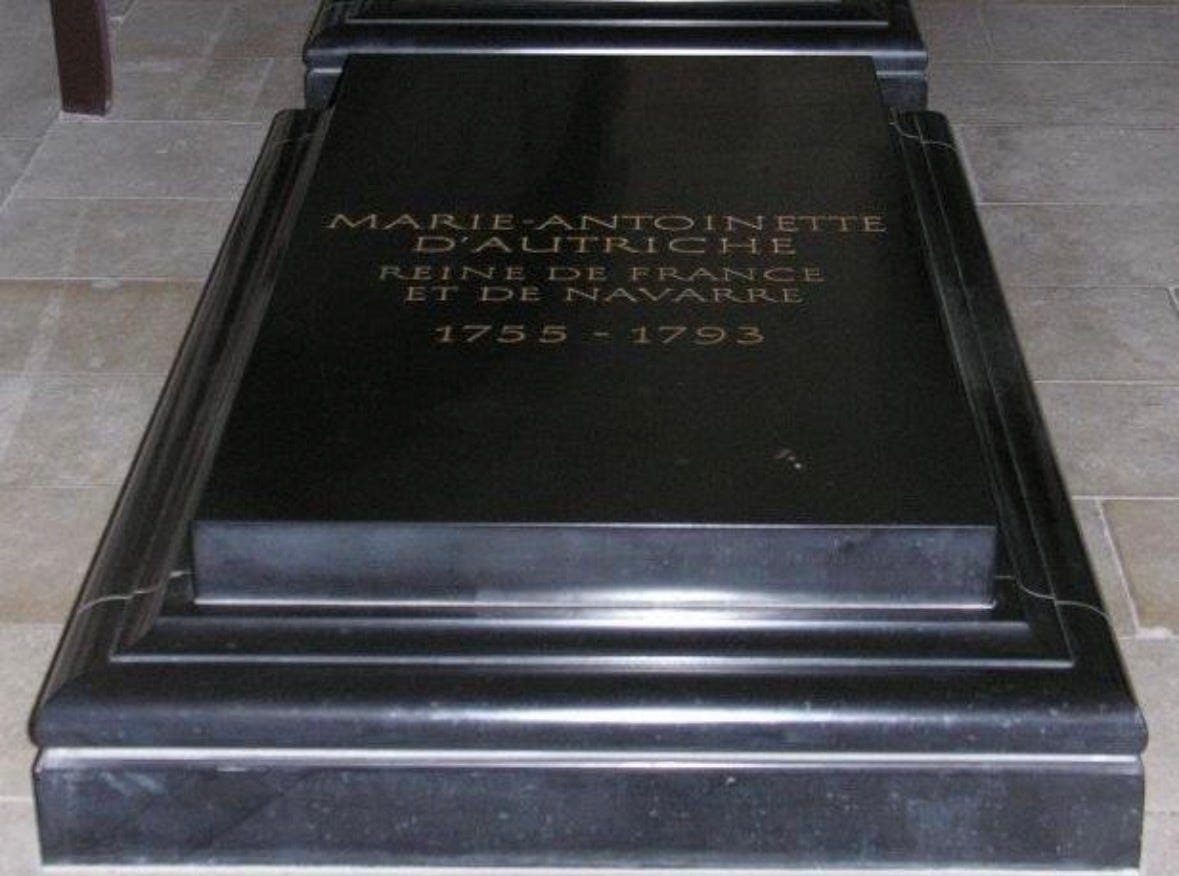
The tomb of Marie Antionette
The Protestant Who Saw the Revolution for What It Was
There is a reason Edmund Burke deserves a prominent place in any Catholic defense of Marie Antoinette.
Burke recognized the Revolution’s destructive tendencies before the worst atrocities of the Terror had occurred.
Writing in 1790, he challenged the assumption that the destruction of inherited institutions necessarily represented moral progress.
His objections extended beyond the fate of the French monarchy.
He feared that revolutionary ideology, once emancipated from religious and moral restraint, would justify violence in the name of abstract political principles.
The subsequent years gave his warnings terrible force.
Louis XVI was executed in January 1793. Marie Antoinette followed in October.
The Revolution also witnessed the September Massacres, the persecution of priests, the suppression of religious institutions, and the bloody conflict in the Vendée.
Burke’s criticism of the Revolution became part of a larger British debate over its character and consequences.
It would be inaccurate to claim that all British Protestants condemned the Revolution. Some British radicals admired it, and its early constitutional aspirations attracted genuine sympathy.
Yet influential Protestant critics, including Burke, recognized the profound moral danger in its escalating violence.
There is something particularly revealing about the spectacle of an Anglican statesman defending the dignity of a Catholic queen while revolutionary Frenchmen treated her humiliation as a political achievement.
Burke’s concern arose from a conviction that civilization depended upon more than written constitutions and declarations of rights.
Custom, religion, restraint, reverence, and inherited obligations mattered.
Destroy those things recklessly, and the resulting society might prove considerably more savage than the one it replaced.
The French Revolution would offer abundant evidence of that danger.
The Revolution That Claimed to Liberate Humanity
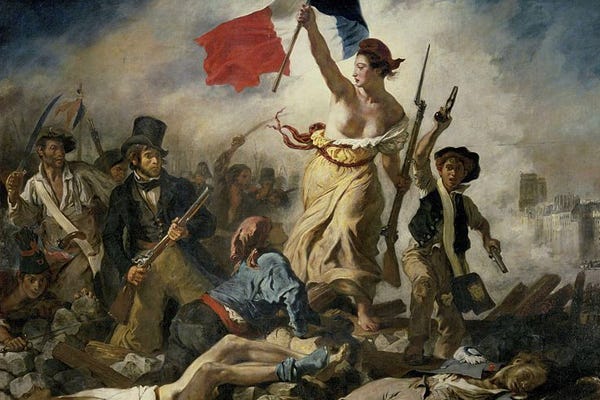
We are frequently invited to regard the French Revolution as one of the great emancipatory events of modern history.
The familiar account emphasizes the overthrow of absolutism, the abolition of feudal privileges, the assertion of legal equality, and the Declaration of the Rights of Man and of the Citizen.
These developments deserve historical examination on their own terms.
France possessed serious social and political problems. Its taxation system was inequitable, its fiscal arrangements required reform, and legitimate grievances existed among ordinary people.
Acknowledging those grievances, however, does nothing to excuse the revolutionary persecution that followed.
The Revolution eventually produced a political culture in which the execution of a king, the public humiliation of his widow, and the imprisonment of their children could be presented as acts of national regeneration.
The persecution of the Catholic Church was particularly revealing.
The revolutionary authorities claimed an extraordinary degree of power over religious life. They attempted to reorganize the Church, compelled oaths from priests, confiscated ecclesiastical property, and punished those who remained faithful to the Church’s legitimate spiritual authority.
Later, radical de-Christianizing campaigns attacked Catholic worship itself.
The Vendée became the scene of terrible violence as republican forces suppressed a predominantly Catholic and royalist uprising.
The extent, classification, and precise responsibility for the atrocities committed there remain subjects of historical debate. The scale of civilian suffering and the brutality of the repression are beyond serious dispute.
A revolution that proclaimed universal rights had proved capable of trampling upon the most elementary rights of those it regarded as enemies.
Marie Antoinette’s execution belongs within this larger history.
Her death was the destruction of a particular woman, with a particular family, whose humanity had been obscured by years of propaganda.
The queen had become a symbol.
The symbol had to die.
And once the killing was complete, the revolutionary mythology could continue doing its work.
The Last Letter of Marie Antoinette
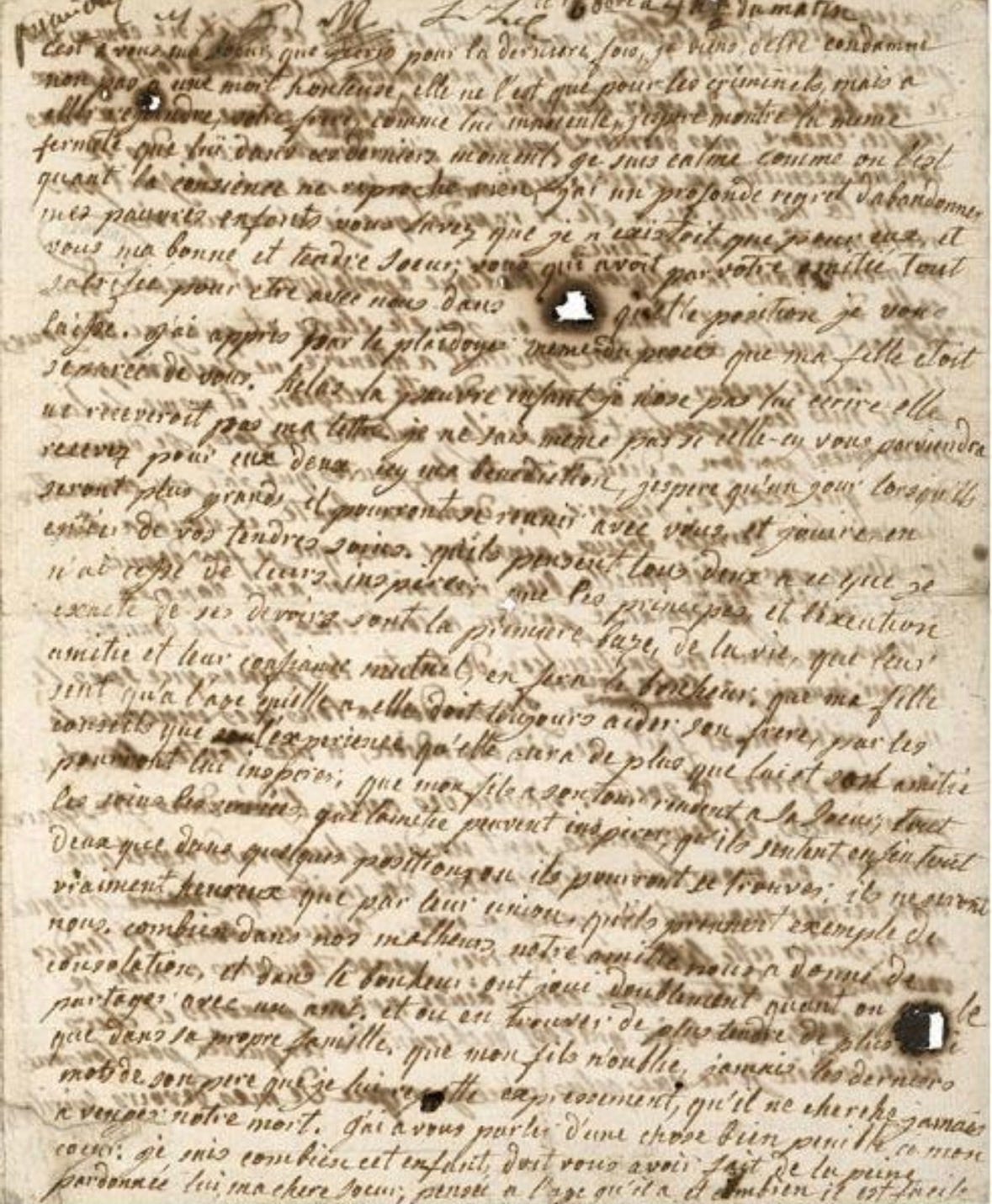
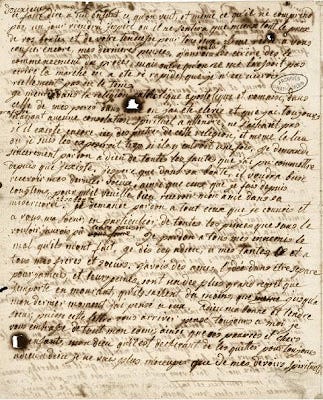
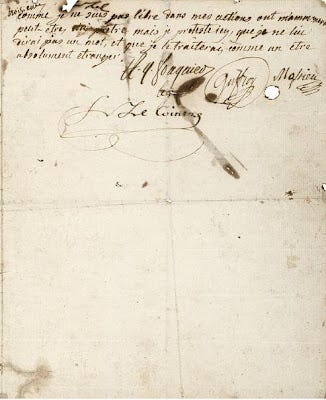
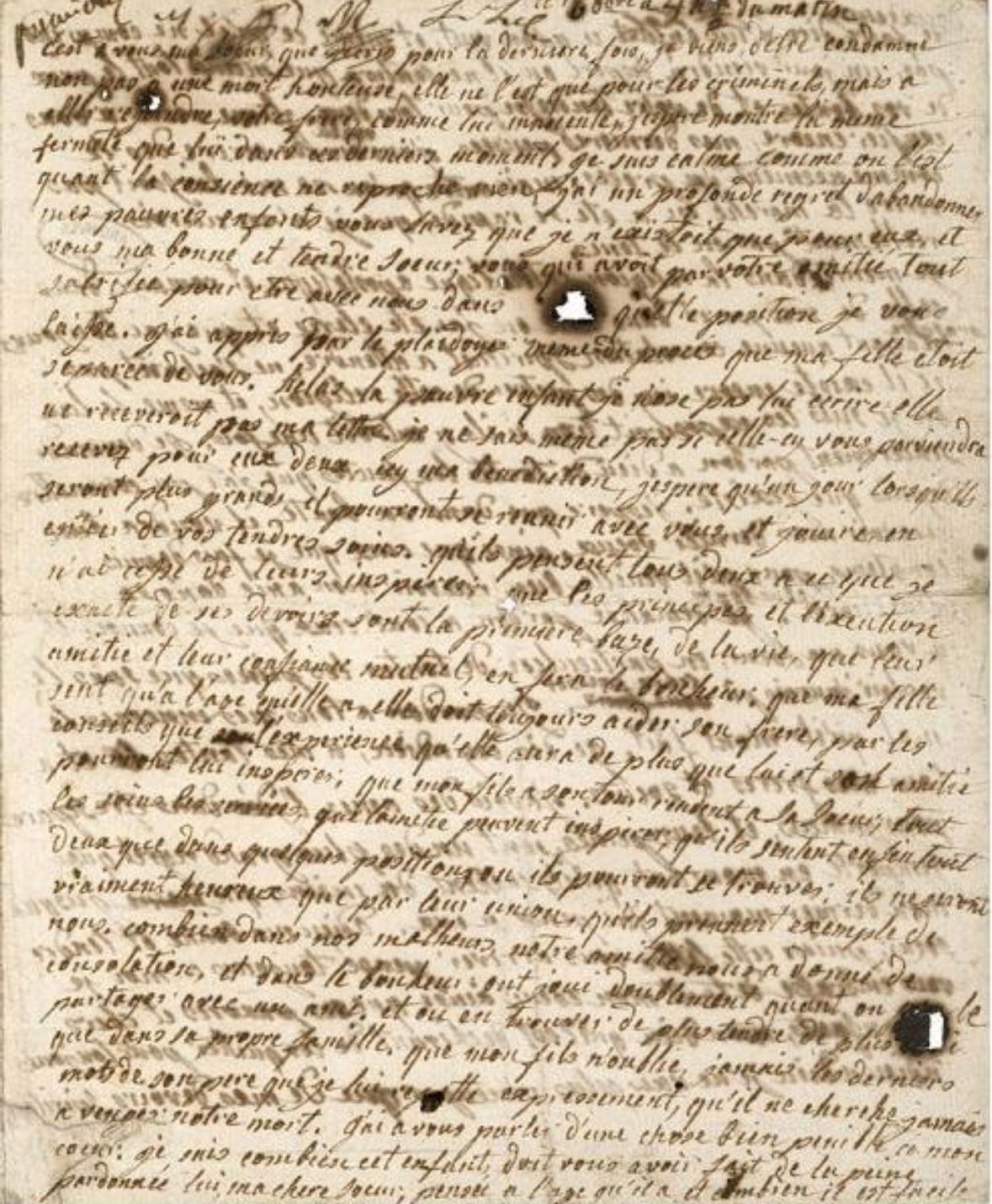
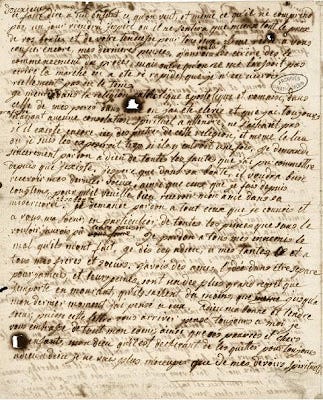
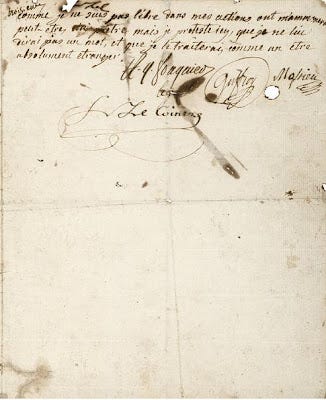
Here are pictures of the queen's last letter, stained by her tears, followed by an English translation. When she speaks of her children the words themselves fall like tears.
I want to return to that prison cell in the early hours of October 16.
At half past four on the morning of October 16, 1793, with only hours remaining before her execution, Marie Antoinette wrote to Madame Élisabeth, the sister of her murdered husband, Louis XVI.
The letter never reached its intended recipient. Madame Élisabeth would herself be guillotined on May 10, 1794.
Its survival gives us something infinitely more valuable than the revolutionary caricatures: the queen’s own words.
Here, in her final hours, Marie Antoinette speaks of her children, her grief at leaving them, her determination to forgive her enemies, and her unwavering adherence to the Catholic religion. She asks her son never to seek revenge for the deaths of his parents and pleads that he be forgiven for the accusations extracted from him during his captivity.
Perhaps most strikingly, she refuses to compromise her religious fidelity even as she prepares to die, explaining why she cannot accept the ministrations of a priest imposed upon her by the revolutionary authorities.
After more than two centuries of calumny, the woman whom the Revolution portrayed as a monster deserves to be heard in her own words.
What follows is Marie Antoinette’s final letter, written on the morning of her execution.
16th October, 4.30 A.M.
It is to you, my sister, that I write for the last time. I have just been condemned, not to a shameful death, for such is only for criminals, but to go and rejoin your brother. Innocent like him, I hope to show the same firmness in my last moments.
I am calm, as one is when one's conscience reproaches one with nothing. I feel profound sorrow in leaving my poor children: you know that I only lived for them and for you, my good and tender sister. You who out of love have sacrificed everything to be with us, in what a position do I leave you! I have learned from the proceedings at my trial that my daughter was separated from you. Alas! poor child; I do not venture to write to her; she would not receive my letter. I do not even know whether this will reach you. Do you receive my blessing for both of them. I hope that one day when they are older they may be able to rejoin you, and to enjoy to the full your tender care. Let them both think of the lesson which I have never ceased to impress upon them, that the principles and the exact performance of their duties are the chief foundation of life; and then mutual affection and confidence in one another will constitute its happiness. Let my daughter feel that at her age she ought always to aid her brother by the advice which her greater experience and her affection may inspire her to give him. And let my son in his turn render to his sister all the care and all the services which affection can inspire. Let them, in short, both feel that, in whatever positions they may be placed, they will never be truly happy but through their union. Let them follow our example. In our own misfortunes how much comfort has our affection for one another afforded us! And, in times of happiness, we have enjoyed that doubly from being able to share it with a friend; and where can one find friends more tender and more united than in one's own family? Let my son never forget the last words of his father, which I repeat emphatically; let him never seek to avenge our deaths.
I have to speak to you of one thing which is very painful to my heart, I know how much pain the child must have caused you. Forgive him, my dear sister; think of his age, and how easy it is to make a child say whatever one wishes, especially when he does not understand it. It will come to pass one day, I hope, that he will better feel the value of your kindness and of your tender affection for both of them. It remains to confide to you my last thoughts. I should have wished to write them at the beginning of my trial; but, besides that they did not leave me any means of writing, events have passed so rapidly that I really have not had time.
I die in the Catholic Apostolic and Roman religion, that of my fathers, that in which I was brought up, and which I have always professed. Having no spiritual consolation to look for, not even knowing whether there are still in this place any priests of that religion (and indeed the place where I am would expose them to too much danger if they were to enter it but once), I sincerely implore pardon of God for all the faults which I may have committed during my life. I trust that, in His goodness, He will mercifully accept my last prayers, as well as those which I have for a long time addressed to Him, to receive my soul into His mercy. I beg pardon of all whom I know, and especially of you, my sister, for all the vexations which, without intending it, I may have caused you. I pardon all my enemies the evils that they have done me. I bid farewell to my aunts and to all my brothers and sisters. I had friends. The idea of being forever separated from them and from all their troubles is one of the greatest sorrows that I suffer in dying. Let them at least know that to my latest moment I thought of them.
Farewell, my good and tender sister. May this letter reach you. Think always of me; I embrace you with all my heart, as I do my poor dear children. My God, how heart-rending it is to leave them forever! Farewell! farewell! I must now occupy myself with my spiritual duties, as I am not free in my actions. Perhaps they will bring me a priest; but I here protest that I will not say a word to him, but that I will treat him as a total stranger. (Translation by Charles Duke Yonge)
The Queen History Owes an Apology
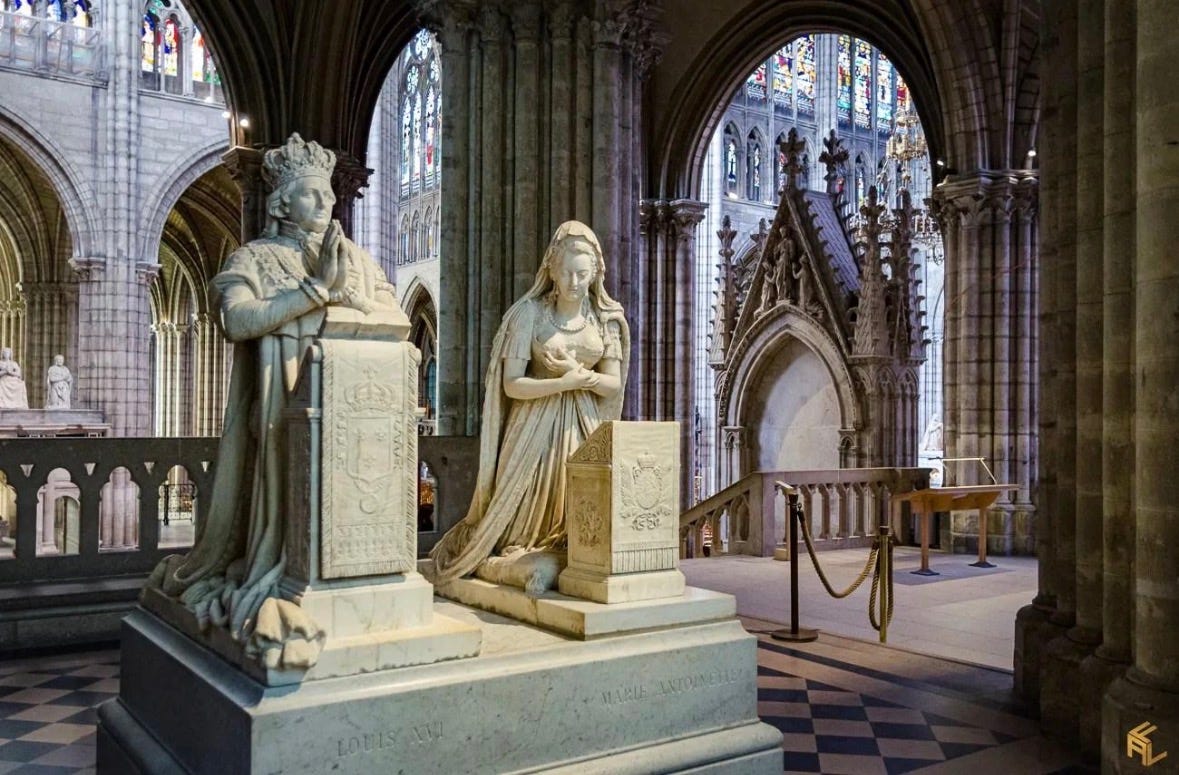
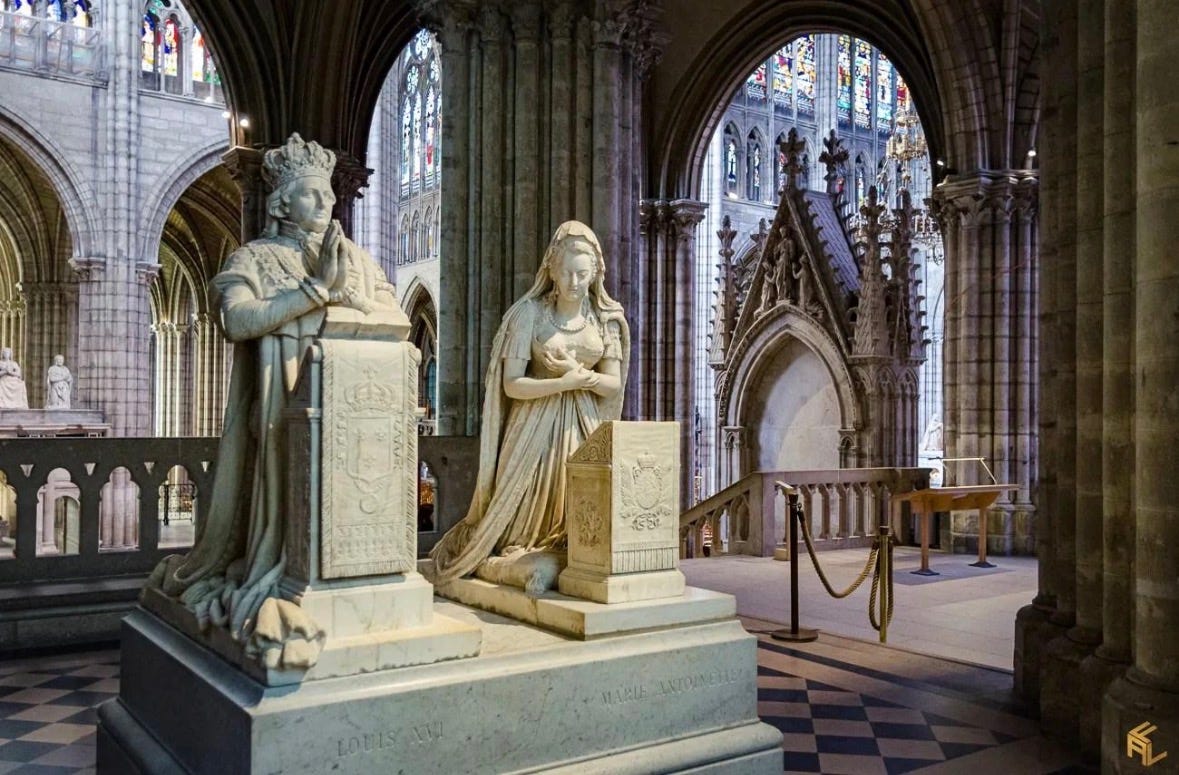
These kneeling statues commemorate Marie Antoinette and Louis XVI. They were commissioned by Louis XVIII after the restoration of the monarchy.
There is a final irony in the way Marie Antoinette is remembered.
The revolutionaries who condemned her claimed to represent reason, justice, and the moral advancement of humanity. Their defenders have spent generations explaining the Revolution’s excesses as regrettable consequences of extraordinary historical circumstances.
Yet the queen herself is still casually condemned on the strength of stories that would never survive serious scrutiny.
A fictional remark about cake.
An extravagant necklace she never purchased.
Obscene pamphlets written by political enemies.
Sexual accusations so depraved that they disgraced the accusers far more than their intended victim.
And beneath all this remains the historical reality of a woman who suffered the loss of her husband, her children, her freedom, and finally her life.
Marie Antoinette deserves a fair hearing.
She was a daughter of the Habsburgs, a Queen of France, a mother, and a Catholic. Her political conduct can be examined critically without accepting the propaganda manufactured to destroy her reputation. Her faults can be acknowledged without pretending that they justified her execution.
Nor must we canonize her ourselves to recognize the spiritual beauty of her final hours.
The Church has given us saints whose heroic virtue has been formally recognized. Marie Antoinette belongs to a different category: a historical Catholic woman whose final testimony offers a moving example of faith under persecution.
Her last letter should be read alongside the revolutionary accusations, because it exposes the immense distance between the woman who actually existed and the monster her enemies invented.
The anniversary of her death offers an opportunity to remember the real queen.
On October 16, 1793, the Revolution took her life. It had already taken her husband and her children. What remained was a woman asking God to forgive her sins, pardoning her enemies, and commending her family to divine mercy.
For all the Revolution’s grand declarations about human dignity, it is Marie Antoinette who emerges from those final hours with her dignity intact.
Requiem aeternam dona ei, Domine, et lux perpetua luceat ei. Requiescat in pace. Amen.
Eternal rest grant unto her, O Lord, and let perpetual light shine upon her. May she rest in peace. Amen.
Last edited by GaiaGoddess; 10-17-2026 at 05:39 PM.


 Reply With Quote
Similar Threads
-
SATAN IS "GOOD", THE VAX IS "HEALTHY", AND THIS IMAGE IS "REAL". WATCH
By Airbornesapper07 in forum Other Topics News and IssuesReplies: 0Last Post: 09-28-2021, 04:17 PM -
"NOT TAKING THIS WHITE HOUSE" "I DON'T CONCEDE" "FIGHT FOR TRUMP"
By Airbornesapper07 in forum Other Topics News and IssuesReplies: 0Last Post: 01-04-2021, 11:49 PM -
Limbaugh: "Illegal Immigration" Proponents Want To "Erase America" And "Western"
By European Knight in forum illegal immigration News Stories & ReportsReplies: 2Last Post: 02-28-2019, 01:31 PM -
MICHELLE'S SKI FOR EXERCISE! It's Like Michelle Obama saying "let them eat cake"
By AirborneSapper7 in forum Other Topics News and IssuesReplies: 1Last Post: 03-31-2013, 10:45 AM -
Forget The "Bazookas": Here Come The "Tomahawks" And "Howitzers" - Greek Endgame
By AirborneSapper7 in forum Other Topics News and IssuesReplies: 0Last Post: 05-22-2012, 02:57 AM


France galvanised by shopkeepers and locals who fought back...
10-20-2026, 06:57 AM in General Discussion