

Results 1 to 10 of 23
 5Likes
Thread Information
Users Browsing this Thread
There are currently 1 users browsing this thread. (0 members and 1 guests)
 LinkBack URL
 About LinkBacks
Hybrid View


-
08-04-2016, 04:04 PM #1Senior Member


- Join Date
- Aug 2008
- Location
- PARADISE (San Diego)
- Posts
- 99,038
SF crime boss ‘Shrimp Boy’ Chow sentenced to life in prison
By Bob Egelko
Updated 12:43 pm, Thursday, August 4, 2016
Photo: Brant Ward, The Chronicle
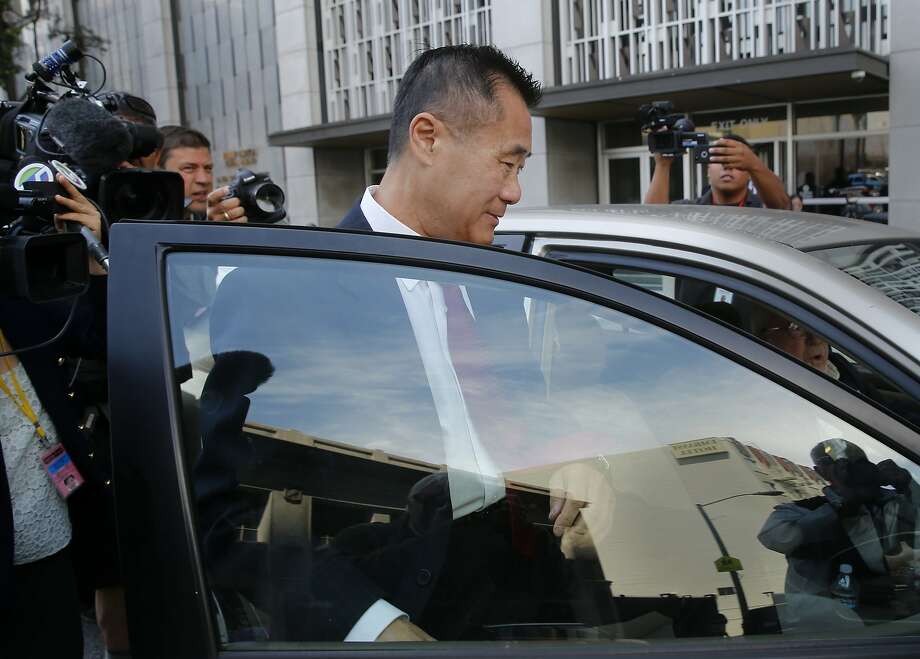
Former state Sen. Leland Yee tried to avoid photographers as he left the Federal building in San Francisco, Calif. Yee pleaded guilty July 1, 2015, to charges of racketeering and admitting he accepted bribes ... more
Raymond “Shrimp Boy” Chow, convicted of racketeering and murder as the leader of a venerable community organization in San Francisco’s Chinatown, was sentenced to life in prison by a federal judge Thursday.
U.S. District Judge Charles Breyer sentenced Chow, 56, to two life terms in prison after a federal court jury in San Francisco found him guilty in January of conspiring to operate the Ghee Kung Tong as a racketeering enterprise and of ordering the murder of its previous leader, Allen Leung, in 2006.
Chow was also convicted of conspiring to try to murder another rival, Jim Tat Kong, who was later shot to death in 2013, of five counts of dealing in stolen liquor and cigarettes, and of 154 counts of money-laundering. The Leung murder conviction carried a mandatory sentence of life without the possibility of parole.
His lawyers plan to appeal his convictions.
The trial followed a five-year undercover federal operation that also implicated then-state Sen. Leland Yee, D-San Francisco, one of 28 defendants indicted along with Chow in 2014.
FBI agents posing as shady campaign contributors contacted Yee through Keith Jackson, a former San Francisco school board president who had ties to Chow’s organization. In July 2015, Yee and Jackson pleaded guilty to racketeering and admitted that the senator, with Jackson’s help, had accepted bribes in exchange for promises of political favors and an agreement to illegally import firearms.
Breyer sentenced Yee to five years in prison in February, while Jackson, who admitted taking payoffs for other crimes, including a fictitious murder-for-hire plot, got a nine-year term. Jackson and two former local government employees are also charged with agreeing to bribes by undercover agents who allegedly sought access to Mayor Ed Lee.
The undercover investigation focused on the inner workings of the Ghee Kung Tong, a century-old Chinatown “brotherhood” that prosecutors said had become a front for crime and corruption under Chow’s direction.
Chow became the tong’s leader after a still-unidentified gunman shot Leung to death in February 2006 at his import-export business in Chinatown.
A self-described gangster for much of his life, Chow was imprisoned in 1993 on another racketeering charge and won early release a decade later for testifying against a gang leader. Testifying in his current case, he told jurors in December that he had reflected on his past while in prison and promised himself to live a crime-free life.
He began counseling troubled youths in minority communities and later won praise from Lee and Sen. Dianne Feinstein, D-Calif. But prosecutors said Chow was plotting all along to take over the Ghee Kung Tong and to run it as a criminal gang, with the help of longtime followers.
One prosecution witness, who had pleaded guilty to lesser charges, said he had heard Chow order Leung‘s murder in the midst of a feud between the two men. The driver of the getaway car also said Chow had set up the killing. Jurors heard a secretly recorded conversation in which Chow supposedly told an undercover agent in 2013 that he had once advised Leung that anyone who messed around with Chow, or with his investments, would be “gone.”
Chow listened to the same recording and testified that he hadn’t been referring to Leung. Defense lawyers told the jury that the prosecution witnesses were convicted criminals and liars who had been allowed to meet in jail and coordinate their stories.
The other homicide charge involved Kong, the onetime rival in an affiliated organization, the Hop Sing Tong, who was shot to death in Mendocino County in 2013. Another co-defendant testifying for the prosecution said Chow had ordered him to kill Kong in 2011, then told him later that the matter had been “handled.” Chow denied any involvement in Kong’s death.
Most of the charges against Chow involved crimes that his subordinates allegedly agreed to commit with an undercover agent who posed as “Dave Jordan,” and described himself as an East Coast businessman with mob connections. The agent recorded three years of conversations with Chow.
Testifying in a courtroom closed to the public, the agent described agreements with members of the tong for sales of supposedly stolen liquor and cigarettes, and some drug deals, with more than $2 million of the proceeds laundered to evade government detection.
The agent said Chow had introduced him to his followers and approved their transactions. Jurors heard recordings in which the agent thanked Chow and pressed envelopes of cash on him, which Jordan said totaled more than $60,000. Chow usually protested, saying he hadn’t done anything for the money and didn’t want to know the details — but, the agent said, he never refused payment.
http://www.sfgate.com/crime/article/...ow-9123055.php
NO AMNESTY
Don't reward the criminal actions of millions of illegal aliens by giving them citizenship.
Sign in and post comments here.
Please support our fight against illegal immigration by joining ALIPAC's email alerts here https://eepurl.com/cktGTn


 Reply With Quote


President Donald J Trump just Reactivated the Immigration Act of...
09-16-2026, 04:37 PM in General Discussion