

Results 1 to 2 of 2
Thread Information
Users Browsing this Thread
There are currently 1 users browsing this thread. (0 members and 1 guests)
 LinkBack URL
 About LinkBacks
Hybrid View


-
09-09-2012, 10:42 AM #1Senior Member

- Join Date
- Nov 2007
- Location
- New Alien City-(formerly New York City)
- Posts
- 12,611
The immigrants among us
The immigrants among us
bozemandailychronicle.com
WHITNEY BERMES, Chronicle Staff Writer
Posted: Sunday, September 9, 2012 12:15 am
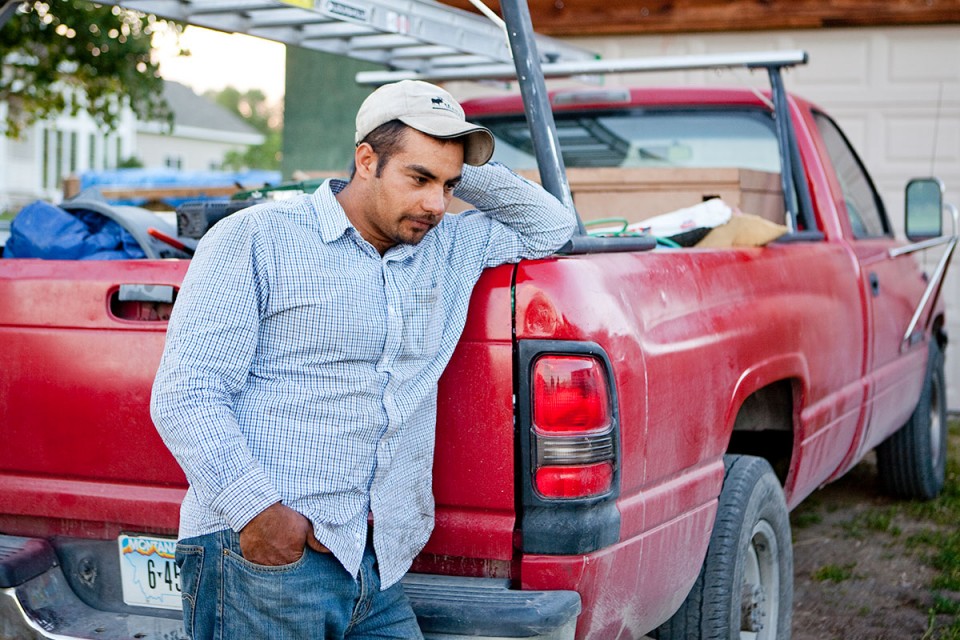
Jose Rios, 26, from the state of Durango in Mexico, reflects on his day's work after arriving at his home in Belgrade on Monday, June 25. Rios, who arrived to the United States at 16, is now a naturalized U.S. citizen and has started his independent contractor business working in different kinds of construction in all of Montana.
Jose Rios came to the United States to escape the violence of his country.
“Mexico started being really bad, dangerous,” said Rios, 26. “A lot of drug dealings, kidnappings. That’s really bad for honest people who try to make a living there.
“I feel a lot more safe here in the United States.”
As a 16-year-old, Rios came to America with his uncle, first living in Colorado before moving to Montana about six years ago. He follows in his family’s footsteps; Rios had a great-uncle who worked as a miner in Butte decades before.
“I came here to work with a masonry company from Colorado,” Rios said. “I stayed here because I really like it here. I like the view and the outdoors activities. There is no crime. It is really nice.”
Rios became a U.S. citizen about two years ago. He owns his own business, employing two others doing residential roofing and framing across Montana, from Bozeman to Billings.
Language was a bit of a barrier at first for Rios, he said. He learned to write English in school in Mexico, but “I didn’t know how to speak it.”
Rios attended high school for a bit in the United States and learned most of the language. He’s continuing to learn here, taking English classes in Bozeman. He hopes to get his GED and attend college in the future, possibly studying construction management.
He said while he hasn’t had a problem with the vast majority of people in Montana, some people have treated him differently because of the color of his skin and his accent.
“Like they say, here you are illegal until you prove it,” Rios said. “And that’s very un-American.
“I run into a lot of nice people, but sometimes there is some racist people,” Rios said. “There is good people and bad people anywhere.”
Rios is one of a growing number of Latino immigrants who make their homes in Montana communities.
Nationwide, the Latino population continues to explode. Latinos make up 16 percent of the U.S. population, which is up from 13 percent in 2000, according to the U.S. Census Bureau. The Hispanic population increased by 15.2 million between 2000 and 2010, accounting for half of the increase in total U.S. population.
Montana followed the national trend, seeing the Hispanic population grow by 45 percent, going from comprising 2 percent of the state’s population to 2.9 percent.
According to 2010 U.S. Census data, Latinos are the largest minority in Gallatin County, accounting for more than 2.7 percent of the population — 2,470 people.
Latinos are the second largest minority population in Montana behind Native Americans. In 2010, when Montana’s population was about 989,400, there were about 28,500 Latinos living in the state.
Yellowstone County has the largest Latino population in Montana with just shy of 7,000. Missoula County is second with 2,800, followed by Cascade County with 2,711.
U.S. Census data does not break down the Latino population based on legal status. The number of illegal immigrants is unknown.
Bethany Letiecq is an associate professor of community health at Montana State University in the health and human development department. Her research has focused on the health and welfare of Mexican migrants in Montana.
“We’re not exactly the hub of Mexican migration,” Letiecq said. “We have seen a huge growth, but the numbers are very small.”
Jobs immigrants take in Gallatin County, and across the state, are typically what Letiecq describes as high-skill and low-education jobs, predominantly construction and agricultural positions.
Rural states like Montana have seen the fastest growth in immigrant communities, Letiecq said. Crime rates are lower, and populations and the land are more similar to where immigrants are coming from.
“The land and the sense of place I think resonate with people,” Letiecq said.
Montana’s beautiful landscapes and bountiful outdoor recreational opportunities, the qualities that bring people from all across the United States, are the same qualities that also attract people from outside our borders.
“They are coming here because of the high quality of life that attracts all of us here,” Letiecq said. “That is drawing a lot of people here. Montana is historically a great state that welcomes people who are immigrating here.”
Will growth of Latino immigrants in Montana continue in the future? That all depends, Letiecq said. Immigration trends are closely related to economic trends, she said.
“If the economy improves, I anticipate we will see people of all classes and shades of color coming to Montana to work because we are trying to grow our economy.”
Whitney Bermes can be reached at wbermes@dailychronicle.com or 582-2648.
The immigrants among us - The Bozeman Daily Chronicle: ImmigrationJoin our efforts to Secure America's Borders and End Illegal Immigration by Joining ALIPAC's E-Mail Alerts network (CLICK HERE)


 Reply With Quote


WATCH: Brussels BURNS as RIOTS spread in HEART of EU with...
10-11-2026, 08:00 PM in Videos about Illegal Immigration, refugee programs, globalism, & socialism