

Results 1 to 1 of 1
Thread Information
Users Browsing this Thread
There are currently 1 users browsing this thread. (0 members and 1 guests)
 LinkBack URL
 About LinkBacks
-
10-02-2026, 03:06 AM #1Senior Member


- Join Date
- Aug 2018
- Posts
- 97,862
ICE posts 50,925 arrests in August — and 5,000 more agents are coming: report
Latin Times
50.7K Followers
ICE posts 50,925 arrests in August — and 5,000 more agents are coming: report
Story by Clara Espinoza
• 13h • 6 min read
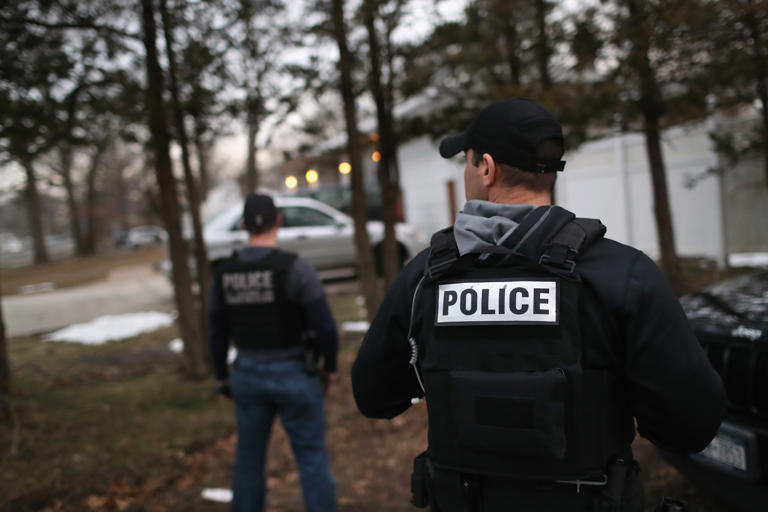
HSI ICE agents detain a suspected MS-13 gang member and Honduran immigrant during Operation Matador, a federal effort targeting transnational gangs on Long Island.© Photo by John Moore/Getty Images
The Briefing:
- ICE's current workforce stands at approximately 29,000 — a new 5,000-person hiring drive targeting a December completion date would push that total to roughly 34,000, a 17% expansion financed through new congressional appropriations
- DHS has formally designated 11 states plus Washington D.C. as enforcement surge targets, including California, Illinois, and New York, home to the country's largest concentrations of Latino families
- Official DHS figures show ICE recorded 50,925 arrests in August 2026 — its third consecutive record-breaking month — after posting 50,208 in July and 43,900 in June
- All persons in the United States, regardless of immigration status, hold Fifth Amendment due-process protections and are not required to answer any questions about their citizenship or how they entered the country
For three consecutive months, Immigration and Customs Enforcement has set a new arrest record, and the Trump administration signaled this week it has every intention of continuing that trajectory. The agency is preparing a second major staffing surge, aiming to add 5,000 officers before the year ends. Simultaneously, DHS launched a targeted crackdown inside the sanctuary states where millions of Latino and immigrant families have established their lives — a combination of scale and geography that creates immediate, concrete risk for mixed-status households in New York, Los Angeles, and Chicago right now.
An Enforcement Machine Built to Keep Accelerating
The Department of Homeland Security confirmed that ICE recorded 50,925 arrests in August 2026 — the single highest monthly total in the agency's history. DHS Secretary Markwayne Mullin, who took office in late March after the departure of Kristi Noem, confirmed the milestone publicly, describing it as evidence that the administration was following through on its enforcement commitments. June's total had reached 43,900, and July pushed that to 50,208, before August set the new peak. The agency is currently averaging roughly 1,600 arrests per day, more than double the daily rate from the opening months of Trump's second term.
Into that already elevated climate comes the announcement of another staffing expansion. According to the New York Times investigation published September 29, 2026, ICE plans to bring aboard 5,000 additional employees before the end of December. Most of those recruits are expected to enter the Enforcement and Removal Operations division — the arm of the agency responsible for tracking, arresting, detaining, and deporting people. Adding 5,000 officers to ICE's current headcount of approximately 29,000 would bring the total to roughly 34,000, a 17% expansion.
 Related video: ICE agents recruitment & immigration enforcement in the US (Oneindia - Video)
View on Watch
Oneindia - Video
ICE agents recruitment & immigration enforcement in the US\
Duration 2:17
A Hiring Push With a Troubled Recent History
The planned drive is explicitly described by DHS as a second wave — the first having already transformed the agency's size. When Trump took office in January 2025, ICE employed roughly 10,000 personnel. The One Big Beautiful Bill, signed into law on July 4, 2025, allocated approximately $30 billion toward ICE recruitment and operations as part of a broader immigration enforcement package. A subsequent congressional reconciliation package pushed total legislative investment in immigration enforcement above $100 billion across the two multi-year measures. The original hiring goal was 10,000 new officers, but the agency exceeded that target: more than 12,000 new personnel were confirmed by January 2026, nearly doubling the force to 22,000 before continued growth brought the current count to approximately 29,000.
That rapid buildup came with documented problems. Earlier in Trump's second term, hundreds of newly hired officers were dismissed or resigned after reports emerged that some candidates had been cleared with little to no background investigation. In one widely cited case, an investigative journalist documented receiving a conditional job offer following a six-minute interview and a drug test. ICE processed more than 220,000 applications during that phase. DHS has pledged more thorough vetting for the incoming recruits, but independent experts have noted publicly that meaningful screening of thousands of candidates in under 90 days presents a significant logistical challenge.
White House Deputy Chief of Staff Stephen Miller, recognized as the principal architect of the administration's immigration enforcement agenda, has publicly pressed for ICE to reach at least 3,000 arrests per day — a target the agency has not yet consistently achieved at the current pace of approximately 1,600 daily.
The 11 States and Washington D.C. Now Under Coordinated Pressure
DHS launched an enforcement surge specifically targeting jurisdictions it classifies as sanctuary locations — states and localities where local law limits cooperation between municipal police and federal immigration agents. The Department of Justice's formal sanctuary jurisdiction list, published in August 2025, names California, Colorado, Connecticut, Delaware, Illinois, Minnesota, New York, Oregon, Rhode Island, Vermont, and Washington state, alongside Washington D.C. and dozens of individual counties and cities.
According to The Hill, ICE officials characterized the operation as focused on people with criminal records who had been freed from local custody in defiance of federal detainer requests. Those same officials indicated that agents would pursue any undocumented person they encountered in the process, not exclusively those with prior convictions. The real-world reach of that approach was illustrated clearly on September 20, when Associated Press reporting confirmed that a U.S. citizen in Evanston, Illinois — a Chicago suburb about 12 miles north of the downtown core — was taken to the ground, left bloodied, and transported by ambulance after ICE agents conducting a fugitive investigation confused him with their intended target. He was released after his citizenship was confirmed; the agents left the scene immediately, citing concerns about bystanders who had gathered.
What the Arrest Statistics Actually Show
The administration has consistently portrayed its enforcement campaign as one directed primarily at dangerous criminals. The data collected independently of DHS tells a more complicated story. NPR's analysis of figures that ICE provided directly to the Deportation Data Project — a joint research initiative of UCLA and UC Berkeley School of Law — found that more than 74,000 people arrested during the first nine months of Trump's second term had no criminal record of any kind. That total represents more than one in three of all ICE arrests during the period studied.
That data carries direct implications for the communities in the named enforcement states. A Center for American Progress analysis identified approximately 4.7 million mixed-status households across the country — homes where at least one undocumented family member lives alongside U.S. citizens or lawful permanent residents. The total number of people living in those households reaches roughly 16.7 million. In New York, Los Angeles, and Chicago — three of the cities under the most concentrated enforcement pressure — community health organizations and schools have documented sharp drops in clinic attendance, classroom enrollment, and cooperation with local police, effects that fall on documented residents as heavily as on the undocumented.
Know Your Rights: What the Law Guarantees in an ICE Encounter
The Fifth Amendment to the U.S. Constitution guarantees due-process protections to all persons within U.S. borders, citizens and noncitizens alike. Legal advocacy organizations confirm the following rights apply regardless of immigration status:
You are not required to open your door. Unless agents present a judicial warrant — a document signed by a federal judge — they do not have the legal authority to enter a private home by force. An administrative warrant issued by DHS, which does not carry a judge's signature, does not meet that standard.
You have the right to remain silent. No law requires you to answer questions about where you were born, how you entered the country, or what your immigration status is.
You may film ICE activity that is occurring in a public space.
If you are detained, immediately request to speak with an attorney and do not sign any document — even one an agent says will speed up your release — without first consulting legal counsel.
Hotlines and Resources / Líneas de Ayuda y Recursos
National · Nacional
National Lawyers Guild — ICE activity hotline (free, multilingual, unmonitored): 1-844-363-1423
New York · Nueva York
NYC Mayor's Office of Immigrant Affairs (MOIA) — multilingual Know Your Rights materials and legal support hotline. Immigration status is not required to access any MOIA services.
Chicago · Chicago
Illinois Coalition for Immigrant and Refugee Rights (ICIRR) — bilingual rapid-response hotline, reports ICE sightings by ZIP code: 855-435-7693
California · California
San Francisco ICE Activity Hotline: 415-200-1548 | Immigrant Legal Resource Center (ILRC) — statewide Know Your Rights guides in multiple languages
Colorado · Colorado
Colorado Immigrant Rights Coalition (CIRC) — bilingual, 24/7 rapid-response hotline: 844-864-8341
ICE posts 50,925 arrests in August — and 5,000 more agents are coming: reportIf you're gonna fight, fight like you're the third monkey on the ramp to Noah's Ark... and brother its starting to rain. Join our efforts to Secure America's Borders and End Illegal Immigration by Joining ALIPAC's E-Mail Alerts network (CLICK HERE)



 Reply With Quote
Similar Threads
-
Donald Trump Says That A Great Depression Is Coming. He Is Right. August 6, 2024
By Airbornesapper07 in forum Other Topics News and IssuesReplies: 0Last Post: 08-11-2024, 10:58 PM -
New Michael Jaco: Mass Arrests Coming! Are Arrests Coming for the DS Politicians or W
By Airbornesapper07 in forum Other Topics News and IssuesReplies: 0Last Post: 07-27-2024, 03:53 PM -
Jim Willie Special Report: Says Arrests Are Coming and Replacement Clones Are All Rea
By Airbornesapper07 in forum Other Topics News and IssuesReplies: 0Last Post: 03-13-2022, 03:33 AM -
The End Of Biden Will Be Coming Soon! - On The Fringe Must Video Monday, August 30, 2
By Airbornesapper07 in forum Other Topics News and IssuesReplies: 0Last Post: 08-30-2021, 08:09 PM -
MCSO arrests hotel manager after August raid
By JohnDoe2 in forum illegal immigration News Stories & ReportsReplies: 1Last Post: 10-02-2011, 02:36 AM


US judge rules law criminalizing noncitizen voting is...
10-03-2026, 02:09 AM in Non-Citizen & illegal migrant voters