

Results 1 to 3 of 3
Thread: Bees Dying by the Millions
Thread Information
Users Browsing this Thread
There are currently 1 users browsing this thread. (0 members and 1 guests)
 LinkBack URL
 About LinkBacks
Threaded View


-
07-13-2013, 10:57 AM #1Banned

- Join Date
- Jun 2013
- Posts
- 8,506
Bees Dying by the Millions
Bees Dying by the Millions
July 8th, 2013ThePost (Hanover, Ontario)
By Jon Radojkovic
ELMWOOD - Local beekeepers are finding millions of their bees dead just after corn was planted here in the last few weeks. Dave Schuit, who has a honey operation in Elmwood, lost 600 hives, a total of 37 million bees.
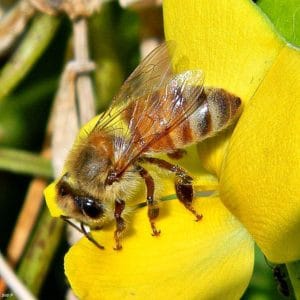 Image source:
Bob Peterson, Wikimedia
“Once the corn started to get planted our bees died by the millions,” Schuit said. He and many others, including the European Union, are pointing the finger at a class of insecticides known as neonicotinoids, manufactured by Bayer CropScience Inc. used in planting corn and some other crops. The European Union just recently voted to ban these insecticides for two years, beginning December 1, 2013, to be able to study how it relates to the large bee kill they are experiencing there also.
Local grower Nathan Carey from the Neustadt, and National Farmers Union Local 344 member, says he noticed this spring the lack of bees and bumblebees on his farm. He believes that there is a strong connection between the insecticide use and the death of pollinators.
“I feel like we all have something at stake with this issue,” he said. He is organizing a public workshop and panel discussion about this problem at his farm June 22 at 10 a.m. He hopes that all interested parties can get together and talk about the reason bees, the prime pollinators of so any different plant species, are dying.
At the farm of Gary Kenny, south west of Hanover, eight of the 10 hives he kept for a beekeeper out of Kincardine, died this spring just after corn was planted in neighbouring fields.
What seems to be deadly to bees is that the neonicotinoid pesticides are coating corn seed and with the use of new air seeders, are blowing the pesticide dust into the air when planted. The death of millions of pollinators was looked at by American Purdue University. They found that, “Bees exhibited neurotoxic symptoms, analysis of dead bees revealed traces of thiamethoxam/clothianidin in each case. Seed treatments of field crops (primarily corn) are the only major source of these compounds.
Local investigations near Guelph, led to the same conclusion. A Pest Management Regulatory Agency investigation confirmed that corn seeds treated with clothianidin or thiamethoxam “contributed to the majority of the bee mortalities” last spring.
“The air seeders are the problem,” said Ontario Federation of Agriculture director Paul Wettlaufer, who farms near Neustadt. This was after this reporter called John Gillespie, OFA Bruce County president, who told me to call Wettlaufer. Unfortunately, Wettlaufer said it was, “not a local OFA issue,” and that it was an issue for the Grain Farmers of Ontario and representative, Hennry Vanakum should be notified. Vanakum could not be rached for comment.
Yet Guelph University entomologist Peter Kevan, disagreed with the EU ban.
“There’s very little evidence to say that neonicotinoids, in a very general sense, in a broad scale sense, have been a major component in the demise of honeybees or any other pollinators, anywhere in the world,” said Kevan.
But research is showing that honeybee disorders and high colony losses have become a global phenomena. An international team of scientists led by Holland’s Utrecht University concluded that, ”Large scale prophylaxic use in agriculture, their high persistence in soil and water, and their uptake by plants and translocation to flowers, neonicotinoids put pollinator services at risk.” This research and others rsulted in the Eurpean Union ban.
The United Church is also concerned about the death of so many pollinators and has prepared a “Take Action” paper it’s sending out to all its members. The church is basing its action on local research. The Take Action paper states among other things, “Scientific information gathered suggests that the planting of corn seeds treated with neonicotinoids contributed to the majority of the bee mortalities that occurred in corn growing regions of Ontario and Quebec in Spring 2012.”
Meanwhile Schuit is replacing his queen bees every few months now instead of years, as they are dying so frequently. “OMAFRA tells me to have faith. Well, I think it’s criminal what is happening, and it’s hard to have faith if it doesn’t look like they are going to do anything anyway,” Schuit says.
http://www.cornucopia.org/2013/07/be...-the-millions/
For more information on these chemicals I did a search and found this information plus what I am bringing down below this link:
https://startpage.com/do/metasearch.pl
EU Proposes Ban on Neonicotinoids; Syngenta, Bayer Respond
Restrictions on imidacloprid, thiamethoxam, clothianidin expected by July 1.
February 4, 2013
By Jackie Pucci
-
 The ban includes neonicotinoid seed treatments on oil seed rape fields such as this one in Neubrandenburg, Germany.
Bayer CropScience
The European Union proposed a two-year ban on imidacloprid, thiamethoxam and clothianidin on crops attractive to honey bees, a move prompted by a European Food Safety Authority (EFSA) report that identified risks to the bees.
The Commission also wants to prohibit the sale and use of seeds treated with plant protection products containing these active substances, according to a Jan. 31 proposal at a meeting of the Standing Committee on the Food Chain and Animal Health.
The Commission asked member states to put in place a two-year suspension on clothianidin, imidacloprid and thiamethoxam as granules, seed treatment or sprays on maize, oil seed rape, sunflowers, cotton and cereals (except for winter cereals). The regulation is expected to be implemented by July 1.
“These are proportionate measures. We are giving the member states two years to see whether it’s working. Then we will see if we need to review the legislation in Europe,” the Commission’s spokesperson for health and consumer policy, Frederic Vincent, said on Jan. 31 in an article on the Europolitics website.
In its report published Jan. 16, EFSA found that contamination of neonicotinoid-treated crops, neonicotinoid dust exposure, and nectar and pollen exposure contributes to declines in honey bees and weakens their hives. It also identified high risks from exposure to guttation fluid from corn for thiamethoxam.
Syngenta, Bayer React
Basel, Switzerland-based Syngenta, which makes thiamethoxam, said it believes the EFSA “found itself under political pressure to produce a hurried and inadequate risk assessment, which even they acknowledge contains a high level of uncertainty.” A recent study cited by the company showed that without neonicotinoid seed treatment, crop yields would fall by 40% and cost the EU economy around $23.1 billion over five years.
“Seed treated with thiamethoxam has been used across millions of hectares of European crops for over ten years. When used properly the technology does not damage bee populations and this is why many EU countries have continued to support its use,” Syngenta said.
Bayer CropScience -- the principal manufacturer of imidacloprid -- called the proposal "draconian" and a "missed opportunity to achieve a fair and proportional solution."
Bayer, of Monheim, Germany, requested EU member states "adhere to the principles of proportionality when addressing the Commission’s proposal and refer back to solid science before taking any measures."
The company added: "Any disproportionate action would jeopardize the competitiveness of European agriculture and finally lead to higher costs for food, feed, fiber and renewable raw materials and have an enormous economic impact throughout the whole food chain."
http://www.farmchemicalsinternationa...-bayer-respond


 Reply With Quote


Gov. Hochul Reacts To Homan’s Vow To Send Surge Of ICE Agents To...
06-09-2026, 12:50 PM in illegal immigration News Stories & Reports