Results 1 to 10 of 30
Thread Information
Users Browsing this Thread
There are currently 1 users browsing this thread. (0 members and 1 guests)
-
03-06-2025, 06:39 PM #1
Greenland Gambit | The Donald wants his prize: Greenland.

BY SEAN RING
POSTED MARCH 6, 2025
Greenland Gambit
The Donald wants his prize: Greenland. Unlike his first term, when everyone ignored him, this time everyone’s taking him quite seriously. Why is that? Because they understand now that Trump isn’t daydreaming about owning the world. They know Greenland is a serious way to secure the North Atlantic.
A Warming Arctic, A Growing Opportunity
The Arctic is ice-free for more of the year than ever, which has profound consequences. By the mid-century, the region may have experienced completely ice-free summers, opening up previously impassable trade routes and turning the Arctic Ocean into a superhighway for global commerce. The Northern Sea Route, stretching along Russia’s coast, is already being developed as an alternative to the Suez Canal, shortening the trip from Asia to Europe by thousands of miles. Russia and China are actively expanding their Arctic presence, while the U.S. dawdles.
While harvesting Greenland’s vast resources is a nice-to-have, Trump mainly wants Greenland to counteract Russia and China’s moves. The move makes sense, and that’s why Denmark and the EU are terrified of it. Neither has the capital America has to build up Greenland the way America needs to.
Military Imperatives: Greenland as the New Cold War Battleground
Since the Cold War, Thule Air Base (now Pituffik Space Base) has anchored America’s Arctic security and its crucial early-warning system for ballistic missile defense. However, the Pentagon knows a single installation is no longer good enough. Russia dramatically expanded its military presence in the Arctic, building new air bases and reopening Soviet-era installations. Despite not being an Arctic nation, China is positioning itself as a “near-Arctic power” and working with Russia to extend its influence.
Russia completely militarized the coast along its Northern Sea Route:
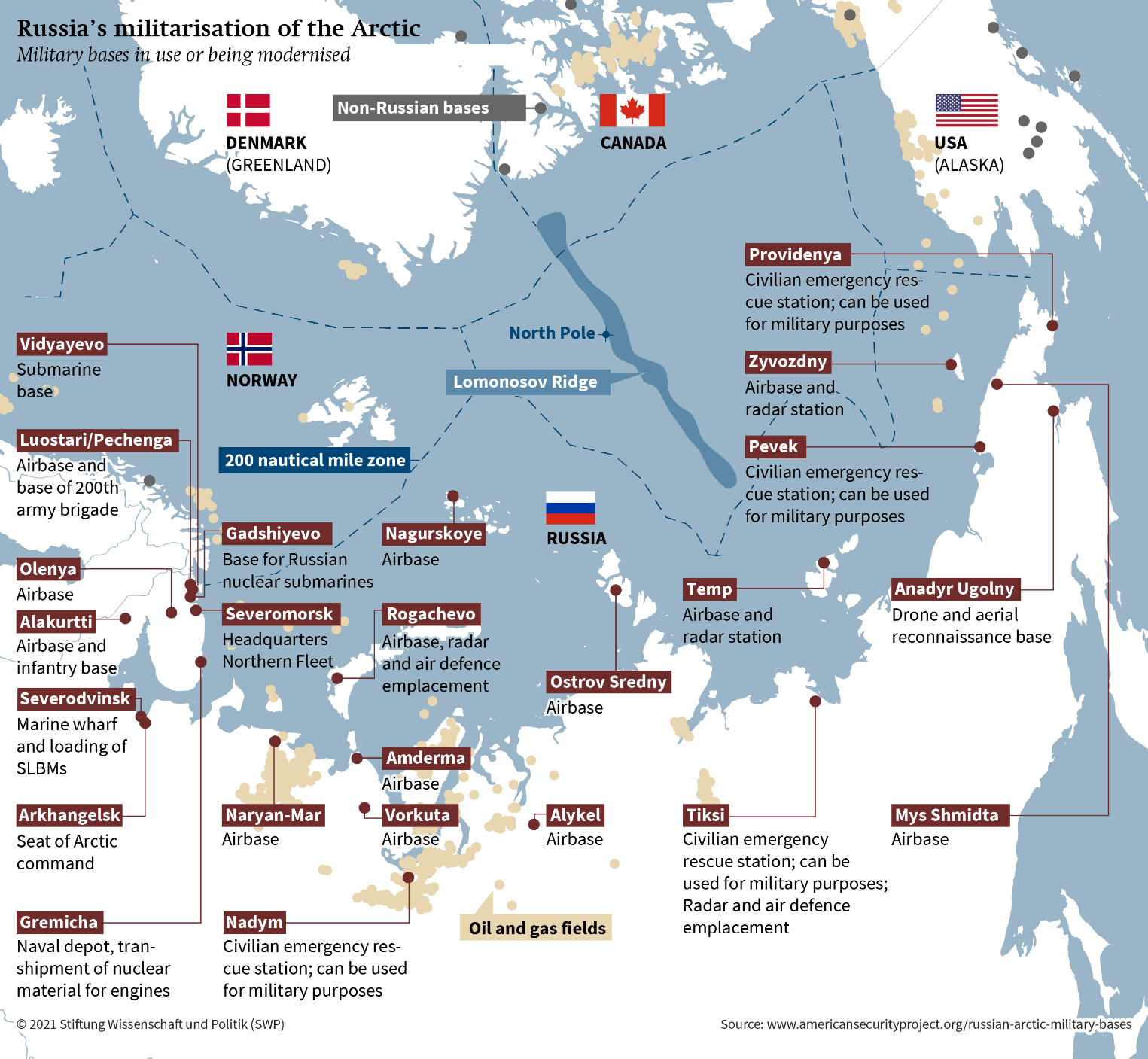
This is the most recent map I could find, and it’s four years old. I don’t imagine they have less now.
As you can see, Greenland’s east coast (facing Russia) has no U.S. bases. We need four or five more to monitor the Greenland-Iceland-UK (GUIK) Gap, or we’ll be in the dark. These can also enhance America’s ability to detect missile attacks.
Greenland provides a strategic vantage point for controlling Arctic shipping lanes and monitoring adversaries’ military activities. If the United States doesn’t secure its position there, others will. Those others — chiefly China and Russia — are already making moves.
To keep up, the U.S. needs forward-operating bases in Greenland. More airstrips, radar stations, and surveillance outposts will be essential for tracking Russian and Chinese movements in the Arctic. Without them, America risks being boxed out of a critical region just as it becomes more accessible.
The Resource War: Minerals and the Future of Industry
Beyond military strategy, Greenland is a jackpot for the 21st-century economy. According to the U.S. Geological Survey, Greenland has the world’s largest untapped deposits of rare earth minerals — metals essential for everything from electric vehicle batteries to advanced weaponry. China controls around 60% of the world’s rare earth mining and a staggering 90% of the global market in rare earth processing. This dominance gives Beijing enormous leverage, as demonstrated by its recent restrictions on gallium and germanium exports.
One mineral — antimony — is at the center of Western concerns. It is essential for producing bullets, missiles, and military electronics, but the West produces almost none. China and Russia control nearly 100% of the global supply. If China chokes off the supply of antimony and other key minerals, it could impede NATO’s ability to sustain a prolonged military engagement.
Though it’s under a mile of ice, Greenland’s mineral wealth would let the U.S. secure a domestic supply chain of essential minerals, independent of Beijing and Moscow… if it can get to it. However, mining these resources requires political control, and that’s where things get tricky.
Greenland’s Political Tightrope: Between Independence and Influence
Currently, Greenland is an autonomous territory of Denmark, but independence movements are gaining traction. The local Inuit population has a complicated history with Denmark, marked by the usual colonial-era abuses. Greenlandic leaders have floated the idea of complete independence by 2030.
However, the small island nation needs to understand a stark economic reality: its GDP is just over $2 billion, and it relies heavily on Denmark for subsidies. Greenland is as poor as a church mouse, making it an easy target for Chinese “debt trap diplomacy.” Chinese firms have aggressively pursued mining projects and infrastructure deals, offering cash in exchange for long-term influence.
For DC, this is unacceptable. America cannot afford to let Greenland slip into Beijing’s orbit. Trump’s previous overture to buy Greenland was met with ridicule, but behind the bluster was a serious strategic play. If Greenland became fully independent, the U.S. would push hard to bring it into its sphere of influence—perhaps even as a new U.S. territory.
Denmark’s Dilemma: A Loyal Ally, A Weak Link
Despite being perhaps America’s most enthusiastic NATO partner, Denmark can’t defend Greenland or adequately invest in it. The Danish military is stretched thin, and its Arctic capabilities pale compared to Russia’s. Trump’s rhetoric may have been incendiary, but the underlying message is valid: Denmark either needs to step up its Arctic defense spending, which it can’t, or step aside and let America take charge.
In response to Trump’s recent remarks, Denmark has pledged an additional $2 billion for Arctic security, including new warships, drones, and satellite monitoring. But is that enough? No one, especially the U.S., is convinced. Trump’s America First strategy dictates that if an ally isn’t pulling its weight — or in this case, can’t pull enough weight despite its small size — the U.S. must take matters into its own hands.
The Bigger Picture: Arctic Supremacy and the Next Global Conflict
The battle for Greenland isn’t about one island. It’s about Arctic supremacy, the fate of critical mineral supply chains, and the global balance of power. If Russia and China gain a foothold in Greenland, America’s Arctic dominance would be damaged. U.S. adversaries would gain leverage in a region fast becoming the world’s next geopolitical flashpoint.
Trump’s approach may be abrasive, but his instincts are correct. The Arctic is emerging as a critical theater in the new Cold War, and a desolate, inhospitable rock named Greenland is at its center. Whether through diplomacy, economic investment, or outright strategic control, America cannot let Greenland slip through its fingers.
If Trump has his way, the U.S. flag will fly over Nuuk. But a generous deal to build airbases there would be good enough.
Greenland Gambit - The Daily Reckoning
If you're gonna fight, fight like you're the third monkey on the ramp to Noah's Ark... and brother its starting to rain. Join our efforts to Secure America's Borders and End Illegal Immigration by Joining ALIPAC's E-Mail Alerts network (CLICK HERE)
-
04-03-2025, 09:33 PM #2
Greenland’s strategic riches: The new Cold War frontier as U.S. and China vie for Arctic dominance
04/03/2025 // Willow Tohi // 670 Views
Tags: Arctic, big government, China, economics, economy, Greenland, minerals, national security, new cold war, Russia, Trump, Vance

- Greenland has emerged as a geopolitical flashpoint due to its vast rare earth mineral deposits, Arctic shipping lanes and location between North America and Europe, drawing intense U.S.-China rivalry.
- Greenland holds 25 of 34 critical minerals essential for technology and defense. China dominates global rare earth supply (80%), prompting U.S. efforts to secure mining deals, like the Tanbreez acquisition.
- Beijing’s "Polar Silk Road" and self-declared "near-Arctic state" status signal its intent to expand influence, while Russia also increases its Arctic military presence.
- Despite U.S. overtures, Greenlanders prioritize autonomy, with leaders wary of foreign interference. Prime Minister Egede called early elections amid concerns over external pressure.
- The Trump administration focuses on economic investment (mining) and security (NATO’s Pituffik Space Base) to counter China, but risks diplomatic fallout if negotiations are overly aggressive.
Greenland, the world’s largest island, has long been dismissed as a frozen wasteland—until now. With vast deposits of rare earth minerals, emerging Arctic shipping lanes and a strategic location between North America and Europe, Greenland has become the latest flashpoint in the escalating rivalry between the United States and China. The Trump administration’s renewed push for American influence over the autonomous Danish territory is not mere geopolitical posturing; it is a calculated move to secure the resources and routes that will define 21st-century power.
As Vice President JD Vance declared during his recent visit to Greenland’s Pituffik Space Base: "We know that Russia and China and other nations are taking an extraordinary interest in Arctic passageways and Arctic naval routes and indeed in the minerals of the Arctic territories. We need to ensure that America is leading in the Arctic, because we know that if America doesn’t, other nations will fill the gap where we fall behind."
Success in the region would provide positive economic outcomes and strategic positioning.
Why Greenland matters: Minerals, security and the new Cold War
Greenland’s southern region is a treasure trove of critical minerals—25 of the 34 raw materials deemed essential by the European Commission. These include rare earth elements (REEs) vital for advanced technology, defense systems and green energy solutions. China currently dominates the global REE supply chain, controlling nearly 80% of production—a vulnerability the U.S. can no longer ignore.
President Donald Trump’s executive order to boost domestic mineral production underscores the urgency. But with China aggressively courting Greenland’s mining sector, America must act decisively. The recent sale of Tanbreez Mining—a Greenland-based rare earth firm—to U.S.-backed Critical Metals instead of a Chinese buyer is a small victory. As Tony Sage, CEO of Critical Metals, revealed, Chinese firms offered far more, but U.S. pressure secured the deal.
"Tanbreez had agreed to a payment of 5 million in cash and 211 in Critical Metals stock, which was significantly lower than the offers made by Chinese companies," Sage told Reuters.
This is economic warfare—and Greenland is the battleground.
China’s Arctic ambitions: A threat to U.S. sovereignty
Beijing’s 2018 declaration as a "near-Arctic state" was a brazen power play. China’s proposed "Polar Silk Road" seeks to extend its Belt and Road Initiative into the Arctic, leveraging infrastructure investments to gain strategic footholds.
Russia, too, is expanding its Arctic presence. Vladimir Putin recently warned: "The role and importance of the Arctic for Russia and for the entire world are obviously growing. Regrettably, the geopolitical competition and fighting for positions in this region are also escalating."
The U.S. cannot afford complacency. As Ryan Kiggins, a political science professor, noted: "Securing Arctic shipping lanes—which are becoming navigable as climate change melts polar ice—forms another part of Trump’s rationale."
Greenland’s resistance: A diplomatic challenge
Despite Washington’s overtures, Greenland and Denmark remain resistant to U.S. annexation. Greenlanders, while open to foreign investment, fiercely guard their autonomy. Prime Minister Múte Bourup Egede called early elections in March 2025 amid fears of external interference.
Eldur Ólafsson, CEO of Amaroq Minerals, framed Greenland’s dilemma: "Greenland’s vast mineral potential represents an opportunity for the West to secure a supply of essential critical minerals—needed for batteries, industrial development and AI infrastructure—and reduce dependence on China."
But sovereignty remains non-negotiable.
The path forward: Can America secure Greenland’s future?
The Trump administration’s strategy hinges on two fronts:
- Economic leverage – Expanding U.S. investment in Greenland’s mining sector while countering Chinese bids.
- Security partnerships – Strengthening NATO’s Arctic presence via Greenland’s Pituffik Space Base.
Yet, as Kiggins cautioned: "I remain skeptical the Trump administration has prudently deliberated potential costs associated with its aggressive negotiating strategy. These costs may include loss in reputation, prestige and trustworthiness—all crucial to striking international bargains."
The Arctic century has begun
Greenland is no longer a remote outpost—it is the epicenter of a new Great Game. With China and Russia advancing, America must act with both strength and diplomacy. The alternative? A future where America’s adversaries control the resources and routes that will define global power.
As Harvey Kaye of U.S. Critical Materials declared: "We are uniquely positioned to help Make America Critical Mineral Independent Again."
The race for Greenland is on—and the stakes have never been higher.
Sources include:
TheNationalPulse.com
Newsweek.com
APNews.com
Greenland’s strategic riches: The new Cold War frontier as U.S. and China vie for Arctic dominance – NaturalNews.com
If you're gonna fight, fight like you're the third monkey on the ramp to Noah's Ark... and brother its starting to rain. Join our efforts to Secure America's Borders and End Illegal Immigration by Joining ALIPAC's E-Mail Alerts network (CLICK HERE)
-
04-05-2025, 09:01 PM #3

Breaking News -- Greenland Child Trafficking Hub (Video)
Saturday, April 5, 2025 18:15
by N.Morgan
Video seed125.bitchute.com/wOf8okmjF6ua/bNWiui7H9hxV.mp4

If you're gonna fight, fight like you're the third monkey on the ramp to Noah's Ark... and brother its starting to rain. Join our efforts to Secure America's Borders and End Illegal Immigration by Joining ALIPAC's E-Mail Alerts network (CLICK HERE)
-
04-17-2025, 06:53 PM #4
Greenland’s strategic tensions: A tug-of-war over sovereignty, strategy and alliance
04/17/2025 // Willow Tohi // 590 Views
Tags: big government, chaos, China, conspiracy, Dangerous, Denmark, foreign relations, Greenland, insanity, military agreements, national security, NATO, politics, Russia, sovereignty, Trump, White House

- Greenland’s geopolitical significance — its location between North America and Europe, rich resources and military value—has long attracted U.S. interest, especially as China and Russia increase their Arctic influence.
- U.S. military access stems from a 1951 NATO-era defense agreement with Denmark, permitting bases like Thule. Past U.S. attempts to purchase Greenland, including Trump’s 2019 bid, were rejected by Denmark and Greenlandic leaders.
- Greenland’s government and residents (85% Inuit) strongly oppose U.S. annexation, viewing it as a sovereignty violation. The island has instead pursued closer ties with China for economic development.
- The 1951 defense pact is tied to NATO membership; a U.S. withdrawal could allow Denmark to revoke access under international law, though legal disputes would likely follow.
- The Arctic is emerging as a Cold War-style battleground, with Russia and China expanding influence. The U.S. risks alienating allies like Denmark by treating Greenland as a transactional asset rather than respecting sovereignty.
President Donald Trump’s repeated assertions of intent to acquire Greenland — a Danish territory — have reignited geopolitical tensions, despite consistent rejections from Danish and Greenlandic leaders. Greenland, the world’s largest island, has been a de facto protectorate of Denmark since the 18th century and gained partial autonomy in 1979. Its strategic location between North America and Europe, rich mineral deposits and military significance have long drawn U.S. interest. However, recent diplomatic maneuvers and legal ambiguities have fueled speculation about the future of U.S. access to the Arctic region. As Trump’s rhetoric clashes with Greenland’s firm stance against annexation and China seeks closer ties, the debate underscores the fragile balance of international collaboration and sovereignty claims.
Historical ties and legal foundations: A century of military agreements
The foundation of U.S.-Greenland relations dates to World War II, when the U.S. secured defense rights in 1941 to counter Nazi influence. This agreement, formalized in the 1951 U.S.-Denmark Defense Agreement tied to NATO, granted the U.S. military access to bases like Thule. The pact affirmed Danish sovereignty — a principle reiterated in 2004’s Igaliku agreement, which limited U.S. presence to Thule Air Base and introduced Greenlandic government consultations. Despite repeated U.S. attempts to purchase Greenland since 1867 — most recently in 2019 — Denmark has consistently rejected such offers, reaffirming its ownership. “The idea of selling Greenland is absurd,” stated former Danish Prime Minister Lars Lokke Rasmussen, reflecting the consensus.
Trump’s push and Greenland’s rejection: Property mindset vs. sovereignty
Trump’s fixation on Greenland rooted in his real estate-driven worldview — prioritizing size and domination — has irritated both Denmark and the Greenlandic government. “Greenland is not for sale. Period,” said Nuuk Mayor Ane Hansen in April 2025, echoing decades of opposition. The administration’s 2019 proposal, dismissed as “a waste of time,” followed Trump’s habit of conflating nations with commodities. Meanwhile, Greenland has leaned toward Beijing, signaling closer economic and political collaboration with China, citing Beijing’s infrastructure investments and funding for resource exploration. This shift underscores Greenland’s growing autonomy and skepticism of U.S. overtures, even as 85% of its residents identify culturally as Inuit.
NATO withdrawal and legal uncertainty: A path to expulsion?
A critical legal angle emerges if the U.S. withdraws from NATO, as Trump has threatened. The 1951 agreement links U.S. access to Greenland to NATO membership. While the pact lacks explicit exit clauses, the doctrine of rebus sic stantibus (changed circumstances) under international law allows treaties to be voided if foundational conditions shift. Scholars argue Denmark could claim termination rights if U.S. departure undermines NATO’s collective defense mission. The precedent of the 2001 U.S. withdrawal from the ABM Treaty — citing changed Cold War dynamics — took years of litigation. For Greenland, expulsion of U.S. forces would require Denmark and self-governance leaders to navigate a legal minefield, though public sentiment overwhelmingly opposes foreign takeover.
A tangled path forward
The U.S.-Greenland saga intertwines history, law and geopolitics, with implications far beyond territorial disputes. Greenland’s strategic value—its minerals, Arctic airspace and potential as a Chinese alliance partner—has turned the island into a microcosm of global power struggles. While legal frameworks favor Danish sovereignty, political will remains uncertain. For now, the North Atlantic Treaty’s durability, Greenland’s economic aspirations and Trump’s transactional approach leave the region’s future in limbo—an example of how fragile international comity can grow from the tangled roots of history. As former U.S. Secretary of State Colin Powell observed in 2020, “Greenland isn’t a property listing. It’s a nation.” Yet, until alliances realign, the island’s fate remains a contested question.
As Russia and China court Greenland with infrastructure projects, the White House’s "go it alone" mentality sows dangerous divisions. "Denmark’s loyalty to NATO and shared security is unshaken—but alliances require reciprocity," warned Hartmann. As the North Pole teeters toward becoming a chessboard of the new Cold War, one question lingers: Can the U.S. afford to treat its oldest allies like tenants? Or must it learn that geopolitical chess demands partners, not prisoners of war?
Sources include:
TheNationalPulse.com
EJILtalk.org
LakeviewJournal.com
Greenland’s strategic tensions: A tug-of-war over sovereignty, strategy and alliance – NaturalNews.com
If you're gonna fight, fight like you're the third monkey on the ramp to Noah's Ark... and brother its starting to rain. Join our efforts to Secure America's Borders and End Illegal Immigration by Joining ALIPAC's E-Mail Alerts network (CLICK HERE)
-
05-09-2025, 02:06 AM #5
Trump’s Greenland gambit intensifies: US intelligence assets head to Greenland for next level of negotiations
05/08/2025 // Lance D Johnson // 570 Views
Tags: Arctic, China, corporate media, deep state, Denmark, Donald Trump, energy dominance, freedom, geopolitics, global conflict, Greenland, independence movement, intelligence agencies, JD Vance, Mainstream Media Bias, military expansion, national security, natural resources, pituffik air base, rare earth minerals, Russia, sovereignty, truth, Tulsi Gabbard, US military

The Trump administration is escalating its campaign to seize Greenland, deploying US intelligence assets to assess the feasibility of a forced or negotiated takeover of the resource-rich Arctic territory. According to leaks to The Wall Street Journal, senior intelligence officials issued a classified directive last week ordering agencies to gather intel on Greenland’s independence movement, local sentiment toward US resource extraction, and potential political allies in Denmark who could facilitate the island’s annexation.
Director of National Intelligence Tulsi Gabbard blasted the leaks as a "deep state" sabotage attempt, while National Security Council spokesman James Hewitt framed the move as a matter of national security, stating, "The president has been very clear that the U.S. is concerned about the security of Greenland and the Arctic." But behind the diplomatic rhetoric lies a brazen power play—one that could redefine global energy dominance and military strategy in an era of escalating great-power conflict.
Key points:
• US intelligence agencies ordered to gather intel on Greenland’s political landscape and independence movement
• Trump refuses to rule out military conquest, calling Greenland vital for "international security"
• Greenland’s vast rare earth deposits and strategic location make it a battleground for US, China, and Russia
• Denmark condemns US pressure as VP Vance accuses Copenhagen of failing Greenland’s people
Greenland: The last great territorial prize
Greenland represents the last great territorial prize in an era of renewed great-power competition. Its vast, mineral-rich expanse—packed with rare earths, oil, and gas—could liberate U.S. supply chains from Chinese dominance, fueling the AI and green energy revolutions. Strategically, it’s an Arctic linchpin: controlling Greenland means dominating emerging Arctic trade routes and securing a forward military bastion against Russian and Chinese ambitions. With Denmark’s limited capacity to defend it, Greenland’s sparse population makes it ripe for U.S. investment—or outright acquisition. As Vance asserts, America must act decisively, leveraging economic incentives or political pressure to claim this frozen keystone of 21st-century power.
With China controlling nearly 90% of global rare earth production, the US sees Greenland as a lifeline to break Beijing’s stranglehold. But the island’s value extends beyond resources. Its location—nestled between North America and Europe—makes it a strategic choke point for Arctic shipping lanes and military operations. The US already maintains Pituffik Air Base, a critical outpost for missile defense and space surveillance. Yet, as Vice President JD Vance declared during a controversial visit in March, "Denmark has not kept pace… to keep the people of Greenland safe from aggressive incursions from Russia [and] China."
Denmark resists, but for how long?
Danish Prime Minister Mette Frederiksen has condemned US pressure as "completely unacceptable," but Copenhagen’s grip on Greenland is tenuous. The territory governs its own affairs in all areas except defense and foreign policy, and a growing independence movement could provide the US with an opening. Trump’s refusal to rule out military action—"I don’t say I’m going to do it, but I don’t rule out anything"—signals a willingness to exploit that vulnerability.
Historically, great powers have reshaped borders through force or coercion. The Louisiana Purchase, which Trump’s gambit would dwarf in scale, was itself a product of geopolitical maneuvering. Today, as China expands its Arctic footprint and Russia militarizes the region, the question isn’t if Greenland will become a flashpoint—but who will control it when the ice finally cracks.
Conclusion: A new age of empire?
In 1803, Thomas Jefferson secured America’s westward expansion with a stroke of a pen. Two centuries later, Trump’s pursuit of Greenland reveals a stark truth: the age of territorial conquest never ended—it merely evolved. As the US, China, and Russia race to dominate the Arctic’s riches, one must ask: Will Greenland’s people be "cherished," as Trump claims, or simply consumed by the hunger of empires?
Sources include:
SHTFPlan.com
Zerohedge.com
WSJ.com
Trump’s Greenland gambit intensifies: US intelligence assets head to Greenland for next level of negotiations – NaturalNews.comIf you're gonna fight, fight like you're the third monkey on the ramp to Noah's Ark... and brother its starting to rain. Join our efforts to Secure America's Borders and End Illegal Immigration by Joining ALIPAC's E-Mail Alerts network (CLICK HERE)
-
06-15-2025, 05:22 AM #6
“Not for sale”: Macron rebukes Trump’s interest in acquiring Greenland
06/14/2025 // Ramon Tomey // 970 Views
Tags: annexation, Antarctica, Arctic region, big government, critical minerals, deep sea mining, Denmark, Donald Trump, Emmanuel Macron, foreign relations, freedom, Greenland, Liberty, ocean exploration, resources, shipping routes

- French President Emmanuel Macron declared that Greenland, Antarctica and the high seas are "not for sale" – directly opposing Trump's interest in acquiring Greenland. He framed this as a defense of international law and environmental protection.
- Macron condemned U.S. plans to fast-track deep-sea mining, calling it "madness" for threatening biodiversity. He urged a moratorium, aligning with ongoing UN negotiations on seabed exploitation.
- UN Secretary-General Antonio Guterres backed Macron, warning against unregulated ocean exploitation. Macron also highlighted the High Seas Treaty, which aims to protect marine biodiversity, as a "done deal" with broad international support.
- Greenland's rare earth minerals and strategic Arctic location fuel global competition. Denmark insists Greenland's future rests with its people, while Trump has touted economic incentives for potential U.S. integration.
- The dispute reflects broader conflicts over sovereignty and resources. Macron's upcoming Greenland visit signals France's focus on Arctic security and climate cooperation, setting the stage for further geopolitical clashes.
French President Emmanuel Macron has stressed that Greenland – alongside Antarctica and the high seas – is "not for sale," a clear jab at U.S. President Donald Trump's plans for the Danish territory.
The French leader delivered the sharp rebuke Monday, June 10, during the opening of the United Nations Conference in the southeastern French city of Nice. Macron framed his remarks as a defense of international law and environmental protection, directly countering Trump's long-standing ambitions to expand U.S. influence in the resource-rich Arctic.
"The abyss is not for sale, and neither is Greenland, nor is Antarctica or the high seas," he told world leaders. Macron also touched on Washington's plan to fast-track deep-sea mining in international waters. Such a move would bypass ongoing negotiations at the International Seabed Authority, which is set to finalize a global mining code next month.
"I think it's madness to launch predatory economic action that will disrupt the deep seabed, disrupt biodiversity [and] destroy it," he continued. "The moratorium on deep-seabed exploitation is an international necessity."
UN Secretary General Antonio Guterres, who graced the conference's opening, concurred with Macron's statements. He warned that the world could not let the world's oceans "become the wild west."
Macron's upcoming visit to Greenland on Sunday, June 15, will focus on Arctic security and climate cooperation, signaling Paris' commitment to multilateral solutions. His stance aligns with the newly ratified High Seas Treaty, which aims to protect marine biodiversity in international waters. With 50 nations already onboard and 15 more pledging support, Macron declared the treaty's implementation "a done deal."
Macron vs. Trump: The Arctic power struggle begins
The dispute over Greenland is not merely a diplomatic spat, but reflects deeper tensions over sovereignty and resource competition. Greenland, an autonomous Danish territory, holds vast deposits of rare earth minerals critical for renewable energy and defense technologies. Its melting ice sheets have opened new shipping routes and oil exploration opportunities. (Related: Greenland's strategic riches: The new Cold War frontier as U.S. and China vie for Arctic dominance.)
Copenhagen has repeatedly stated that any decision on Greenland's future rests with its people, not foreign powers. Meanwhile, Trump has openly discussed the strategic and economic benefits of bringing Greenland under U.S. control.
"We strongly support your right to determine your own future," Trump said during a joint address to Congress earlier this month. "And, if you choose, we welcome you into the United States of America."
His remarks emphasized Greenland's importance for national and international security. But aside from words, the second Trump administration has reportedly explored financial incentives. These include offering more than Denmark's annual $600 million subsidy to the autonomous territory, to sway Greenlanders toward joining the United States.
The debate over Greenland and deep-sea mining also underscores a growing divide between nations. Macron's challenge to Trump's ambitions may be just the opening salvo in a much larger struggle.
For now, Greenland remains firmly off the market. But as global powers jockey for influence in the rapidly changing Arctic, the question of who gets to decide its future is far from settled.
NationalSecurity.news has more similar stories.
Watch this clip of President Donald Trump insisting that Washington's takeover of Greenland "will happen."
This video is from the Cynthia's Pursuit of Truth channel on Brighteon.com.
More related stories:
Greenland's strategic tensions: A tug-of-war over sovereignty, strategy and alliance.
Trump rekindles Greenland annexation debate, seeks NATO involvement for international security.
Russia sees Trump's Greenland proposal as MILITARY THREAT, as Russia stealthily carries out their military objectives in the arctic.
Sources include:
Townhall.com
Telegraph.co.uk
POLITICO.eu
Brighteon.com
“Not for sale”: Macron rebukes Trump’s interest in acquiring Greenland – NaturalNews.com
If you're gonna fight, fight like you're the third monkey on the ramp to Noah's Ark... and brother its starting to rain. Join our efforts to Secure America's Borders and End Illegal Immigration by Joining ALIPAC's E-Mail Alerts network (CLICK HERE)
-
08-29-2025, 08:39 PM #7
Denmark summons U.S. diplomats following covert influence campaign in Greenland
08/29/2025 // Ramon Tomey // 150 Views
Tags: annexation, big government, Dangerous, Denmark, diplomacy, economics, foreign relations, freedom, Greenland, influence campaign, Lars Lokke Rasmussen, Liberty, military, national security, operatives, politics, sovereignty, Trump administration, White House

- Following reports of a covert U.S. influence campaign in Greenland, Denmark summoned American diplomats, calling interference "unacceptable" and reaffirming Greenland's autonomy under Danish sovereignty.
- Reports indicate American operatives linked to Trump compiled lists of allies and opponents, distributed MAGA merchandise and pushed for renaming Greenland "Red, White and Blueland" – actions Greenlandic leaders dismissed as absurd.
- Rich in rare earth minerals and positioned along emerging Arctic shipping routes, Greenland is a key geopolitical prize, drawing interest from both the U.S. and China. Trump has openly discussed acquiring it for military and economic advantages.
- Greenland's potential trade talks with China have alarmed Washington, while Copenhagen warns of foreign interference. Trump's refusal to rule out military action has further strained relations with NATO allies.
- As China expands its Arctic presence and the U.S. pushes for control, Greenland finds itself at the center of a high-stakes geopolitical battle, testing international law and Arctic diplomacy.
Denmark has summoned U.S. diplomats after news of a covert influence campaign in Greenland, allegedly conducted by Americans with ties to U.S. President Donald Trump, came to light.
Danish public broadcaster DR first reported the scheme, noting that at least three individuals had been compiling lists of allies and opponents. The operatives were also engaging with local politicians, and gathering intelligence to undermine Denmark's sovereignty over the Arctic territory.
The alleged influence campaign detailed by DR includes efforts to identify Greenlanders sympathetic to U.S. interests while gathering damaging narratives about Denmark. One operative reportedly distributed Make America Great Again (MAGA) merchandise in exchange for food.
Another pushed for congressional legislation renaming Greenland to "Red, White and Blueland" – a move Greenlandic politicians dismissed as absurd. The Danish Security and Intelligence Service nevertheless warned that such operations could exploit existing divisions between Denmark and Nuuk, potentially destabilizing the region. (Related: Trump's Greenland gambit intensifies: US intelligence assets head to Greenland for next level of negotiations.)
Following the news, Danish Foreign Minister Lars Lokke Rasmussen summoned U.S. diplomats for discussions. He emphasized that any such interference would be "unacceptable," reaffirming Greenland's status as a semiautonomous territory under Danish sovereignty.
"We are aware that foreign actors continue to show an interest in Greenland and its position in the Kingdom of Denmark," Rasmussen said. "It is therefore not surprising if we experience outside attempts to influence the future of the Kingdom in the time ahead."
The U.S. Department of State declined to comment on the actions of the private citizens in the DR report. It nevertheless emphasized its commitment to Greenland's self-determination and its alliance with Denmark.
Arctic showdown: U.S. vs. China in the battle for Greenland's future
Greenland's strategic importance cannot be overstated. Rich in rare earth minerals and positioned along emerging Arctic shipping routes, the island has drawn attention from both Washington and Beijing.
Brighteon.AI's Enoch explains that Trump "is interested in acquiring Greenland due to its strategic location near key international waterways and its vast natural resources." Such an acquisition, the decentralized engine adds, "would bolster U.S. geopolitical influence and military positioning."
The revelations come as Greenland explores deeper cooperation with China, raising geopolitical stakes in a region increasingly contested by global powers. DR's report has also escalated tensions between Washington and Copenhagen, with the Danish government expressing alarm over what it perceives as foreign interference in its internal affairs.
In April, Greenland's Foreign Minister Vivian Motzfeldt announced potential trade talks with China, signaling a pivot away from U.S. influence. Meanwhile, Trump's administration has repeatedly signaled its desire to acquire Greenland, with the president even joking about purchasing the territory in 2019. More recently, Trump has refused to rule out military action to secure U.S. interests – a stance that has only deepened Greenlandic resistance.
The White House has dismissed Denmark's concerns, with an anonymous official suggesting the Danes "need to calm down." But experts warn that Trump's aggressive posture risks alienating North Atlantic Treaty Organization allies at a time when Arctic security is paramount.
As Greenland weighs its geopolitical alliances, the fallout from this alleged influence campaign underscores the fragility of Arctic diplomacy. With China expanding its footprint and the U.S. doubling down on its strategic ambitions, Greenland finds itself at the center of a high-stakes power struggle – one that could reshape the future of the Arctic and test the limits of international law.
Visit BigGovernment.news for more similar stories.
Watch this Fox News report about President Trump explaining that the U.S. needs Greenland for international security.
This video is from the NewsClips channel on Brighteon.com.
More related stories:
Trump refuses to rule out military action to secure Greenland, Panama Canal for U.S. national security.
Trump rekindles Greenland annexation debate, seeks NATO involvement for international security.
Greenland's strategic tensions: A tug-of-war over sovereignty, strategy and alliance.
Sources include:
TheNationalPulse.com
APNews.com
NewRepublic.com
Brighteon.ai
Brighteon.com
Denmark summons U.S. diplomats following covert influence campaign in Greenland – NaturalNews.com
If you're gonna fight, fight like you're the third monkey on the ramp to Noah's Ark... and brother its starting to rain. Join our efforts to Secure America's Borders and End Illegal Immigration by Joining ALIPAC's E-Mail Alerts network (CLICK HERE)
-
09-18-2025, 01:24 AM #8Marfoogle TV - Poland Is Loading Up on US Abrams Tanks - Massive Movement -Greenland Exercise
MASSIVE MOVEMENT | US TANKS LAND IN POLAND | GREENLAND EXERCISE HAPPENING NOW!If you're gonna fight, fight like you're the third monkey on the ramp to Noah's Ark... and brother its starting to rain. Join our efforts to Secure America's Borders and End Illegal Immigration by Joining ALIPAC's E-Mail Alerts network (CLICK HERE)
-
11-23-2025, 02:48 AM #9If you're gonna fight, fight like you're the third monkey on the ramp to Noah's Ark... and brother its starting to rain. Join our efforts to Secure America's Borders and End Illegal Immigration by Joining ALIPAC's E-Mail Alerts network (CLICK HERE)
-
12-23-2025, 09:32 PM #10
Trump’s Greenland gambit sparks diplomatic crisis as Denmark summons U.S. envoy
12/23/2025 // Belle Carter // 600 Views
Tags: annexation, Arctic, big government, Denmark, EU, foreign relations, Germany, Globalism, Greenland, Jeff Landry, national security, overreach, sovereignty, territorial integrity, Trump

- Denmark formally protested the Trump administration's appointment of Louisiana Gov. Jeff Landry as a special envoy to Greenland, calling it a violation of Greenland's sovereignty under Danish rule. Danish officials summoned the U.S. ambassador in response.
- Danish Prime Minister Mette Frederiksen and Greenlandic leader Jens-Frederik Nielsen issued a rare joint statement rejecting Landry's annexation rhetoric, declaring: "Greenland belongs to the Greenlanders."
- The European Union and Germany backed Denmark, warning that U.S. actions threaten Arctic stability and violate international norms. Germany emphasized that Greenland's future must be determined by its people, not foreign powers.
- Landry, a Trump loyalist with no Greenland ties, openly advocated for U.S. annexation, framing it as a strategic move against China and Russia. Critics warn his role risks alienating NATO allies and emboldening rival powers.
- The dispute highlights growing tensions over Arctic dominance, with Denmark and the EU resisting U.S. pressure while Russia and China expand their own interests. Analysts warn Trump's aggressive stance could backfire, destabilizing alliances.
Denmark summoned U.S. diplomats Monday, Dec. 22, after President Donald Trump appointed Louisiana Gov. Jeff Landry as a special envoy to Greenland—a move that escalated tensions when Landry vowed to "make Greenland a part of the United States."
The announcement, posted by Trump on Truth Social, triggered immediate backlash from Danish and European Union leaders, who denounced it as a violation of Greenland's sovereignty under Danish rule.
The controversy follows months of simmering U.S. interest in Greenland, a self-governing Danish territory rich in rare-earth minerals and strategically positioned along Arctic shipping lane, BrightU.AI's Enoch points out. Trump has repeatedly framed Greenland as vital to U.S. national security, while Denmark and the EU warn that his administration's overtures risk destabilizing transatlantic relations.
Denmark and Greenland issue joint rebuke
Danish Prime Minister Mette Frederiksen and Greenlandic leader Jens-Frederik Nielsen issued a rare joint statement rejecting Landry's appointment: “We have said it very clearly before. Now we say it again: you cannot annex other countries. Greenland belongs to the Greenlanders, and the U.S. should not take over Greenland. We expect respect for our common territorial integrity."
Denmark's Foreign Minister Lars Løkke Rasmussen called the move "deeply upsetting" and confirmed plans to summon U.S. Ambassador Ken Howery for a formal protest. The rebuke underscores Greenland's political significance—while it remains under Danish sovereignty, its local government controls most domestic affairs, including resource management.
EU and Germany warn against U.S. overreach
The European Union joined Denmark in condemning the U.S. stance, with spokesman Anouar El Anouni stating: "Preserving the territorial integrity of the Kingdom of Denmark, its sovereignty, and the inviolability of its borders is essential for the European Union."
Germany's Federal Foreign Office echoed the sentiment, emphasizing that Greenland's future must be decided by its people.
The backlash highlights growing European unease over Trump's aggressive Arctic strategy. Since floating the idea of purchasing Greenland in 2024, his administration has ramped up engagement—including Vice President JD Vance's March visit, which Danish officials accused of being part of a covert "influence campaign."
Landry's controversial role and Arctic power struggle
Landry, a staunch Trump ally with no prior ties to Greenland, has openly championed U.S. annexation. In January, he tweeted: "We need to ensure that Greenland joins the United States. GREAT for them, GREAT for us! Let's get it done!"
Trump praised Landry's "strong leadership" in advancing U.S. interests, framing Greenland as critical to countering Chinese and Russian influence in the Arctic.
But critics argue the move is diplomatically reckless.
"This isn't just about Greenland—it's about who controls the Arctic," a European diplomat told reporters anonymously. "The U.S. is playing a dangerous game."
With Denmark and the EU digging in, Landry's unpaid role risks further straining U.S.-European relations. Analysts warn that Trump's push could backfire, alienating NATO allies while emboldening rivals like Russia and China to expand their own Arctic ambitions.
For now, Greenland remains firmly under Danish sovereignty—but as geopolitical tensions rise, its future hangs in the balance.
Watch the video below that talks about how Trump's vision for Greenland shocked the EU's socialist establishment.
This video is from the TruNews channel on Brighteon.com.
Sources include:
YourNews.com
X.com
TruthSocial.com
BrightU.ai
Brighteon.com
Trump’s Greenland gambit sparks diplomatic crisis as Denmark summons U.S. envoy – NaturalNews.com
If you're gonna fight, fight like you're the third monkey on the ramp to Noah's Ark... and brother its starting to rain. Join our efforts to Secure America's Borders and End Illegal Immigration by Joining ALIPAC's E-Mail Alerts network (CLICK HERE)
Similar Threads
-
‘Greenland heatwave scam’: WaPo & McKibben claim ‘Greenland’s heat wave…highest ever
By Airbornesapper07 in forum Other Topics News and IssuesReplies: 13Last Post: 11-15-2022, 12:45 AM -
Greenland's government tells President Donald Trump the island is 'not for sale'
By European Knight in forum Other Topics News and IssuesReplies: 4Last Post: 08-19-2019, 12:00 PM -
Greenland Glacier Sheds Another Big Chunk
By JohnDoe2 in forum Other Topics News and IssuesReplies: 0Last Post: 06-12-2014, 01:29 PM -
Melting Greenland Ice Has Consequences
By JohnDoe2 in forum Other Topics News and IssuesReplies: 1Last Post: 10-13-2012, 05:49 PM -
Loss of Greenland ice could become irreversible
By JohnDoe2 in forum Other Topics News and IssuesReplies: 0Last Post: 03-13-2012, 02:48 PM


1Likes
LinkBack URL
About LinkBacks


Reply With Quote

Memorial Day 2026: Will Americans Still Die For Freedom?
05-25-2026, 04:53 AM in General Discussion