

Results 1 to 10 of 541
 29Likes
LinkBacks (?)
-
Untitled document
Refback This thread03-29-2014, 08:21 PM -
Untitled document
Refback This thread03-28-2014, 11:03 AM -
03-26-2014, 03:41 PM
-
Untitled document
Refback This thread03-18-2014, 03:00 PM -
Untitled document
Refback This thread03-18-2014, 12:22 PM -
Multiple independent tests confirmed that levels nuclear radiation detected Calif beaches more than 10x normal level : Cecalli_Helper
Refback This thread02-01-2014, 12:39 PM -
WHY IS'NT MSM REPORTING ON THE escalating DANGERS of Radiation from Fukushima - WASALive
Refback This thread01-05-2014, 02:45 PM -
01-05-2014, 10:26 AM
-
ALIPAC: WHY IS'NT MSM REPORTING ON THE escalating DANGERS of Radiation from Fukushima
Refback This thread01-04-2014, 05:46 PM -
01-04-2014, 04:21 PM
-
01-04-2014, 04:13 PM
Thread Information
Users Browsing this Thread
There are currently 1 users browsing this thread. (0 members and 1 guests)
 LinkBack URL
 About LinkBacks
Hybrid View


-
01-04-2014, 05:49 PM #1AprilGuest
As you watch this 10-minute montage of news clips and footage from the Fukushima nuclear power plant disaster, you will hear bleak visions of the future offered by a variety of international experts, as they discuss the impact the disaster has had on our food chain and will have on our health in the years to come.
Let's just say, it's really not a pretty picture they paint...(make sure you get to the 5:00 mark)
-
01-04-2014, 05:52 PM #2AprilGuest
This is a medical journal article from December 2011......
Medical Journal Article: 14,000 U.S. Deaths Tied to Fukushima Reactor Disaster Fallout
This is a medical journal article from December 2011......
Medical Journal Article: 14,000 U.S. Deaths Tied to Fukushima Reactor Disaster Fallout
Impact Seen As Roughly Comparable to Radiation-Related Deaths After Chernobyl; Infants Are Hardest Hit, With Continuing Research Showing Even Higher Possible Death Count.
WASHINGTON, Dec. 19, 2011 /PRNewswire-USNewswire/ -- An estimated 14,000 excess deaths in the United States are linked to the radioactive fallout from the disaster at the Fukushima nuclear reactors in Japan, according to a major new article in the December 2011 edition of the International Journal of Health Services. This is the first peer-reviewed study published in a medical journal documenting the health hazards of Fukushima.
Authors Joseph Mangano and Janette Sherman note that their estimate of 14,000 excess U.S. deaths in the 14 weeks after the Fukushima meltdowns is comparable to the 16,500 excess deaths in the 17 weeks after the Chernobyl meltdown in 1986. The rise in reported deaths after Fukushima was largest among U.S. infants under age one. The 2010-2011 increase for infant deaths in the spring was 1.8 percent, compared to a decrease of 8.37 percent in the preceding 14 weeks.
The IJHS article will be published Tuesday and will be available online as of 11 a.m. EST at http://www.radiation.org.
Just six days after the disastrous meltdowns struck four reactors at Fukushima on March 11, scientists detected the plume of toxic fallout had arrived over American shores. Subsequent measurements by the U.S. Environmental Protection Agency (EPA) found levels of radiation in air, water, and milk hundreds of times above normal across the U.S. The highest detected levels of Iodine-131 in precipitation in the U.S. were as follows (normal is about 2 picocuries I-131 per liter of water): Boise, ID (390); Kansas City (200); Salt Lake City (190); Jacksonville, FL (150); Olympia, WA (125); and Boston, MA (92).
Epidemiologist Joseph Mangano, MPH MBA, said: "This study of Fukushima health hazards is the first to be published in a scientific journal. It raises concerns, and strongly suggests that health studies continue, to understand the true impact of Fukushima in Japan and around the world. Findings are important to the current debate of whether to build new reactors, and how long to keep aging ones in operation."
Mangano is executive director, Radiation and Public Health Project, and the author of 27 peer-reviewed medical journal articles and letters.
Internist and toxicologist Janette Sherman, MD, said: "Based on our continuing research, the actual death count here may be as high as 18,000, with influenza and pneumonia, which were up five-fold in the period in question as a cause of death. Deaths are seen across all ages, but we continue to find that infants are hardest hit because their tissues are rapidly multiplying, they have undeveloped immune systems, and the doses of radioisotopes are proportionally greater than for adults."
Dr. Sherman is an adjunct professor, Western Michigan University, and contributing editor of "Chernobyl - Consequences of the Catastrophe for People and the Environment" published by the NY Academy of Sciences in 2009, and author of "Chemical Exposure and Disease and Life's Delicate Balance - Causes and Prevention of Breast Cancer."
The Centers for Disease Control and Prevention (CDC) issues weekly reports on numbers of deaths for 122 U.S. cities with a population over 100,000, or about 25-30 percent of the U.S. In the 14 weeks after Fukushima fallout arrived in the U.S. (March 20 to June 25), deaths reported to the CDC rose 4.46 percent from the same period in 2010, compared to just 2.34 percent in the 14 weeks prior. Estimated excess deaths during this period for the entire U.S. are about 14,000.
EDITOR'S NOTE: A streaming audio replay of a related news event will be available on the Web at http://www.radiation.org as of 4 p.m. EST/2100 GMT on December 19, 2011. Embargoed copies of the medical journal article are available by contacting Ailis Aaron Wolf, (703) 276-3265 or aawolf@hastingsgroup.com.
SOURCE Joseph Mangano and Janette Sherman, International Journal of Health Services
http://www.prnewswire.com/news-relea...135859288.html
-
01-10-2014, 08:35 PM #3Senior Member


- Join Date
- Aug 2008
- Location
- PARADISE (San Diego)
- Posts
- 99,038
. . . The announcement coincides with other news this week that another team of Japanese scientists reported finding 17 strains of microalgae, algae and plants could absorb and help remove some of the radioactive pollution from the waters around Fukushima Daiichi.
Cleanup in the area is expected to cost about $35 billion, Japan's Ministry of Energy said. Slated to be complete by March, the deadline has since been pushed back to 2017, the Japan Times reported.
http://www.alipac.us/f19/japan-nucle...eactor-295388/NO AMNESTY
Don't reward the criminal actions of millions of illegal aliens by giving them citizenship.
Sign in and post comments here.
Please support our fight against illegal immigration by joining ALIPAC's email alerts here https://eepurl.com/cktGTn
-
01-10-2014, 08:52 PM #4Senior Member
- Join Date
- Aug 2008
- Location
- PARADISE (San Diego)
- Posts
- 99,038

POSTED ON JANUARY 4, 2014 BY DR. M
Is the sea floor littered with dead animals due to radiation? No.
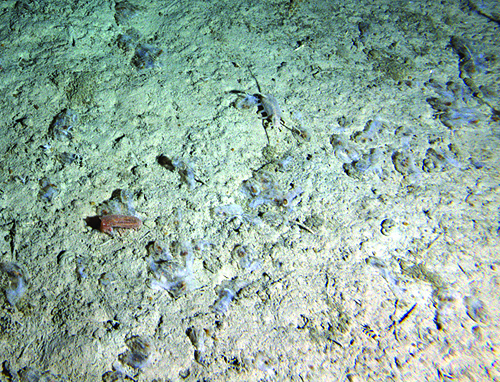
In spring 2012, the muddy seafloor at Station M was literally covered with the silvery bodies of dead salps (gelatinous midwater animals that feed on microscopic algae). This debris provided food for seafloor animals such as sea cucumbers. Image © 2012 MBARI
Recently we at Deep-Sea News have tried to combat misinformation about the presence of high levels of Fukushima radiation and its impact on marine organisms on the west coast of the United States.
After doing thorough research, reading the scientific literature, and consulting with experts and colleagues, we have found no evidence of either. In the comments of those posts and on Twitter, readers have asked us about the “evidence” of dead marine life covering 98% of ocean floor in the Pacific as directly attributed to Fukushima radiation. After some searching I found the main “news” article that is referenced.
The Pacific Ocean appears to be dying, according to a new study recently published in the journal Proceedings of the National Academy of Sciences. Scientists from the Monterey Bay Aquarium Research Institute (MBARI) in California recently discovered that the number of dead sea creatures blanketing the floor of the Pacific is higher than it has ever been in the 24 years that monitoring has taken place, a phenomenon that the data suggests is a direct consequence of nuclear fallout from Fukushima.
Before I discuss this “evidence” further, I want to provide a little background. I am a deep-sea biologist and over the last several years my research has focused on the biodiversity of deep-sea communities off the California coast.
Like many others, I am also working toward understanding how deep-sea life will respond to increased anthropogenic impacts particularly climate change. This resulted in a high profile publication in the Proceedings of the National Academy of Science. I mention this background because 1. It explains why I view myself as an expert to comment on this and 2. it explains why I was confounded for a moment when I thought I had missed a paper in a journal I have published in, on a geographic region I study, and on a topic close to my own research. And to boot from researchers at institution (MBARI) I was formerly employed with.
The reason I am unfamiliar with a study providing evidence of “Dead sea creatures cover 98 percent of ocean floor off California coast; up from 1 percent before Fukushima” is because no such study exists. Here are the details of the actual study.
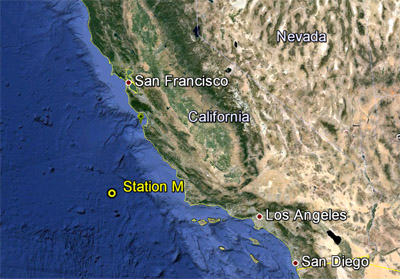
Station M is a long-term study site on the abyssal plain, about 220 kilometers (140 miles) off the Central California coast and 4,000 meters (13,100) feet below the ocean surface. Base image: Google Earth. From MBARI
Ken Smith’s group at MBARI has monitored a deep-sea abyssal site called Station M off the California coast continuously since 1989 (24 years). Their work has lead to many major findings. A majority of deep-sea animals are completely reliant on the sinking of food from the surface, i.e. marine snow. One of the most important findings from Smith and colleagues’ work is that rhythm of deep-sea life is intrinsically linked to the production of phytoplankton at the oceans surface. Thus El Nino/La Nina cycles and other such meteorological/oceanic events leave a deep-sea signature. Ken’s research has been paradigm shifting for deep-sea research. We have moved from a belief of a stable and climate-buffered view of the deep sea to one of a dynamic system intimately related to seasonal, annual, and decadal changes in surface production and ocean currents.
This group’s newest paper
Smith, K. L., H. A. Ruhl, M. Kahru, C. L. Huffard, and A. D. Sherman. (2013). Deep ocean communities impacted by changing climate over 24 y in the abyssal northeast Pacific Ocean. Proceedings of the National Academy of Sciences,www.pnas.org/cgi/doi/10.1073/pnas.1315447110.
reports findings that large and episodic pulses of marine snow occur. These large blizzards are met by hungry deep-sea animals that quickly gobble the meal. The amount of food these blizzards deliver are huge equaling years, if not decades, of normal marine snow. But the amounts and frequency of both normal marine snow and the blizzards are changing.
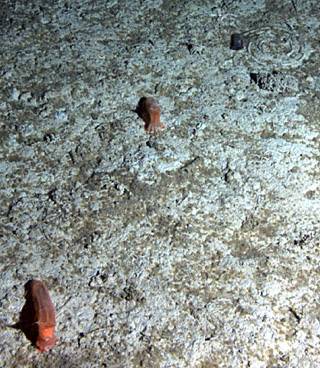
Sea cucumbers at Station M feed on dead algae (brown material on gray deep-sea mud) that sank from the sunlit surface waters after a massive algal bloom. Image © 2012 MBARI
From 2003 to 2012 the amount of phytoplankton production, fodder for marine snow, was higher than years prior. After 2006, the frequency of spikes in marine snow, i.e. blizzards, also increased. In the summer of 2011, the first of three dramatic blizzards occurred. During this event a large number of diatoms bloomed at the surface and sank rapidly to the seafloor.
The second event in the spring/early summer of 2012, was triggered by a major bloom of gelatinous salps. As mentioned in the press release of the paper,
“These salps became so abundant that they blocked the seawater intake of the Diablo Canyon nuclear power plant, located on the California coast east of Station M.” When these salps died, as they do after a bloom, they carpeted the seafloor. In September 2012 another plankton bloom occurred and this combined with fecal pellets from salps (who hungrily munched on the algae) again carpeted the floor with marine snow. In addition the greatest amounts of marine snow and consumption by deep-sea life (as measured by respiration rates) occurred in the last two years of the time series.

Modified from Smith et al. 2013. Long time-series measurements from July 1989 through November 2012 at Station M in the northeast Pacific Ocean on a monthly basis.
Blue bars highlight the timing of peaks in NPP (a proxy for phytoplankton production) from 2010 to 2012. (B) Net primary production (NPP) within 100-km-radius circle around Station M. (C) Satellite estimated EF (export flux a measurement of the amount of material sinking to the deep sea) in a 100-km-radius circle around Station M, calculated for a nominal depth of 100 m.
What caused these recent changes in marine snow?
From the paper,The abyssal area surrounding Station M is influenced by the California Current, which is experiencing increased wind stress, resulting in increased upwelling of nutrient-rich subsurface waters, contributing to increased primary production. With increasing primary production there has been a corresponding increase in POC flux and detrital aggregate accumulation on the sea floor over the past several years.
And from the press release,The researchers note that deep-sea feasts may be increasing in frequency off the Central California coast, as well as at some other deep-sea study sites around the world. Over the last decade, the waters off Central California have seen stronger winds, which bring more nutrients, such as nitrate, to the ocean surface. These nutrients act like fertilizer, triggering blooms of algae, which, in turn, sometimes feed blooms of salps. The fallout from all of this increased productivity eventually ends up on the seafloor.
Nowhere does the paper or the press release mention radiation or Fukushima. Nilch, negatory, nadda, never.
But this is not good enough for staff writer Ethan Hunt and others outlets that continue to recycle this story.Though the researchers involved with the work have been reluctant to pin Fukushima as a potential cause — National Geographic, which covered the study recently, did not even mention Fukushima — the timing of the discovery suggests that Fukushima is, perhaps, the cause.
MBARI today also issued a press release addressing the “several misleading stories [that] have been in circulation on the internet.” The press release points out the obvious.
- MBARI research actually showed evidence that there were MORE algae and salps living in California surface waters during 2011 and 2012 than during the previous 20 years.
- Salps are small gelatinous animals that eat single-celled algae. They are known to experience large blooms in their populations. Large populations of salps have been periodically documented in California waters since at least the 1950s.
- Blooms of gelatinous animals (including salps) and single-celled algae are a common occurrence off the California Coast. They come and go, running their course when they use up their food and nutrients.
- Animals and algae that live in the surface waters eventually die. If they are not eaten in surface waters then they sink to the deep sea. This is the main food source for deep-sea animal and microbe communities.
- Soon after the salp bloom and die-off at the surface in 2012, the deep seafloor at the researchers’ study site was littered with dead salps. This was observed at one location, and salps were the only dead animals observed in large numbers.
- There is no indication that any of the events in this study were associated with the Fukushima nuclear accident.
I will also note the Fukushima disaster occurred in March 2011, five years after the researches begin to see changes in surface production. To reiterate the statements points, there is evidence of more life recently in California waters. The supposed “die off” is a common feature of any bloom of short-lived invertebrates. The “die off” was experienced at one location and with one species. The entire Pacific seafloor is not littered with dying organisms. I would also point out that these massive food falls of marine invertebrates are a common occurrence. For example, in 2002 a massive deposition of jellyfish was seen in the deep Arabian Sea.
As I write this post on this cold Saturday morning, my attitude matches. I have wanted to write about this paper for a while here at DSN.
And I’m sorry I did not. I shoudn’t be defending great science against propaganda and poor journalism. I should be writing about how this paper answers a major question about the deep sea. Previous studies have noted that the energy requirements of deep-sea animals could not be met by normal and minimal marine snow. Research over the last decade or so set out to determine how this deficit is made up. Smith and colleagues’ work solves this riddle.
Deep-sea animals simply wait for a sporadic feast. Smith’s work suggests this is likely linked to climatic events.
If anything the paper is a cautionary tale of climate change not radiation.
Share the post "Is the sea floor littered with dead animals due to radiation? No."

- Three Reasons Why Fukushima Radiation Has Nothing to Do with Starfish Wasting Syndrome

- True facts about Ocean Radiation and the Fukushima Disaster

- Climate Change and Food Availability in the Deep
- Simple Summer Recipes for Dead Seafloor Carrion

- Japan Finds Radiation in Fish
Dr. M Craig McClain is the Assistant Director of Science for the National Evolutionary Synthesis Center, created to facilitate research to address fundamental questions in evolutionary science. He has conducted deep-sea research for 11 years and published over 40 papers in the area. He has participated in dozens of expeditions taking him to the Antarctic and the most remote regions of the Pacific and Atlantic. Craig’s research focuses mainly on marine systems and particularly the biology of body size, biodiversity, and energy flow. He focuses often on deep-sea systems as a natural test of the consequences of energy limitation on biological systems. He is the author and chief editor of Deep-Sea News, a popular deep-sea themed blog, rated the number one ocean blog on the web and winner of numerous awards. Craig’s popular writing has been featured in Cosmos, Science Illustrated, American Scientist, Wired, Mental Floss, and the Open Lab: The Best Science Writing on the Web.
http://deepseanews.com/2014/01/is-th...-radiation-no/NO AMNESTY
Don't reward the criminal actions of millions of illegal aliens by giving them citizenship.
Sign in and post comments here.
Please support our fight against illegal immigration by joining ALIPAC's email alerts here https://eepurl.com/cktGTn
-
01-10-2014, 09:13 PM #5Senior Member
- Join Date
- Aug 2008
- Location
- PARADISE (San Diego)
- Posts
- 99,038
The reason the MSM isn't covering this issue is that most of this is false information put out by anti-nuclear groups. IMO
NO AMNESTY
Don't reward the criminal actions of millions of illegal aliens by giving them citizenship.
Sign in and post comments here.
Please support our fight against illegal immigration by joining ALIPAC's email alerts here https://eepurl.com/cktGTn
-
01-10-2014, 10:56 PM #6Senior Member
- Join Date
- Aug 2008
- Location
- PARADISE (San Diego)
- Posts
- 99,038
Fukushima Radiation Scare Stories Are Going Viral On the Internet. Are They Real Or Fake?
http://www.policymic.com/articles/78...y-real-or-fake
@
http://www.alipac.us/f19/fukushima-r...l-fake-295406/
NO AMNESTY
Don't reward the criminal actions of millions of illegal aliens by giving them citizenship.
Sign in and post comments here.
Please support our fight against illegal immigration by joining ALIPAC's email alerts here https://eepurl.com/cktGTn
-
01-11-2014, 12:39 PM #7AprilGuest
Thanks for posting all the cover up material JD2 that is out there, any one who thinks that 300-400 tons of radiation daily being poured into the ocean and atmosphere is fine is clueless or being paid off OR BOTH. If you read the thread NUCLEAR scientist are letting us all know we are screwed for decades. As I recall.... for awhile you did not believe the NSA was recording all our communications..... and finding out that you are an advocate for MSM..... that at this time even most of the clueless know are nothing more than propaganda machines, is no surprise....thanks again.
-
01-11-2014, 12:42 PM #8AprilGuest
Japan Professors: Worst case scenario at Fukushima, nuclear rods melted and went through reactor floors; Contamination is impacting rest of world; Likely that entire Pacific will be affected — Farmer: Gov’t doesn’t have any idea about status of fuel (VIDEO)
Kenichi Hasegawa, Farmer from Iitate Village in Fukushima Prefecture, Parliamentary Meeting in Australia, Published March 12, 2013 (at 46:00 in): So the government is promoting image threat it wasn’t a big deal. It’s over, everything’s under control. That’s what government tries to disseminate to the population. However, even now 2 years after, the nuclear fuel that melted down, they don’t have any idea even the constant status. They don’t know what to do with it. That’s the current situation.Published: October 13th, 2013 at 12:43 am ET
The 2011 Eastern Japan Great Earthquake Disaster – Kyoto University’s Okada Norio, Yoshio Kajitani, Hirokazu Tatano & Beijing University’s Tao Ye, Peijun Shi: [T]he nuclear accident gradually became a level 7 nuclear event, which is a major accident and the highest level on the International Nuclear and Radiological Event Scale (INES), equivalent to the Chernobyl disaster in April 1986. The radiation in the vicinity of the reactor rose steeply, becoming a deadly threat to the local residents […] three units were exposed to level 7 accidents and one unit was exposed to a level 3 incident. The critical issue in the crisis became the cooling systems failures. […] The high temperature turned most of the internal coolant water into steam, which in turn exposed the fuel rods to air. […] Fuel would escape away from control rods, intensify decay, melt through the reactor floor, and consequently induce a massive release of radioactive isotopes, a worst case scenario. […] Radioactive isotopes released from Fukushima were later detected in North America and other regions in the world. […] The long-term impact of the nuclear crisis to Japan, the Asia-Pacific region, and the entire world is still not fully revealed. […] The radioactive contamination caused by the nuclear accident following the earthquake and tsunami is affecting the rest of the world through atmospheric circulation. The polluted water released by the Tokyo Electric Power Company is likely to affect the entire Pacific Ocean in the coming decades.
Watch Hasegawa’s presentation to Australia’s MPs here
http://enenews.com/japan-professors-worst-case-scenario-fukushima-n...
-
01-11-2014, 12:43 PM #9AprilGuest
Nuclear Expert: Biggest concern at Fukushima is the huge source of radioactivity from molten fuel and spent fuel pools winding up in ocean — “The health of the entire Northern Pacific is at stake” (AUDIO)
Title: Can an ice wall contain Fukushima’s radiation?Published: September 7th, 2013 at 4:45 pm ET
By ENENews
Source: Day 6 with Brent Bambury – CBC Radio
Date: September 6, 2013
h/t Anonymous tip
At 12:30 in

Full broadcast here
http://enenews.com/nuclear-expert-biggest-concern-at-fukushima-is-r...
-
01-11-2014, 12:43 PM #10AprilGuest
Hidden gov’t forecast shows Fukushima contamination spread throughout Northern Pacific Ocean in 5 years (VIDEO)
China-Korea Cooperation on the Development of Ocean Monitoring and ..., 2013: In this study we are concerned with long-term oceanic-scale dispersion of Cs 137 released from the Fukushima Daiichi NPP. [...] the simulation is carried out up to 2041.Published: November 29th, 2013 at 1:56 pm ET
By ENENew
(This animation was left on the server and found by randomly typing in guesses for the URL address. Note that the ocean releases used for this model appear to end soon after 3/11. This means the daily release of 400 tons of radioactive water that’s likely been ongoing since the disaster began is not being accounted for.)
The model that is available for public viewing on the joint Chinese/Korean website was recently published here: Gov't model shows West Coast of N. America to get highest level of ...
http://enenews.com/hidden-govt-forecast-shows-fukushima-contaminati...


 Reply With Quote


Des Moines East High mourns loss sophomore hit by motorcycle |...
04-28-2026, 06:08 PM in Americans Killed By illegal immigrants / illegals