

Results 11 to 20 of 32
Thread Information
Users Browsing this Thread
There are currently 1 users browsing this thread. (0 members and 1 guests)
 LinkBack URL
 About LinkBacks
-
08-01-2007, 07:30 PM #11Senior Member


- Join Date
- May 2007
- Location
- NC
- Posts
- 16,593
Trashing The Border
USA Today
http://immigrationlatinosamnesty.blogsp ... order.html
Every time I go down to the Mexican border, I’m struck by a down and dirty realization: This beautiful land looks like a dump.

Recently I was at a waist-high border vehicle barrier in a valley northeast of Tecate, Baja California. As far as the eye could see, strewn past barbed wire or collecting knee-deep in culverts, were water bottles, food wrappers, used paper products such as toilet paper and maxi pads, even felt shoe covers designed to obscure tracks.
From California to Texas, illegal immigrants and drug runners leave such calling cards on their trek north.
“This was a beautiful refuge 10 years ago,â€Join our efforts to Secure America's Borders and End Illegal Immigration by Joining ALIPAC's E-Mail Alerts network (CLICK HERE)
-
08-01-2007, 07:34 PM #12Senior Member
- Join Date
- May 2007
- Location
- NC
- Posts
- 16,593
Sunday, June 03, 2007
Illegals Dumped 25 Million Pounds of Trash
http://www.therawfeed.com/2007/06/illeg ... ds-of.html

Wow. The U.S. Bureau of Land Management estimates that illegal immigrants have dumped some 25 MILLION POUNDS OF TRASH on the U.S. side of the U.S.-Mexican border. Cleanup crews and volunteer groups have spent enormous time and resources cleaning up the garbage, but have thus far picked up only 1 percent of it -- 250,000 pounds.Join our efforts to Secure America's Borders and End Illegal Immigration by Joining ALIPAC's E-Mail Alerts network (CLICK HERE)
-
08-01-2007, 07:36 PM #13Senior Member

- Join Date
- Jan 1970
- Location
- Eastern Washington State
- Posts
- 249
The trash sucks for sure. Still , notice in the articles put out that they use the terms disturbing wildlife , habitat destruction but they totally skirt the fact that no one down there has to look very hard to find the remains of what was once a viable and thriving diversity of wildlife that is now gone.
They skirt the subject because fact is people are more forgiving of litter bugs then poachers of a living breathing fly , running national resource.
The hunters don't want it shut down . Those that take a thrill in the stalking never do.
Those that sell them hunting licenses remain silent , the money from the hunters pay the enforcers pay check.
Those that normally stand in defense of wildlife will look away to allow immigration of humans over protection of the animals they get paid to protect.
All and all it is one of the most emotion stirring stories waiting to be exposed in our nation today in many ways. A good wildlife story about the massive loss along the border without the sob stories of those doing the damage would raise emotions in every one into wildlife preservation.
That is what they fear most and the reason they avoid tipping any one about it in their official published articles.
-
08-01-2007, 07:39 PM #14Senior Member
- Join Date
- May 2007
- Location
- NC
- Posts
- 16,593
http://usinfo.state.gov/eap/east_asia_p ... nment.html
Illegal Entrants' Residue; Trash Woes Piling Up
By Tony Davis, The Arizona Daily Star (Tucson), August 24, 2005
Pima County in Arizona is looking for more money to deal with trash left by illegal immigrants entering the United States.
"It has been estimated that the average desert-walking immigrant leaves behind 8 pounds of trash during a journey that lasts one to three days if no major glitches occur," Davis writes. "Assuming half a million people cross the border illegally into Arizona annually, that translates to 2,00 tons of trash that migrants dump each year.
What makes migrant trash especially problematic is that it is in remote scattered areas where it is dangerous to cattle and wildlife and difficult and expensive for garbage crews to reach and pick up.
Smugglers make the illegals dump their stuff so more people can be packed into vehicles for the trip north; other illegals dump their stuff in favor of nicer clothes to better blend in with the communities where they will be staying.
Dumping of Trash, Waste, Endemic in State with Flood of Illegal Immigration
By Arthur H. Rotstein, Associated Press Newswires, Dateline Coronado National Memorial, Arizona, July 12, 2004
Take a walk through Arizona's remote deserts, parks and ranches, and what might you see?
Empty food cans, water bottles, soiled diapers, human feces, castoff clothing, abandoned cars, trampled vegetation and bushes burned for campfires -- all the residue of a ceaseless flow of thousands of illegal immigrants trying to get into the United States.
"Environmental degradation has become among the migration trend's most visible consequences," Rotstein writes. "A few years ago, there were 45 abandoned cars on the Buenos Aires refuge near Sasabe, and enough trash that a volunteer couple filled 723 large bags with 18,000 pounds of garbage over two months in 2002." (Editor's note: The 115,900-acre Buenos Aires National Wildlife Refuge was established in 1985 to reintroduce and protect native plant and animal species.)
"The bureau of Land Management received $1.3 million from Congress during the past two years to clean up trash and restore damaged lands. It has shared the money with other federal agencies, organizations and communities. Most often, ranchers, park rangers and other employees end up picking up trash in the course of their daily work," Rotstein reports.
Roger Di Rosa, refuge manager, Cabeza Prieta National Wildlife Refuge
Testimony delivered June 17 before
The U.S. Senate Commerce, Science, and Transportation Committee
The U.S. Fish and Wildlife Service is finding itself increasingly preoccupied with international border security, according to Roger Di Rosa, manager of the Cabeza Prieta National Wildlife Refuge in southwest Arizona.
In testimony delivered June 17 before the U.S. Senate Commerce, Science, and Transportation Committee, Di Rosa said "the Service has had to adapt its activities in response to the increased focus on homeland security issues in order to more effectively fulfill its mission of conserving wild plants, animals, and habitats."
Tougher border security in traditional ports of entry make remote park lands more attractive to drug and people smugglers, he said. "More than 100,000 pounds of marijuana was seized on refuge lands last year along the southwest border," he told the Senate committee. "More than 23,000 illegal immigrants were apprehended in 2003 on refuges in Arizona alone."
These illegal activities, he said, is damaging refuge environments as well as threatening the safety of volunteers, the public and Service employees.
While increase U.S. Border Patrol presence is a help, more officers and technological means is needed, he said.
Di Rosa noted that there are eight National Wildlife Refuges in the United States totaling 1.1 million acres that share 153 miles of border with Mexico.
See the full text of Di Rosa's testimony.
Bitter Division for Sierra Club on Immigration
By Felicity Barringer, The New York Times, March 16, 2004
Immigration is creating a bitter leadership struggle in the Sierra Club, a 112-year-old organization of 750,000 members that works to bring conservation and pollution issues to public attention.
Barringer writes that the Sierra Club is struggling over "whether to advocate tough immigration restrictions as a way to control environmental damage that has been associated with rapid population growth."
U.S. Census Bureau figures show that nearly 40 percent of the U.S. population growth over the last 10 years has been a result of direct immigration; many of the immigrants have settled in California, the Sierra Club's home base.
Violent Drama Plays Out Amid Natural Splendor
By Bob Marshall, Newhouse News Service, Dateline Why, Arizona, March 15, 2004
A feature story that focuses on the impact illegal immigrants are having on Organ Pipe Cactus National Monument, a 330,000-acre park in the Sonoran Desert on the Arizona-Mexico border.
Each year, an estimated 200,000 to 400,000 illegal immigrants try to make the 15 to 30 mile hike through the wilderness to reach cities in the United States. Last year, 173 were found dead, most from exposure.
Most of the illegal border crossers spend at least two nights in the park. Marshall writes: "That works out to a city the size of Baton Rouge, La., living in the park without a sewage system, without garbage collection, without a grid of dedicated roads or sidewalks. They move where they want in four-wheel-drive cars, ATVs, motorcycles, bicycles and their own feet."
Fred Patton, chief ranger at Organ Pipe, is quoted as saying: "We've now got 300 miles of illegal roads these people have cut through the desert, and thousands of miles of illegal trails they've created. We collect over 30 vehicles a year, and we measure the trash they leave behind, everything from cans and bottles to clothes, by the ton. And they've fouled the few water sources to the point they are too filthy now even for the animals to drink."
Many of the illegals come to the United States simply to seek a better life; others are dangerous criminals. In August 2002, Ranger Kris Eggle was shot and killed by smugglers.
In the hope of controlling the problem, the United States is building a 30-mile fence along the park border with Mexico that will at least stop vehicles from crossing into the parklands.
--------------------------------------------------------------------------------
2003
--------------------------------------------------------------------------------
Cross-Border Traffic Ravages Desert Park; Drug Runners, Migrants BlamedBy Hugh Dellios, Chicago Tribune, Dateline Organ Pipe Cactus National Monument, Arizona, August 19, 2003
The 300,000-acre Organ Pipe Cactus National Monument in Arizona has become the most dangerous and among the most trash-strewn of U.S. national parks, thanks to drug runners and illegal immigrants, this article says.
Tougher border controls in the wake of the September 11 terrorist attacks make national parks like Organ Pipe Cactus National Monument -- along with Cabeza Prieta National Wildlife Refuge, The Buenos Aires National Wildlife Refuge and the Coronado National Memorial -- more attractive to illegal border crossers. The result: beautiful and environmentally sensitive wildlife preserves are being destroyed by vehicles and human refuse.
In the desolate areas of the parks, many illegals die from the severe desert heat, and armed bandits are a constant threat. Last year, Organ Pipe park ranger Kris Eggle was shot and killed by a suspected drug trafficker fleeing Mexican police investigating a quadruple murder in Mexico.
Immigration Taking Toll on Parks, Refuges Near U.S.-Mexico Border
By April Reese, Land Letter, Environment and Energy Publishing, LLC, Public Lands, Vol. 10, No. 9, February 13, 2003
Waves of illegal immigrants are taking a heavy toll on U.S. public lands along the Mexican border, federal officials say.
Some 900,000 people are caught each year trying to sneak into the United States. Their efforts to reach the United States drive them into protected desert lands, where they crowd out wildlife at watering holes and destroy and trash habitat.
Mike Coffeen, a biologist with the Fish and Wildlife Service in Tucson, Arizona, is quoted as saying, while surveying the area by airplane: "the level of impact is just shocking."
The National Park Service is looking at a proposal that would put up vehicle barriers to help stem illegal immigrant traffic into Arizona's Organ Pipe Cactus National Monument.
See: executive summary for Report to the House of Representatives Committee on Appropriations on Impacts Caused by Undocumented Aliens Crossing Federal Lands in Southeast Arizona.
Illegal Immigrants Tied to Costly Wildfires
Associated Press, Dateline Tucson, Arizona, September 9, 2002
Illegal immigrants trying to get to the United States via the Mexican border with southern Arizona are suspected of having caused eight major wildfires this year, this report says.
The fires destroyed 68,413 acres (about 108 square miles) and cost taxpayers $5.1 million to fight.
Fire officials haven't identified individuals suspected of causing the fires, but the physical evidence left where the fires began strongly points to illegal border crossers. Escaped campfires caused the conflagrations when border crossers attempted to warm themselves on cold spring and fall nights along known people-smuggling routes in remote areas rarely used by legal visitors.
Join our efforts to Secure America's Borders and End Illegal Immigration by Joining ALIPAC's E-Mail Alerts network (CLICK HERE)
-
08-01-2007, 08:28 PM #15Senior Member

- Join Date
- Jul 2007
- Location
- North Carolina
- Posts
- 892
Here is another site on the subject.
http://www.desertinvasion.us/
-
08-01-2007, 09:19 PM #16
- Join Date
- Jan 1970
- Location
- Boston
- Posts
- 94
DAMN! Looks like a Steven King movie! Maybe something ate them all and spit out the clothes!

I think it would be a GOOD place for a mountain lion sanctuary.
-
08-01-2007, 09:28 PM #17

- Join Date
- Jan 1970
- Location
- Heart of America
- Posts
- 458
... remember they do jobs that Americans won't do..... and this thread is the proof!
No soy de los que se dicen 'la raza'... Am not one of those racists of "The Race"
-
08-01-2007, 09:40 PM #18Senior Member
- Join Date
- Jan 1970
- Location
- Eastern Washington State
- Posts
- 249
Mountain lions ? They would end up cougar on a stick. I would not leave a cat out there. I have to much respect for cats.
-
08-01-2007, 09:49 PM #19Senior Member
- Join Date
- May 2007
- Location
- NC
- Posts
- 16,593
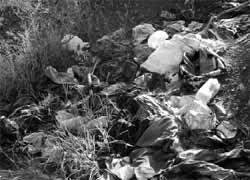
Trash left by illegal aliens on Tohono O'odham Indian Nation land.Join our efforts to Secure America's Borders and End Illegal Immigration by Joining ALIPAC's E-Mail Alerts network (CLICK HERE)
-
08-01-2007, 09:56 PM #20Senior Member
- Join Date
- May 2007
- Location
- NC
- Posts
- 16,593
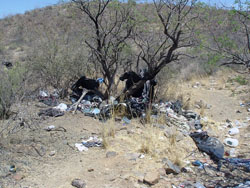
Layup area near the San Pedro river and I10.
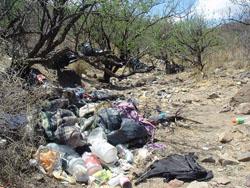
Layup area near the San Pedro river and I10.
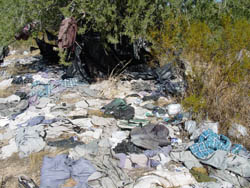
Layup area at Lake Pleasant, approximately 50 miles northwest of Phoenix.
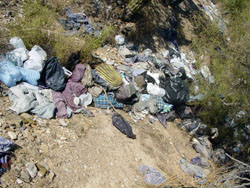
Layup area at Lake Pleasant, approximately 50 miles northwest of Phoenix.
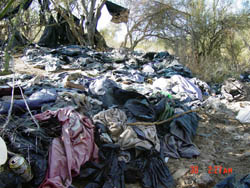
Layup area at Lake Pleasant, approximately 50 miles northwest of Phoenix.Join our efforts to Secure America's Borders and End Illegal Immigration by Joining ALIPAC's E-Mail Alerts network (CLICK HERE)


 Reply With Quote

‘Green Bay Man’ Accused of Trying to Murder Ex-Girlfriend with a...
04-29-2026, 08:05 PM in illegal immigration News Stories & Reports