

Results 1 to 10 of 22
 25Likes
Thread Information
Users Browsing this Thread
There are currently 1 users browsing this thread. (0 members and 1 guests)
 LinkBack URL
 About LinkBacks
Hybrid View


-
12-26-2015, 10:25 AM #1Super Moderator


- Join Date
- May 2005
- Location
- Heart of Dixie
- Posts
- 36,007
US signs historic deal with El Salvador and Honduras for remittance securitization
I have posted this before and I am reposting for 2016. This is one of Hillary's accomplishments, it arranges for these countries to get loans based on what their illegals send home from the USA. why isn't anyone talking about this?
US signs historic deal with El Salvador and Honduras for remittance securitization
SUBMITTED BY SANKET MOHAPATRA
WED, 10/13/2010
The United States has recently signed separate Memorandums of Understanding (MoUs) with El Salvador and Honduras to assist them in securitizing their future remittance receipts to raise financing for infrastructure and development projects. Under the Building Remittance Investment for Development, Growth, and Entrepreneurship (BRIDGE) initiative, banks in these countries will leverage their future remittance receipts to raise lower-cost and longer-term financing in international capital markets to fund infrastructure, public works, and commercial development initiatives (see press release).
In a speech in New York City on September 22, Secretary of State Hillary Clinton explained how BRIDGE would work to raise critically needed development funding:
“…Now, if they [migrants] send these remittances through the formal financial system, they create huge funding flows that are orders of magnitude larger than any development assistance we can dream of. By harnessing the potential of remittances, BRIDGE will make it easier for communities in El Salvador and Honduras to get the financing they need to build roads and bridges, for example, to support entrepreneurs, to make loans, to bring more people into the financial system…..Through BRIDGE and its in-country partners, local banks will be able to leverage their remittance flows….With the leverage from remittances, the local banks will be able to get lower-cost, longer-term financing for investments in infrastructure projects and small businesses.”
The financing structure proposed under BRIDGE is similar to that used by banks in several remittance-receiving countries such as Brazil, Jamaica, Kazakhstan, Mexico, Peru and Turkey, to raise over $15 billion in international financing during the last decade (see previous work on this topic by my colleagues Dilip Ratha and Suhas Ketkar on securitization of future-flow receivables and new paths to funding).
The BRIDGE initiative provides an excellent application of innovative financing instruments leveraging on migration and remittances. The World Bank group has recently become involved in this area.
The International Finance Corporation has recently provided up to $30 million debt financing for securitizing the significant remittances of El Salvadorans working abroad to raise financing for a credit cooperative Fedecredito. These additional resources will be used to increase lending to micro-entrepreneurs and low-income people in the country. Increasingly the Bank is receiving requests to assist countries to raise funds through diaspora bonds.
http://blogs.worldbank.org/peoplemov...securitization
Last edited by Newmexican; 06-30-2018 at 11:32 AM.
-
12-26-2015, 01:35 PM #2Senior Member

- Join Date
- Aug 2005
- Posts
- 55,877
I remember when you posted about this, Newmexican. It's disgusting. This was a move headed up by the drug cartels that own all these lousy politicians selling out our country.
A Nation Without Borders Is Not A Nation - Ronald Reagan
Save America, Deport Congress! - Judy
Support our FIGHT AGAINST illegal immigration & Amnesty by joining our E-mail Alerts at https://eepurl.com/cktGTn
-
12-29-2015, 02:57 AM #3Super Moderator
- Join Date
- May 2005
- Location
- Heart of Dixie
- Posts
- 36,007
-
07-05-2016, 11:22 AM #4Super Moderator
- Join Date
- May 2005
- Location
- Heart of Dixie
- Posts
- 36,007
Share ThisNew Paths to Funding
FINANCE & DEVELOPMENT, June 2009, Volume 46, Number 2
Suhas Ketkar and Dilip Ratha
When financing is scarce, developing countries may try innovative approaches to raise capital
Developing countries have an outstanding short-term debt of nearly a trillion dollars. According to the World Bank, they face a financing gap of $370–$700 billion. Given the severe crisis of confidence in debt markets, it will be extremely difficult for countries to obtain private financing using traditional financial instruments. Innovative financing approaches are required, especially for private sector borrowers in developing countries, who face even harsher credit rationing than public sector borrowers.
Scarcity of capital threatens to jeopardize long-term growth and employment generation in many developing countries, which have limited access to capital even in the best of times. Official aid alone will not be adequate to bridge near- or long-term financing gaps. Ultimately, it will be necessary to use official funding to catalyze private flows to developing countries—adopting innovative financing approaches such as targeting previously untapped potential investors or using structures with credit enhancements to tap existing investors.
Stimulating such approaches is easier said than done, especially during the deepening financial crisis. But the debt crisis of the 1980s was ultimately resolved via an innovation—the creation of Brady bonds in 1989. Those bonds, named for then–U.S. Treasury Secretary Nicholas Brady, securitized the bank debt of mainly Latin American countries into tradable bonds that could be purchased by a broad investor base.
Some innovative market-based financing mechanisms that developing countries could use include borrowing from their expatriate (diaspora) communities, securitizing future revenues, and issuing bonds indexed to growth. Preliminary estimates suggest that sub-Saharan African countries could raise $5–$10 billion by issuing diaspora bonds and $17 billion by securitizing future remittances and other future receivables.
Diaspora bonds
The governments of India and Israel have raised about $40 billion, often during liquidity crises, by tapping into the wealth of their diaspora communities to support balance of payments needs and finance infrastructure, housing, health, and education projects. Diaspora bond issuance by the Development Corporation for Israel (DCI) has been a recurrent feature of that nation's annual foreign funding program, raising well over $25 billion since 1951. The State Bank of India (SBI) has issued diaspora bonds on just three occasions—in 1991, following the balance of payments crisis; in 1998, after the country conducted nuclear tests; and in 2000. The SBI has raised $11.3 billion. Jewish diaspora investors paid a steep price premium (perhaps better characterized as a large patriotic yield discount) when buying DCI bonds. Indians living abroad purchased SBI bonds when ordinary sources of funding for India had all but vanished.
The rationale behind diaspora bonds is twofold. For the countries, diaspora bonds represent a stable and cheap source of external finance, especially in times of financial stress. For investors, diaspora bonds offer the opportunity to display patriotism by helping their country of origin. Furthermore, the worst-case scenario for diaspora bonds is that debt service payments by the issuer are in local rather than hard currency. But because diaspora investors often have liabilities in their country of origin, they are likely to view the risk of receiving payments in local currency with much less trepidation than would nondiaspora investors.
Among countries with large diaspora communities are the United States (which has large groups from the Philippines, India, China, Vietnam, and Korea, in Asia; El Salvador, the Dominican Republic, Jamaica, Colombia, Guatemala, and Haiti, in Latin America and the Caribbean; and Poland, in eastern Europe), Japan (with a major diaspora presence of Koreans and Chinese), the United Kingdom (with large Indian and Pakistani communities), Germany (with people from Turkey, Croatia, and Serbia), France (with diaspora communities from Algeria and Morocco), and South Africa (home to migrants from neighboring countries in southern Africa). Large pools of migrants from India, Pakistan, the Philippines, Bangladesh, Indonesia, and Africa in the oil-rich Gulf countries are also potential purchasers of diaspora bonds.
If banks and other issuers want to tap the U.S. retail market, they likely will have to register their diaspora bonds with the U.S. Securities and Exchange Commission, whose customary disclosure requirements could prove daunting for countries with weak financial institutions. But countries with a significant diaspora presence in Europe, where regulatory requirements are relatively less stringent, may be able to raise funds there. Diaspora bonds might also be issued in Hong Kong SAR, Malaysia, Russia, Singapore, and South Africa.
Future-flow securitization
Securitization is a much maligned term at present because the global crisis had its roots in securitized debt in the United States. Securitization, however, was not the main problem. It was overaggressive valuation of the underlying assets. As long as this error is not repeated and ample excess coverage is provided to allow for declines in the value of the underlying collateral, debt securitized by future hard-currency receivables will be a viable option for developing countries seeking to raise funds in the prevailing environment of low global risk appetite.
Ever since Mexico's Telmex undertook the first securitized transaction based on future U.S. dollar revenue flows, the main credit rating agencies have assessed more than 400 such transactions, valued at $80 billion. A wide variety of future receivables have been securitized—including exports of oil, minerals, and metals; airline tickets, credit card vouchers, electronic and paper remittances, and international telephone calls; oil and gas royalties; and tax revenue. Securitization of diversified payment rights (DPRs)—which include all hard-currency receivables that come through the international payments system—is a more recent innovation. DPRs are deemed attractive collateral because the diversity of their origin makes such flows stable. During 2002–04, when Brazil had difficulty accessing international capital markets, many Brazilian banks securitized future hard-currency DPRs to raise $4.9 billion.
By pledging future hard-currency receivables, securitized transactions subordinate the interests of current and future creditors. In a world of perfect capital markets, this might raise the cost of future borrowing and eliminate the principal rationale for securitization (Chalk, 2002). But many developing countries face capital markets that are far from perfect, and creditors may have trouble distinguishing between good and bad risks, paving the way for securitization.
Transactions backed by future revenue streams are structured so that the payments do not enter the issuer's home country until obligations to bond investors are met. Although this structure reduces sovereign transfer and convertibility risks, several other risks remain. These include:
• performance risk associated with the issuing entity's ability to generate the receivable,
• product risk associated with the stability of receivable flows because of price and volume fluctuations, and
• diversion risk if the issuer's government forces sales to customers not designated to direct their payments into the trust.
Many of these risks can be reduced through the selection of future-flow receivables and excess coverage. The latter has now become critical as a result of the recent dismal performance of mortgage-backed securities. Unlike the securitization of existing assets such as local-currency mortgage loans, future-flow securitization structures (involving foreign-currency export revenue or diversified payment rights) have held up very well during this financial crisis.
Still, issuance of securitized bonds is far below potential. Constraints include a lack of good receivables and strong (investment-grade) local entities and the absence of clear laws, particularly bankruptcy laws. There are, however, fewer barriers today than a decade ago.
Performance-indexed bonds
Debt service payments on fixed-coupon bonds can conflict with a country's ability to pay. When an internal or external shock cuts growth, revenue falls and social safety net expenditures rise. The resulting increase in fiscal pressure can force a country to choose between defaulting on foreign debt and adopting policies that increase the funds available for debt service but exacerbate the decline in output. Growth-indexed bonds are designed to overcome this problem. Coupons on such bonds are set to vary according to the growth performance of a country's gross domestic product (GDP), a proxy for its ability to pay. This feature lets a developing country follow countercyclical fiscal policy, paying less during an economic slowdown and more during an expansion. It is plausible that developing countries would be willing to pay a higher rate on indexed bonds than they would pay on fixed-coupon bonds to be able to avoid potential debt defaults.
This idea has been around for a while, but despite their apparent attractiveness, growth-indexed bonds have not caught on. Only a few developing countries—Argentina, Bosnia and Herzegovina, Bulgaria, and Costa Rica—have incorporated clauses or warrants that increase the payoff to bondholders if GDP growth exceeds a threshold. The GDP-indexed warrants in the Argentine program, for instance, represent the government's obligation to pay 5 percent of the excess annual GDP in any year in which the GDP growth rate rises above the trend. The market's initial low valuation of these warrants improved throughout 2007 as the Argentine economy posted strong growth.
Widespread use of growth-indexed bonds has been held back because of concerns regarding the accuracy of GDP data, the potential for deliberate underreporting of growth, and the complexity of the bonds. These obstacles are not overwhelming, but the liquidity of growth-indexed bonds has been low so far, and there appears to be a novelty premium (Costa, Chamon, and Ricci, 2008.
Similar to the growth-indexed bonds issued by sovereigns, subsovereign borrowers could issue performance-indexed bonds (PIBs). A PIB's coupon would be linked to a well-defined indicator of the performance of the borrowing entity. For a provincial or municipal government, for example, it could be a fiscal revenue target; for a public sector port authority, the indicator could be clearance or transit time; and for a private corporation, it could be earnings (Ramachandran, Gelb, and Shah, 2009). Such instruments have not yet been tested, but they seem potentially useful for large subsovereign borrowers in emerging markets.
Public policy issues
Like earlier financial innovations, diaspora bonds, future-flow-backed securities, and performance-indexed bonds facilitate access to funding for developing countries. Future-flow securitizations are designed to transfer credit risk from borrowers, thereby enhancing credit ratings and expanding liquidity. Diaspora bonds are meant to enhance liquidity. Growth- or performance-indexed bonds are designed to reduce credit risk by linking coupons to the ability to pay and to enhance liquidity by giving creditors an option on the performance of sovereign and subsovereign borrowers in developing countries.
Multilateral institutions and official donors can play an important role in promoting market-based innovations. They can provide credit enhancements to developing country borrowers facing severe financing gaps. They can offer technical assistance on legal frameworks, structuring, pricing, and risk management—and in the design of projects financed by innovative instruments. The institutions can help establish sovereign ratings, opening up access to international capital markets for poor countries in Africa, many of which are unrated (see box). They can also provide seed money to cover investment banking fees and rating costs incurred in structuring transactions supported by future-flow receivables. They may also offer partial guarantees on future flows to mitigate risk and catalyze private flows. They have a clear role to play in improving the accuracy and transparency of GDP data to support the issuance of growth-indexed bonds.
Sovereign ratings and market access
Developing countries’ access to credit markets is affected not only by the type of debt they are offering but by the quality judgments of the rating agencies, which, when applied to a nation, are called sovereign credit ratings. Sovereign ratings also provide a benchmark for subsovereign borrowers.
In general, sovereign debt spreads fall as sovereign credit ratings improve. But the major effect occurs when a rating rises to investment grade (see chart). Still, not having a sovereign rating may be worse than having a low rating. In 2005, foreign direct investment (FDI) accounted for 85 percent of private
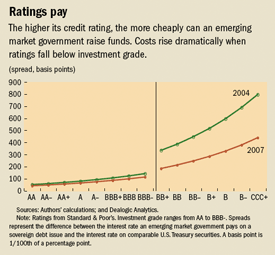
capital flows to the 70 developing countries that have no rating. Bank loans made up most of the rest. In comparison, capital flows were much more diversified for rated countries—roughly 55 percent from FDI, 15 percent from bank loans, as much as 25 percent from bonds, and nearly 5 percent from equity flows. Even B-rated countries were better off. An examination of 55 unrated countries reveals that they were more creditworthy than previously believed: eight of those 55 countries would likely be above investment grade; another 18 would likely be in the B to BB category. This suggests that there is hope for some of the unrated developing countries to obtain financing in global capital markets. Access to debt, however, must be accompanied by prudential debt management practices. In addition, countries benefiting from the IMF and World Bank’s Heavily Indebted Poor Countries Initiative and Multilateral Debt Relief Initiative should observe caution in taking on debt from opportunistic free riders.
This article draws on Innovative Financing for Development by Suhas Ketkar and Dilip Ratha, published in 2008 by the World Bank.
http://www.imf.org/external/pubs/ft/.../06/ketkar.htm
-
07-05-2016, 11:30 AM #5Super Moderator
- Join Date
- May 2005
- Location
- Heart of Dixie
- Posts
- 36,007
The big banks are making money off of the remittances and they don;t want to lose that cash flow.
REMITTANCE PRICES WORLDWIDE
MAKING MARKETS MORE TRANSPARENT
HIGHLIGHT
 Globally, sending remittances costs an average of 7.60 percent of the amount sent. This figure is used to monitor the progress of the global effort for reduction of remittance prices. Read our March 2016 report on global trends for remittance prices.
Check the fees and Banks and businesses that are benefiting HERE
https://remittanceprices.worldbank.org/en
-
10-19-2016, 11:46 AM #6Super Moderator
- Join Date
- May 2005
- Location
- Heart of Dixie
- Posts
- 36,007
Hillary has been incentivizing the illegals for years.


 Reply With Quote
Similar Threads
-
US signs historic deal with El Salvador and Honduras for remittance securitization
By Newmexican in forum General DiscussionReplies: 13Last Post: 07-09-2015, 02:39 PM -
Senate Bill: Enough Green Cards for Everyone In Guatemala, Honduras, El Salvador
By florgal in forum General DiscussionReplies: 1Last Post: 07-22-2014, 01:05 PM -
U.S. BRIDGE Initiative Commitments with El Salvador and Honduras
By Newmexican in forum General DiscussionReplies: 2Last Post: 04-11-2014, 07:30 PM -
Killings in el salvador dip, raising questions of a deal
By JohnDoe2 in forum illegal immigration News Stories & ReportsReplies: 0Last Post: 03-25-2012, 06:19 PM -
Sheriff`s deal in Honduras defended
By FedUpinFarmersBranch in forum illegal immigration News Stories & ReportsReplies: 2Last Post: 05-25-2008, 12:21 PM


Republican Lawmakers Demand Action After Somali Gangs Open Fire...
07-24-2026, 09:25 PM in General Discussion