

Results 201 to 210 of 212
 13Likes
Thread Information
Users Browsing this Thread
There are currently 1 users browsing this thread. (0 members and 1 guests)
 LinkBack URL
 About LinkBacks
-
11-12-2014, 02:15 PM #201Senior Member


- Join Date
- May 2007
- Location
- South West Florida (Behind friendly lines but still in Occupied Territory)
- Posts
- 117,088
Russian defense ministry says bomber patrols will reach Gulf of Mexico
Published November 12, 2014 Associated Press
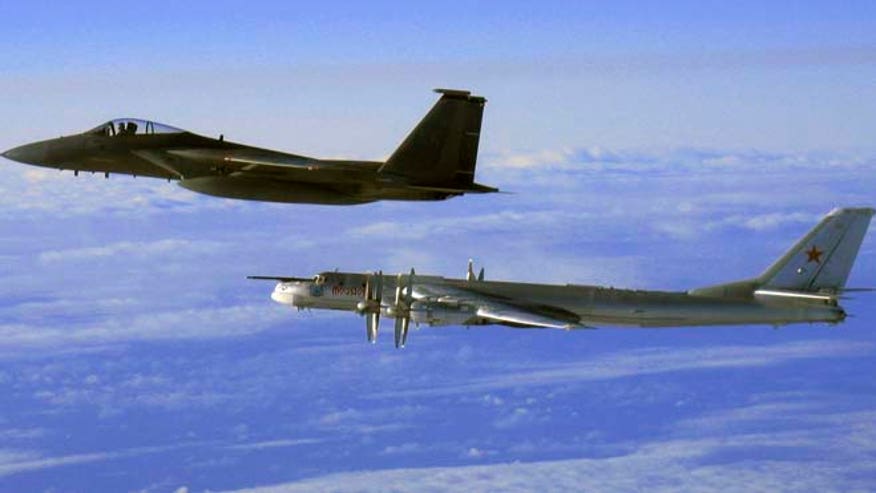
Sept. 28, 2006: This file photo provided by the U.S. Air Force shows an F-15C Eagle from the 12th Fighter Squadron at Elmendorf Air Force Base in Anchorage, Alaska, flying next to a Russian Tu-95 "Bear" bomber, right, during a Russian exercise which brought the bomber near the west coast of Alaska. Russias defense minister says the military will conduct regular long-range bomber patrols, ranging from the Arctic Ocean to the Caribbean and the Gulf of Mexico. (AP/US Air Force)
MOSCOW – Russia's long-range bombers will conduct regular patrol missions from the Arctic Ocean to the Caribbean and the Gulf of Mexico, the military said Wednesday, a show of muscle reflecting tensions with the West over Ukraine.
A statement from Defense Minister Sergei Shoigu comes as NATO has reported a spike in Russian military flights over the Black, Baltic and North seas as well as the Atlantic Ocean. It came as NATO's chief commander accused Moscow of sending new troops and tanks into Ukraine -- a claim quickly rejected by Moscow.
Shoigu said Russian long-range bombers will conduct flights along Russian borders and over the Arctic Ocean. He added that "in the current situation we have to maintain military presence in the western Atlantic and eastern Pacific, as well as the Caribbean and the Gulf of Mexico."
He said that the increasing pace and duration of flights would require stronger maintenance efforts and relevant directives have been issued to industries.
Russian nuclear-capable strategic bombers were making regular patrols across the Atlantic and the Pacific Oceans during Cold War times, but the post-Soviet money crunch forced the military to cut back. The bomber patrol flights have resumed under Putin's rule and have become increasingly frequent in recent years.
Earlier this year, Shoigu said that Russia plans to expand its worldwide military presence by seeking permission for navy ships to use ports in Latin America, Asia and elsewhere for replenishing supplies and doing maintenance. He said the military was conducting talks with Algeria, Cyprus, Nicaragua, Venezuela, Cuba, Seychelles, Vietnam and Singapore.
Shoigu said Russia was also talking to some of those countries about allowing long-range bombers to use their air bases for refueling.
Ian Kearns, director of the European Leadership Network, a London-based think tank, said the bomber patrols were part of Kremlin's efforts to make the Russian military "more visible and more assertive in its actions."
The new bomber flights "aren't necessarily presaging a threat," Kearns said. "They are just part of a general ramping-up of activities."
But he said "the more instances you have of NATO and Russian forces coming close together, the more chance there is of having something bad happening, even if it's not intentional."
On Monday, the European Leadership Network issued a report that found a sharp rise in Russian-NATO military encounters since the Kremlin's annexation of Ukraine's Crimean Peninsula in March, including violations of national airspace, narrowly avoided mid-air collisions, close encounters at sea, harassment of reconnaissance planes, close overflights over warships and Russian mock bombing raid missions.
Three of the nearly 40 incidents, the think tank said, carried a "high probability" of causing casualties or triggering a direct military confrontation: a narrowly avoided collision between a civilian airliner and a Russian surveillance plane, the abduction of an Estonian intelligence officer and a large-scale Swedish hunt for a suspected Russian submarine that yielded no result.
In September, the report said, Russian strategic bombers in the Labrador Sea off Canada practiced cruise missile strikes on the U.S. Earlier this year, in May, the report said, Russian military aircraft approached within 50 miles (80 kilometers) of the California coast, the closest such Russian military flight reported since the end of the Cold War.
Russia-West ties have dipped to their lowest point since Cold War times over Moscow's annexation of Crimea and support for pro-Russian insurgents in eastern Ukraine. The West and Ukraine have continuously accused Moscow of fueling the rebellion with troops and weapons -- claims Russia has rejected.
Fighting has continued in the east despite a cease-fire agreement between Ukraine and the rebels signed in September, and Ukraine and the West accused Russia recently of sending in new troops and weapons.
U.S. Gen. Philip Breedlove said Wednesday that in the last two days "we have seen columns of Russian equipment, primarily Russian tanks, Russian artillery, Russian air defense systems and Russian combat troops entering into Ukraine."
Breedlove, who spoke in Sofia, Bulgaria, wouldn't say how many new troops and weapons have moved into Ukraine and wouldn't specify how the alliance obtained the information. The Russian Defense Ministry quickly rejected Breedlove's statement as groundless.
Breedlove said that the Russia-Ukraine border is "completely wide open," and "forces, money, support, supplies, weapons are flowing back and forth across this border completely at will."
"We need to get back to a situation where this international border is respected," he said.
http://www.foxnews.com/world/2014/11...h-gulf-mexico/Join our efforts to Secure America's Borders and End Illegal Immigration by Joining ALIPAC's E-Mail Alerts network (CLICK HERE)
-
11-12-2014, 11:30 PM #202Senior Member
- Join Date
- May 2007
- Location
- South West Florida (Behind friendly lines but still in Occupied Territory)
- Posts
- 117,088

Russian bomber patrols to reach Gulf of Mexico
Russian nuclear-capable strategic bombers were making regular patrols across the Atlantic and the Pacific Oceans during Cold War times, reaching areas from which nuclear-tipped cruise missiles could be launched at the United States.
chron.com
Russian bomber patrols to reach Gulf of Mexico
By VLADIMIR ISACHENKOV, Associated Press | November 12, 2014 | Updated: November 12, 2014 1:41pm
Comments 138
 Photo By Robyn Stewart/AP
FILE - This is a Wednesday, Oct. 29, 2014 file photo provided by Britain's Royal Air Force of a Russian military long range bomber aircraft photographed by an intercepting RAF quick reaction Typhoon (QRA) as it flies in international airspace. Russia's defense minister says the military will conduct regular long-range bomber patrols, ranging from the Arctic Ocean to the Caribbean and the Gulf of Mexico. Sergei Shoigu's statement comes as NATO has reported a spike in Russian military flights over the Black, Baltic and North seas as well as the Atlantic Ocean. It reflects Moscow's increasingly tough posture amid tensions with the West over Ukraine.
 Photo By ITAR-TASS/AP
FILE - In this Tuesday, Aug. 16, 2005 file photo, wearing a flying gear Russian President Vladimir Putin holds his souvenir, a mock-up of a supersonic Tu-160 strategic bomber, at an airfield near the northern city of Murmansk, Russia, shortly after landing there aboard a Tu-160, with the bomber crew in the background. Russia’s defense minister says the military will conduct regular long-range bomber patrols, ranging from the Arctic Ocean to the Caribbean and the Gulf of Mexico.
 Photo By Misha Japaridze/AP
FILE - In this Thursday, Aug. 7, 2008 file photo, Russia's strategic bomber Tu-160 or White Swan, the largest supersonic bomber in the world, seen at Engels Air Base near Saratov, about 700 kilometers (450 miles) southeast of Moscow, Russia. Russia’s defense minister says the military will conduct regular long-range bomber patrols, ranging from the Arctic Ocean to the Caribbean and the Gulf of Mexico.
 Photo By ITAR-TASS/AP
FILE - In this Tuesday, Aug. 16, 2005 file photo, a supersonic Tu-160 strategic bomber with Russian President Vladimir Putin aboard flies above an airfield near the northern city of Murmansk. Russia’s defense minister says the military will conduct regular long-range bomber patrols, ranging from the Arctic Ocean to the Caribbean and the Gulf of Mexico.
 Photo By Pavel Golovkin/AP
FILE - In this Wednesday, May 7, 2014 file photo Russian Air Force strategic bombers, Tu-95, fly in formation over Red Square during a rehearsal for the Victory Day military parade, slated for May 9 at the Square to celebrate 69 years of the victory in WWII, in Moscow, Russia. Russia’s defense minister says the military will conduct regular long-range bomber patrols, ranging from the Arctic Ocean to the Caribbean and the Gulf of Mexico.
 Photo By Anonymous/AP
FILE - In this Feb. 9, 2008 file photo released by the U.S. Navy, one of two Russian Tupolev 95 Bear long rang bomber aircraft is seen near the U.S. Navy aircraft carrier USS Nimitz, south of Japan. Russia’s defense minister says the military will conduct regular long-range bomber patrols, ranging from the Arctic Ocean to the Caribbean and the Gulf of Mexico.
 Photo By Anonymous/AP
FILE - This Thursday, Sept. 28, 2006 file photo provided by the U.S. Air Force shows an F-15C Eagle from the 12th Fighter Squadron at Elmendorf Air Force Base in Anchorage, Alaska, flying next to a Russian Tu-95 "Bear" bomber, right, during a Russian exercise which brought the bomber near the west coast of Alaska. Russia’s defense minister says the military will conduct regular long-range bomber patrols, ranging from the Arctic Ocean to the Caribbean and the Gulf of Mexico.
MOSCOW (AP) — In a show of military muscle amid tensions with the West, Russia will send long-range strategic bombers on regular patrol missions across the globe, from the Arctic Ocean to the Gulf of Mexico, a top official said Wednesday.
The announcement by Russian Defense Minister Sergei Shoigu came as NATO's chief accused Russia of sending fresh troops and tanks into eastern Ukraine.
"Over the last few days, we have seen multiple reports of large convoys moving into Eastern Ukraine," said NATO Secretary-General Jens Stoltenberg. "We assess that this significant military buildup includes Russian artillery, tanks, air defense systems and troops. His statement called the situation a "severe threat to the cease-fire."
Moscow denied the allegation as unfounded, but Shoigu also said the dispute with the West over Ukraine would require Russia to beef up its forces in the Crimea, the Black Sea Peninsula that Russia annexed in March.
Shoigu said Russian long-range bombers will conduct flights along Russian borders and over the Arctic Ocean. He said, "In the current situation we have to maintain military presence in the western Atlantic and eastern Pacific, as well as the Caribbean and the Gulf of Mexico."
Shoigu would not say how frequent the patrol missions would be or offer any other specifics, but he noted that the increasing pace and duration of flights would require stronger maintenance efforts and that relevant directives have been issued to industries.
He said the Russian air force's long-range planes also will conduct "reconnaissance missions to monitor foreign powers' military activities and maritime communications."
A senior U.S. military official said Russia has not previously flown actual bomber patrols over the Gulf of Mexico, including during the Cold War.
Long-range bombers have been in the area before, but only to participate in various visits to the region when the aircraft stopped over night at locations in South or Central America. During the Cold War, other types of Russian aircraft flew patrols there, including surveillance flights and anti-submarine aircraft.
The official, who spoke on condition of anonymity because he wasn't authorized to discuss the flights publicly, also said that the pace of Russian flights around North America, including the Arctic, have largely remained steady, with about five incidents per year.
Col. Steve Warren, a Pentagon spokesman, declined to call this a Russian provocation. He said the Russians have a right, like any other nation, to operate in international airspace and in international waters. The important thing, Warren said, is for such exercises to be carried out safely and in accordance with international standards.
Russian nuclear-capable strategic bombers were making regular patrols across the Atlantic and the Pacific Oceans during Cold War times, reaching areas from which nuclear-tipped cruise missiles could be launched at the United States. But that stopped in the post-Soviet economic meltdown.
The bomber patrol flights have resumed under President Vladimir Putin's tenure, and they have become even more frequent in recent weeks, with NATO reporting a spike in Russian military flights over the Black, Baltic and North seas as well as the Atlantic Ocean.
Earlier this year, Shoigu said that Russia plans to expand its worldwide military presence by seeking permission for navy ships to use ports in Latin America, Asia and elsewhere for replenishing supplies and doing maintenance. He said the military was conducting talks with Algeria, Cyprus, Nicaragua, Venezuela, Cuba, Seychelles, Vietnam and Singapore.
Shoigu said Russia also is talking to some of those countries about allowing long-range bombers to use their air bases for refueling.
Ian Kearns, director of the European Leadership Network, a London-based think tank, said the bomber patrols are part of Kremlin's efforts to make the Russian military "more visible and more assertive in its actions."
The new bomber flights "aren't necessarily presaging a threat," Kearns said. "They are just part of a general ramping-up of activities."
But, he added, "The more instances you have of NATO and Russian forces coming close together, the more chance there is of having something bad happening, even if it's not intentional."
On Monday, the European Leadership Network issued a report that found a sharp rise in Russian-NATO military encounters since the Kremlin's annexation of Crimea, including violations of national airspace, narrowly avoided midair collisions, close encounters at sea, harassment of reconnaissance planes, close overflights over warships, and Russian mock bombing raid missions.
Three of the nearly 40 incidents, the think tank said, carried a "high probability" of causing casualties or triggering a direct military confrontation: a narrowly avoided collision between a civilian airliner and a Russian surveillance plane, the abduction of an Estonian intelligence officer, and a large-scale Swedish hunt for a suspected Russian submarine that yielded no result.
In September, the report said, Russian strategic bombers in the Labrador Sea off Canada practiced cruise missile strikes on the U.S. Earlier this year, in May, the report said, Russian military aircraft approached within 50 miles (80 kilometers) of the California coast, the closest such Russian military flight reported since the end of the Cold War.
Russia-West ties have dipped to their lowest point since Cold War times over the Kremlin's annexation of Crimea and support for pro-Russia insurgents in Ukraine. The West and Ukraine have continuously accused Moscow of fueling the rebellion in eastern Ukraine with troops and weapons — claims Russia has rejected.
Fighting has continued in the east, despite a cease-fire agreement signed between Ukraine and the rebels signed in Minsk, Belarus, in September.
Stoltenberg, the NATO chief, urged Russia to "pull back its forces and equipment from Ukraine, and to fully respect the Minsk agreements. "
U.S. Air Force Gen. Philip Breedlove, the Supreme Allied Commander in Europe, said Wednesday that in the last two days "we have seen columns of Russian equipment, primarily Russian tanks, Russian artillery, Russian air defense systems and Russian combat troops entering into Ukraine."
Breedlove, who spoke in Sofia, Bulgaria, wouldn't say how many new troops and weapons have moved into Ukraine or specify how the alliance obtained the information.
The Russian Defense Ministry quickly rejected Breedlove's statement as groundless.
Breedlove said the Russia-Ukraine border is "completely wide open," and "forces, money, support, supplies, weapons are flowing back and forth."
___
John-Thor Dahlburg in Brussels, Veselin Toshkov in Sofia, Bulgaria, and Lolita C. Baldor and Robert Burns in Washington contributed to this report.
http://www.chron.com/news/world/arti...co-5887639.php
Join our efforts to Secure America's Borders and End Illegal Immigration by Joining ALIPAC's E-Mail Alerts network (CLICK HERE)
-
11-12-2014, 11:32 PM #203Senior Member
- Join Date
- May 2007
- Location
- South West Florida (Behind friendly lines but still in Occupied Territory)
- Posts
- 117,088
Backed by China, Russia to Deploy Bombers over Gulf of Mexico

Nov 12, 2014 // 3:35pm As seen on Shepard Smith Reporting
by Fox News Insider
Posted in:
// Jennifer Griffin
// Gordon Chang
// Russia
// China
// Vladimir Putin
// Gulf of Mexico
Shepard Smith reported this afternoon that Russia will soon begin sending long-range bombers on regular patrols from the Arctic Ocean to the Caribbean and the Gulf of Mexico, according to military officials.
Jennifer Griffin joined Shep and said that this show of muscle reflects both the tensions over the ongoing conflict in Ukraine and Russian President Vladimir Putin's increasing boldness.
Griffin said that Pentagon officials don't see the move as a serious threat, but it is a reminder that Putin is trying to make his military more visible and more assertive.
China's Not Thrilled About This Video of 'Heartthrob' Putin & Chinese First Lady
Shep noted that this move comes right after NATO claimed that Russia is flowing troops, tanks and artillery into Ukraine, which Russian officials denied.
He added that the Russian defense ministry did say that they are seeking permission from Algeria, Cyprus, Nicaragua, Venezuela, Cuba, Seychelles, Vietnam and Singapore for Russian Navy ships to use ports in those countries for replenishing supplies and doing maintenance, as they begin these long-range missions.
Condi Rice: The World Isn't Listening to Us Anymore
Gordon Chang suggested that Putin is feeling emboldened by his new friendship with the Chinese - and their financial backing - and is grabbing what he wants, especially while the U.S. is distracted in other regions.
According to Chang, Putin is flaunting his relationship with China and saying to the rest of the world, "I can do whatever I want, and the U.S. can't stop me."
"They both see themselves as on the same page," Chang explained. "They see the U.S. as the common adversary. That's why they're molding their militaries together ... and that's why they're now cooperating in East Asia as well as other places."
Watch the clip from "Shepard Smith Reporting" above and read more on FoxNews.com.
Putin Beats Obama on Forbes' 'Most Powerful' List
http://insider.foxnews.com/2014/11/1...er-gulf-mexicoJoin our efforts to Secure America's Borders and End Illegal Immigration by Joining ALIPAC's E-Mail Alerts network (CLICK HERE)
-
11-12-2014, 11:35 PM #204Senior Member
- Join Date
- May 2007
- Location
- South West Florida (Behind friendly lines but still in Occupied Territory)
- Posts
- 117,088
12 November 2014 Last updated at 12:52 ET
Russian planes to patrol in Caribbean, Gulf of Mexico

Related Stories
Russian planes test Nato defences
Study reveals Russia's near misses in Europe
Why Nato-Russia relations soured
Russia has said its air force will conduct regular air patrols from the Arctic Ocean to the Caribbean and the Gulf of Mexico.
Russia had wound down such long-range missions after the end of the Cold War.
Defence Minister Sergei Shoigu said there was a plan to provide long-range aviation maintenance for the flights.
Amid renewed tensions over Ukraine, Western analysts say Russia has been returning to methods used to test Nato defences during the Cold War.
On Wednesday, Mr Shoigu said "long-range aviation units" would fly along the borders of the Russian Federation and over the waters of the Arctic Ocean.
He added: "Under the prevailing circumstances we need to ensure a military presence in the western Atlantic and eastern Pacific oceans, the waters of the Caribbean basin and the Gulf of Mexico."
He also said he had approved "an action plan to improve the condition of our long-range aviation technology, which provides for its repair and servicing at industrial facilities".
Close encounters Earlier this year, Mr Shoigu said Russia was planning military bases in a number of foreign countries, including Cuba, Venezuela and Nicaragua.
Negotiations included the option for Russian strategic bombers to refuel whilst on patrol, he said.
Mr Shoigu's latest comments came as Nato said it had observed columns of Russian military equipment entering eastern Ukraine, a claim that was dismissed by the Russian defence ministry.
Tensions between Russia and Nato members have risen over the Ukraine crisis.
Nato has recently reported "unusual" increases in Russian military aircraft conducting manoeuvres over European airspace.
The European Leadership Network, a London-based think tank, chronicled almost 40 specific close military encounters between Russia and the West over the past eight months.
They included violations of national airspace, emergency scrambles, narrowly avoided mid-air collisions and close encounters at sea.
Related Stories
- Russian planes test Nato defences
30 OCTOBER 2014, EUROPE - Study reveals Russia's near misses in Europe
09 NOVEMBER 2014, EUROPE - Why Nato-Russia relations soured
02 SEPTEMBER 2014, EUROPE
http://www.bbc.com/news/world-europe-30028371Join our efforts to Secure America's Borders and End Illegal Immigration by Joining ALIPAC's E-Mail Alerts network (CLICK HERE)
-
11-16-2014, 10:42 PM #205Senior Member
- Join Date
- May 2007
- Location
- South West Florida (Behind friendly lines but still in Occupied Territory)
- Posts
- 117,088
Ukraine Bank Runs Begin As Poroshenko Plans To Sever Socio-Economic Ties With Separatist-Held Regions
 Submitted by Tyler Durden on 11/16/2014 13:31 -0500
In what the pro-Russian separatists call "an act of genocide," Ukraine's President Poroshenko signed a decree Friday that will explicitly withdraw state support for the regions within a month. While appearing to implicitly recognize the regions of Donetsk and Luhansk as autonomous, the decree means that the central bank will no longer service bank accounts, prisoners will be transferred (inmates with minor offences will be released), and perhaps most troubling as the cold winter begins, the order covers all public services, including crucial ones, such as schools, hospitals, and emergency services; and local heating and power plants will be subject to new laws that could involve cutting energy supplies altogether to the plants that don’t pay. Luhansk's leader exclaimed, "the total socio-economic blockade of Donbass is de facto an act on genocide and devastation of our people," and as the images below show, bank runs have already begun across the region with long lines forming at ATMs.
As The BBC reports,* * *
Ukraine's president has ordered the withdrawal of all state services, including funding for hospitals and schools, from rebel-held areas.

Petro Poroshenko issued a decree that also asks parliament to revoke a law granting self-rule to the Donetsk and Luhansk regions.
As RT reports,* * *
Kiev has suspended the protection of human rights and ordered the withdrawal of its institutions from areas controlled by local militia in the nation's east. Rebels have branded the decree, which hits the population on winter’s eve, an ‘act of genocide.'
The move was prepared by the Ukrainian National Security and Defense Council last week and enacted by a presidential decree signed on Friday. It has yet to be ratified by the newly-elected parliament, but the decree explicitly says that this procedure must be expedited – so there is little doubt that the new governing coalition will adopt it next week.
Arguably the most controversial part of the decree is the suspension of the European Convention on Human Rights in rebel-held areas. The convention, which guarantees basic human rights and fundamental freedoms in Europe, has a provision which allows some of its articles to be derogated by a signatory “in time of war or other public emergency threatening the life of the nation.”
Kiev has been insisting that the military campaign it launched against the dissenting provinces is not a war, but an “anti-terrorist operation.” Apparently the operation threatens the life of Ukraine, which will now observe only those provisions of the convention, which cannot be derogated under any circumstances. In particular, they are the right to life, the prohibition of torture and slavery, and the right not to be subjected to unlawful punishment.
In practical terms, the decree orders that many social and economic ties with the self-proclaimed Donetsk and Lugansk People’s Republics be severed. Kiev will withdraw all its officials and evacuate its offices in rebel-held areas. The order covers all public services, including crucial ones, such as schools, hospitals, and emergency services.
...
Local heating and power plants will be subjected to a “special procedure for accounting supplies of fuel” to ensure that their debt will not grow. This potentially could involve cutting supplies altogether to the plants that don’t pay.
“Poroshenko’s decree on the total socio-economic blockade of Donbass is de facto an act on genocide and devastation of our people,” Igor Plotnitskiy, leader of the Lugansk People’s Republic, said.
And as Sputnik News explains,* * *
Ukraine's President Petro Poroshenko has ordered a halt in serving bank accounts of enterprises and residents in southeastern Ukraine within a month, said a decree published on the president's official website Saturday.
"National bank of Ukraine [shall] adopt measures within one month to stop serving bank accounts, including card accounts, that belong to economic entities… and residents in the territories of anti-terror operation in Donetsk and Luhansk regions," the decree said.
...
The Ukrainian central bank has been ordered to stop servicing all banks operating in the rebel-held areas. The accounts of individuals living there and companies located there have been frozen. This will stifle the local economy, as businesses will have to conduct transactions in cash or use a bartering system.
At the same time, the rules of taxation and budget transfers between Kiev and local governments in the Donetsk and Lugansk regions will be altered under the decree.
As AFP reports, the bank runs have begun...* * *
People line up to withdraw money from the cash machine at a bank in the eastern city of Donetsk.

The Ukrainian president plans to shut state offices and banks in the region.
What is perhaps even more surprising is that following plans by authorities of self-proclaimed Donetsk People’s Republic plan to open new banks tomorrow to replace the existing branches of one of Ukrainian lenders, Poroshenko has stomped on that idea too..
- Ukraine Denounces as Illegal Plan by Insurgents to Set Up Bank
Almost seems like someone is spoliing for a fight again and is annoyed at the lack of headlines (and cash) his country is getting since the ceasefire began.
http://www.zerohedge.com/news/2014-1...aratist-held-rJoin our efforts to Secure America's Borders and End Illegal Immigration by Joining ALIPAC's E-Mail Alerts network (CLICK HERE)
-
11-25-2014, 07:00 AM #206Senior Member

- Join Date
- Feb 2005
- Posts
- 17,893
10 Signs That Russia Is Preparing To Fight (And Win) A Nuclear War With The USA
Michael Snyder
End Of The American Dream
November 25, 2014
If the United States and Russia fought a nuclear war, who would win? You might be surprised by the answer. Under the Obama administration, the rapidly aging U.S. strategic nuclear arsenal has been shrinking. Meanwhile, the Russians have been developing an entirely new generation of bombers, submarines and missiles that have the capability of delivering an absolutely crippling first strike. At this point, most Americans consider a full-scale nuclear war to be inconceivable. But in Russia attitudes are completely different. To the Russians, the United States is enemy number one these days and the Russians are feverishly preparing for a potential military showdown. Of course the Russians don’t actually want to have to resort to nuclear war. Such an event would be an unspeakable horror for the entire globe. But if one does happen, the Russians want to make sure that they are the ones that come out on top.
A lot of Americans are still operating under the faulty assumption that the doctrine of “mutually assured destruction” still applies. The thinking was that both sides had so many nuclear missiles that a launch by one side would guarantee the destruction of both parties.
But since that time, so much has changed.
For one, the U.S. nuclear arsenal is far, far smaller than it was back then. Back in 1967, the U.S. military possessed more than 31,000 strategic nuclear warheads. Now, we only have 1,642 deployed, and that number is scheduled to be further reduced to about 1,500.
Sadly, reducing the size of our nuclear arsenal by close to 95 percent is not enough for anti-nuke crusader Barack Obama. He has spoken of unilaterally reducing the size of our strategic nuclear arsenal down to just 300 warheads.
During this same time period, the Russians have been developing some very impressive stealth delivery systems which have the capability of hitting targets inside the United States within just minutes of an order being issued. This is particularly true of their submarine-launched missiles. The newest Russian subs have the ability to approach our coastlines without us even knowing that they are there. If the Russians came to the conclusion that war with the United States was unavoidable, an overwhelming first strike using submarine-based missiles could potentially take out nearly our entire arsenal before we even knew what hit us. And if the Russians have an anti-ballistic missile system that can intercept the limited number of rockets that we can launch in return, they may be able to escape relatively unscathed.
In order for “mutually assured destruction” to work, we have to see the Russian missiles coming and have enough time to order a launch of our own. Thank to emerging technologies, the balance of power has fundamentally shifted. The old way of thinking simply does not apply anymore and the Russians understand this.
The following are 10 signs that Russia is preparing to fight (and win) a nuclear war with the United States…
#1 Russia is spending an enormous amount of money to develop the PAK DA Strategic Bomber. Not a lot is known about this stealth bomber at this time. The following summary of what we do know comes from an Australian news source…
Russia’s answer to the B-2 “Spirit”, this next-generation strategic bomber is intended to be almost invisible to radarand capable of carrying a huge array of conventional and nuclear missiles. Little else is known other than its expected service date: 2025.
#2 Russian nuclear bombers have been regularly buzzing areas in northern Europe and along the coast of Alaska. The Russians appear to be brazenly testing NATO defenses. Here is just one recent example…Russian strategic nuclear bombers carried out air defense zone incursions near Alaska and across Northern Europe this week in the latest nuclear saber rattling by Moscow.
Six Russian aircraft, including two Bear H nuclear bombers, two MiG-31 fighter jets and two IL-78 refueling tankers were intercepted by F-22 fighters on Wednesday west and north of Alaska in air defense identification zones, said Navy Capt. Jeff A. Davis, a spokesman for the U.S. Northern Command and North American Aerospace Defense Command. Two other Bears were intercepted by Canadian jets on Thursday.
#3 Russian Defense Minister Sergei Shoigu says that Russian nuclear bombers will now conduct regular patrols “in the western Atlantic and eastern Pacific, as well as the Caribbean and the Gulf of Mexico“.
#4 Russia is constructing an anti-ballistic missile system which will supposedly be superior to anything that the U.S. currently has…Currently under development, the S-500 missile is intended to be capable of intercepting intercontinental ballistic missiles when combined with radar input from the likes of the new A-100 AWACS aircraft. It is supposed to be able to track and shoot at up to 10 supersonic targets at any one time at heights of up to 40km.
#5 Russia recently successfully test launched a new submarine-based intercontinental ballistic missile…A Russian Northern Fleet nuclear submarine on Wednesday fired a test intercontinental missile from the Barents Sea to the country’s far eastern Kura Range on the Kamchatka Peninsula, the Russian Defense Ministry said in a statement Wednesday.#6 Russia already possesses super silent nuclear attack submarines that arevirtually undetectable when submerged. In a previous article, I discussed how the U.S. Navy refers to these virtually undetectable subs as “black holes“…
“Within the frameworks of testing the reliability of marine strategic nuclear forces, the Tula [nuclear submarine] launched a Sineva intercontinental ballistic missile from the Barents Sea to the Kura Range [in Kamchatka],” the statement says.
The RSM-54 intercontinental ballistic missile Sineva (NATO code name SS-N-23 Skiff) is part of the D-9RM launch system.
The D-9RM launch system equipped with RSM-54 missiles was put into service in 1986. The production of the RSM-54 was halted in 1996 but after three years, the Russian government resumed the production of a modernized version of the missile.
Did you know that Russia is building submarines that are so quiet that the U.S. military cannot detect them? These “black hole” submarines can freely approach the coastlines of the United States without fear of being detected whenever they want. In fact, a “nuclear-powered attack submarine armed with long-range cruise missiles” sailed around in the Gulf of Mexico for several weeks without being detected back in 2012. And now Russia is launching a new class of subs that have “advanced stealth technology”. The U.S. Navy openly acknowledges that they cannot track these subs when they are submerged. That means that the Russians are able to sail right up to our coastlines and launch nukes whenever they want.#7 Russian media outlets are reporting that 60 percent of all Russian nuclear missiles will have radar-evading capability by 2016…
Russia’s Defense Ministry plans to complete the rearmament of Strategic Missile Forces within six years. “By 2016, the share of new missile systems will reach nearly 60%, and by 2021 their share will increase to 98%. At the same time the troop and weapon command systems, combat equipment will be qualitatively improved, first of all — their capabilities for the suppression of antimissile defense will be built up,” Defense Ministry’s RVSN spokesman Colonel Igor Yegorov told ITAR-TASS on Friday.
#8 For the first time ever, Russia has more strategic nuclear warheadsdeployed than the United States does…For the first time, Russia, which is in the midst of a major strategic nuclear modernization, has more deployed nuclear warheads than the United States, according to the latest numbers released by the State Department.
Russia now has 1,643 warheads deployed on intercontinental ballistic missiles, submarine-launched ballistic missiles and heavy bombers. The United States has 1,642, said the fact sheet released Wednesday.
The warhead count for the Russians, based the Sept. 1 report required under the 2010 New Strategic Arms Reduction Treaty (START), shows an increase of 131 warheads since the last declaration on March 1. The U.S. reported a warhead increase of 57 during the same period. It is not clear why the warhead numbers increased.
#9 Russia has a massive advantage over the United States and NATO when it comes to tactical nuclear weapons…As for tactical nuclear weapons, the superiority of modern-day Russia over NATO is even stronger.#10 Russian President Vladimir Putin has initiated a huge “weapons modernization program” that is projected to cost the equivalent of 540 billion dollars…
The Americans are well aware of this. They were convinced before that Russia would never rise again. Now it’s too late.
To date, NATO countries have only 260 tactical nuclear weapons in the ETO. The United States has 200 bombs with a total capacity of 18 megatons. They are located on six air bases in Germany, Italy, Belgium, the Netherlands and Turkey. France has 60 more atomic bombs. That is pretty much it. Russia, according to conservative estimates, has 5,000 pieces of different classes of TNW – from Iskander warheads to torpedo, aerial and artillery warheads! The US has 300 tactical B-61 bombs on its own territory, but this does not change the situation against the backdrop of such imbalance.
Putin said Russia’s weapons modernization program for 2016-2025 should focus on building a new array of offensive weapons to provide a “guaranteed nuclear deterrent;” re-arming strategic and long-range aviation; creating an aerospace defense system and developing high-precision conventional weapons.Meanwhile, the Chinese have been investing heavily in this kind of technology as well.
He would not elaborate on prospective weapons, but he and other officials have repeatedly boasted about new Russian nuclear missiles’ capability to penetrate any prospective missile shield.
The Kremlin has bolstered defense spending in the past few years under an ambitious weapons modernization program that runs through 2020 and costs the equivalent of $540 billion.
In fact, just the other day the Chinese successfully tested a new submarine-launched intercontinental ballistic missile…China’s JL-2 second-generation intercontinental-range submarine-launched ballistic missile, which has the ability to reach the continental USA, is already believed to be deployable by the People’s Liberation Army, reports Huanqiu, the Chinese-language website of the nationalistic Global Times tabloid.
The Julang-2 — literally “Giant Wave 2″ — has reached a preliminary level of proficiency, according to the US-China Economic and Security Review Commission in its report to US Congress on Nov. 20.
Most Americans do not believe that any of this is a concern whatsoever.
Most Americans just assume that a full-scale nuclear war is virtually impossible.
But the truth is that a successful first strike against the United States is more possible today than it ever has been before.
Hopefully the American people will wake up to this reality before it is too late.
Related posts:
- While Obama Snoozes, Russia Is Preparing For Nuclear War With The United States
- Russia Test Fires Intercontinental Missile From Submerged Nuclear Sub: Defense Ministry
- Russia to Quadruple Precision Strategic Weapon Platforms by 2021
- Russia to Deploy 22 New Ballistic Missiles in 2014
- The Rise Of The Bear: 18 Signs That Russia Is Rapidly Catching Up To The United States
http://www.prisonplanet.com/10-signs...ed-states.htmlJoin our FIGHT AGAINST illegal immigration & to secure US borders by joining our E-mail Alerts at http://eepurl.com/cktGTn
-
11-28-2014, 06:39 AM #207Senior Member
- Join Date
- Feb 2005
- Posts
- 17,893
NATO wrestles with new fast-reaction force prompted by Ukraine crisis
"who is going to pay for it and who is going to provide troops and equipment"? By Adrian Croft 17 hours ago
By Adrian Croft
BRUSSELS (Reuters) - NATO's planned new fast-reaction force, centerpiece of its response to Russia's annexation of Crimea, is proving harder to set up than expected because of shortages of vital equipment and arguments over funding, diplomats say.
NATO leaders meeting in Wales in September agreed on a new "spearhead" force of up to 5,000 ground troops with air, sea and special forces support as part of a plan to reassure eastern European allies nervous about Russia's actions in Ukraine.
NATO leaders envisaged a force able to quickly reinforce eastern Europe - comprising countries that were under Soviet domination during the Cold War but are now NATO members - in case of trouble. Some units would be ready to move in two days, compared with the five needed by NATO's current response force.
"We've found that standing up that capability has more difficulty involved than perhaps the alliance expected when it took the decision at Wales," Britain's ambassador to NATO, Adam Thomson, told reporters.
One reason is the downsizing of NATO armed forces, reducing the ability to whisk equipment across Europe since the Cold War.
"We have moved so far away from the capabilities that the alliance developed for collective defense through the Cold War," Thomson said.
NATO foreign ministers meet next Tuesday to review progress since the summit. NATO expects defense ministers to approve the size and design of the "spearhead" force next February.
But diplomats do not expect it to be fully operational until 2016. Next year, NATO will strive to improve its existing rapid reaction force as a stepping stone to the new "spearhead".
Another NATO diplomat, speaking on condition of anonymity, said the debate over the "spearhead" focused on "who is going to pay for it and who is going to provide troops and equipment"?
European allies are expected to play the lead role in the "spearhead". However, because of capability gaps exacerbated by years of spending cuts, the Europeans may have to rely on the United States, NATO's dominant military power, to help with air transport of heavy equipment and reconnaissance.
Fewer than 100 NATO troops are expected to be based in the Baltic states, Poland, Romania and Bulgaria to organize rapid reinforcement. The "spearhead" force would rotate between different countries each year, with the best equipped European allies - Britain, France and Germany - taking the lead.
Diplomats say other allies need to come forward to avoid having the burden fall too heavily on a few countries.
http://news.yahoo.com/nato-wrestles-...172832149.htmlJoin our FIGHT AGAINST illegal immigration & to secure US borders by joining our E-mail Alerts at http://eepurl.com/cktGTn
-
12-03-2014, 01:18 PM #208Senior Member
- Join Date
- Feb 2005
- Posts
- 17,893
US Army Sends 100 Tanks To Eastern Europe To "Deter Russian Aggression"
The ink on Barack Obama's Chuck Hagel termination letter hasn't dried yet but already the US president's new, and seemingly far more hawkish advisors, are having their warmongering presence felt. Case in point: the Eastern European theater of (Cold) war, where Military.com reports that the new Army commander in Europe plans to bolster the U.S. armored presence in Poland and the Baltic states and keep rotations of U.S. troops there through next year and possibly beyond to counter Russia. Lt. Gen. Frederick "Ben" Hodges, who replaced Lt. Gen. Donald M. Campbell earlier this month as commander of U.S. Army Europe, said the Army was looking to add about 100 Abrams tanks and Bradley Fighting Vehicles to the forces in Eastern Europe.

These U.S. Army M1A2 Abrams tanks are part of the European Activity Set,
a combined-arms battalion-sized set of vehicles and equipment pre-positioned
at Germany’s Grafenwoehr Training Area. Markus Ruachenberger/U.S. Army
"We are looking at courses of action for how we could pre-position equipment that we would definitely want to put inside a facility where it would be better maintained, that rotational units could then come and draw on it and use it to train, or for contingency purposes," Hodges said in a briefing from Vilnius, Lithuania.
So "better maintained... or for contingency purposes." Got it. That probably also explains why as NATO is seeking to deliver 100 tanks to Eastern Europe, it has already added several squadrons of fighter jets just minutes away from Russia's border. For "contingency purposes."
Before:

After:

As before, we wonder how the US would react if Russia were to place a few extra fighter jets in Cuba or a few hundred tanks in Mexico. Aside from historical fact of course.
But back to NATO's tanks whose only mission is "contingency", and certainly not to intimidate Putin that the NATO ring around the nation is closing.
Hodges visited a training site in Lithuania that could be used to store armor and said he would look at similar sites in Estonia and Poland. "Certainly, I don't see a need to build infrastructure -- a FOB [Forward Operating Base] if you will -- or anything like that, that would be used for U.S. forces," Hodges said.Which is why it is best to provoke Russia first by building up NATO armed forces on Russia borders, something NATO previously express would not happen.
Since taking command, Hodges has made clear his concerns about Russia, which annexed Crimea last March and has supported the separatists in eastern Ukraine. U.S. Army Europe, which had 280,000 troops at the height of the Cold War, now has 31,000.
The rotations of U.S. troops on training missions in Eastern Europe would provide "deterrence against Russian aggression," Hodges said.
"I don't think that Russia has any intention of some sort of a conventional attack into NATO territory because they know that would generate an Article 5 response."
He referred to the NATO treaty article calling on all member states to respond to an attack on any member of the alliance. Poland, Lithuania, Estonia and Latvia are all members of the 28-member NATO alliance.Well, no, that's not what the Russians want. But if NATO keeps piling fighter jets and tanks on its border it will leave Putin no other choice. Which is precisely what the NATO endgoal is here.
"I think that what they [the Russians] do want to do is to create that ambiguity, plant the seeds of uncertainty so that the alliance members lose confidence that the rest of the alliance would come to their aid if they were, in fact, attacked," Hodges said.Well, actually here the US is lying once again. Recall that "Hacked US Documents Said To Reveal Extent Of Undisclosed US "Lethal Aid" For Ukraine Army", proving once again that the US is just as heavily involved in the Ukraine civil war as is Russia, also implying that the stated NATO reason for intervention is nothing but the red herring NATO wants to brings tensions to a new high, one that preferably breaks out in limited conflict or contained armed combat. Because clearly the global economy has reached its GDP plateau and only war can push it beyond at this point.
In other news, speaking on background, a senior administration official traveling with Vice President Joe Biden on his trip to Ukraine last week said the U.S. has provided more than $100 million in non-lethal assistance "to help the Ukrainians defend themselves."
The aid included night-vision goggles;protective vests; counter-mortar radars; blankets; vehicles; and Meals, Ready to Eat, the official said. The official said the U.S. had concluded that arming Ukraine would be counter-productive since "no matter how many weapons we provided to Ukraine, they were going to get outgunned by the Russians."
As for how Russia feels about this latest NATO expansion, we go to Bloomberg where we read that "Russia is taking countermeasures and will take more, based on analysis of NATO actions near it’s borders, Interfax news service says citing Alexander Grushko, Russia’s envoy to military alliance, in Brussels."
Grushko adds that there is "no reasons for additional deployment of NATO forces near Russian borders, according to IFX", and that NATO measures, strengthening military activity near Russian borders, lead to intensification of military tensions.
Of course they do. And NATO knows it all too well.
And speaking of limited conflict, Germany is already having nightmares about what is sure to be a very, very long recession. As Pravda reported, "the German government prepares for a long conflict with Russia." German Foreign Minister Frank-Walter Steinmeier said the crisis with Russia could take more than a decade, and Ukraine's aspirations to NATO only "adds fuel to the fire," he said in an interview with ZDF television channel on Sunday, November 30th.Horrible news if you are Europe, right? Well yes... and no. Horrible if you are a member of the soon to be exinct middle-class, i.e., the 99%. If you are lucky enough to be among Europe's uber-rich, all that the decade long conflict between Europe and Russia will do is provide the ECB with a constant scapegoat to engage in more, more, more easing, be it QE or otherwise, which in turn will crush the middle class like in the US, but make the uber-rich, uber-richer than they have ever been.
"Sometimes, 14 days are enough to start a conflict, but may take 14 years to solve this conflict," the head of German diplomacy said. When asked whether the conflict with Russia could last for such a long time, Steinmeier responded positively.
For the German minister, the issue of Crimea's future appears to be unsolvable. According to Steinmeier, international recognition of the Crimea as a part of the Russian territory is impossible. "We can not either ignore the illegal annexation of the Crimea, or forget about it and just ignore this fact. The conflict between us will continue," the Foreign Minister of Germany said.
Which is ironic: as Europe's wealthiest wage a war of words against the former KGB spy and current head of Russia through their numerous media holdings, it is they that should be most grateful for his existence.
http://www.zerohedge.com/news/2014-1...ian-aggressionJoin our FIGHT AGAINST illegal immigration & to secure US borders by joining our E-mail Alerts at http://eepurl.com/cktGTn
-
12-03-2014, 02:27 PM #209Senior Member

- Join Date
- Aug 2008
- Location
- PARADISE (San Diego)
- Posts
- 99,038
NO AMNESTY
Don't reward the criminal actions of millions of illegal aliens by giving them citizenship.
Sign in and post comments here.
Please support our fight against illegal immigration by joining ALIPAC's email alerts here https://eepurl.com/cktGTn
-
12-05-2014, 05:56 PM #210Senior Member
- Join Date
- Aug 2008
- Location
- PARADISE (San Diego)
- Posts
- 99,038
U.S.-led forces conduct 20 air strikes against Islamic State
U.S.-led forces conduct 20 air strikes against Islamic State
WASHINGTON Fri Dec 5, 2014 3:25pm EST
An explosion following an air strike is seen in western Kobani neighbourhood, November 23, 2014.
CREDIT: REUTERS/OSMAN ORSAL
RELATED NEWS
- More air strikes near Tripoli in struggle between Libya's rival groups
- Islamic State launches attack on Syrian army air base: activists
- Pakistani Taliban squeezed by Afghan revolt, U.S. drone strikes
- Australia exercises sweeping new security laws, bans Syria travel
- Takata has yet to find 'root cause' of air bag ruptures: executive
ANALYSIS & OPINION
- Top Egyptian Muslim leader urges broader action against Islamist militants
- Pope Francis says it is wrong to equate Islam with violence
(Reuters) - The United States and partner nations have conducted 20 air strikes against Islamic State targets in Syria and Iraq since Wednesday, the U.S. Central Command said on Friday.
Five of six air strikes by U.S. military forces in Syria targeted the contested city of Kobani near the border with Turkey, Centcom said in a statement. Those destroyed six Islamic State fighting positions and a heavy weapon, it said.
In Iraq, U.S. and partner nations conducted 14 air strikes, mostly targeting areas in the oil-producing north of the country controlled by Islamic State.
Four air strikes near al-Qaim destroyed checkpoints, armored vehicles, bunkers, fortifications and a tactical unit, the U.S. military said. Others were directed at Islamic militants targets near Kirkuk, Samarra, Tal Afar and Falluja.
Two air strikes near Mosul destroyed 11 bunkers, nine heavy weapons, a vehicle and hit two Islamic State units, Centcom said.
http://www.reuters.com/article/2014/...0JJ23D20141205
NO AMNESTY
Don't reward the criminal actions of millions of illegal aliens by giving them citizenship.
Sign in and post comments here.
Please support our fight against illegal immigration by joining ALIPAC's email alerts here https://eepurl.com/cktGTn


 Reply With Quote


Bummer: Trump Adds 5 More Countries To Travel Ban List
12-18-2025, 05:28 PM in General Discussion