

Results 1 to 10 of 34
 29Likes
Thread Information
Users Browsing this Thread
There are currently 1 users browsing this thread. (0 members and 1 guests)
 LinkBack URL
 About LinkBacks
Hybrid View


-
02-14-2017, 12:44 AM #1Senior Member


- Join Date
- Aug 2008
- Location
- PARADISE (San Diego)
- Posts
- 99,038
20% of dams in populated areas lack emergency plan
USA TODAY NETWORK Benjamin Spillman, Jill Castellano and Tracy Loew, USA TODAY Network Published 7:29 p.m. ET Feb. 13, 2017 | Updated 3 hours ago
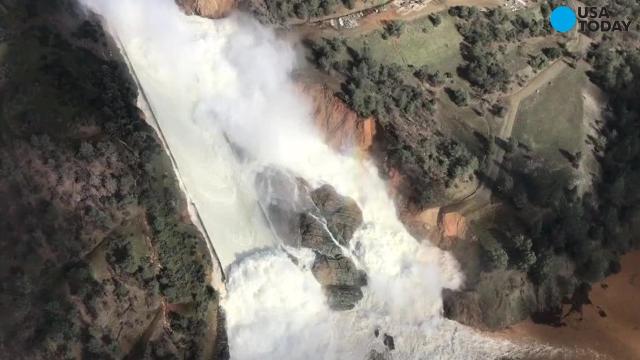
Aerial footage shows water gushing down the spillway of Oroville Dam during the same week the spillway collapsed because of damage, causing at least 188,000 people to evacuate the area. USA TODAY NETWORK

(Photo: Elijah Nouvelage, Getty Images)
As the nation's 84,000 dams continue to age, a growing number of people downstream are at risk, experts say.
That's not only because of older infrastructure but also because of population growth around some of the dams.
More than a quarter were developed primarily for recreational purposes, according to National Inventory of Dams data from 2016.
"The nation’s dams are aging, and the number of high-hazard dams is on the rise," according to a 2013 report from the American Society of Civil Engineers. "Many of these dams were built as low-hazard dams protecting undeveloped agricultural land. However, with an increasing population and greater development below dams, the overall number of high-hazard dams continues to increase."
That problem was highlighted this week as nearly 200,000 people evacuated an area near California's Oroville Dam, about 150 miles northeast of San Francisco. California water officials were worried that erosion they discovered Sunday at the top of its emergency spillway could send a 30-foot tall wall of water down the Feather River and through the Northern California cities of Oroville, Yuba City and Marysville.
► Related: New storms could imperil Oroville where 200,000 were evacuated
The population of Oroville, the county seat of Butte County that's less than 10 miles downriver from Oroville Dam, has more than doubled since the dam was completed in 1968.
Most U.S. dams were completed between 1950 and 1980. A small fraction of dams, 2.8%, were built before 1900.
More than 4,000 dams have been built since 2000, accounting for 4.5% of all U.S. dams.

A playground is seen Feb. 13, 2017, submerged in flowing water at Riverbend Park in Oroville, Calif. as the Oroville Dam releases water down its main spillway about 10 miles up the Feather River. (Photo: Josh Edelson, AFP/Getty Images)
The latest data in the dams inventory, which the Army Corps of Engineers compiles, shows almost 15,500 dams across the USA are characterized as high hazard, meaning at least one person could die if the dam were to fail.
Among those high-hazard dams, nearly 1 in 5 lack an emergency action plan, a document dam owners maintain that includes critical information such as emergency contacts, details about the dam and an inundation map.
“If you have a good emergency action plan, you are going to reduce the consequences if the dam fails,” said Lori Spragens, executive director of the Association of State Dam Safety Officials.
The average age of the United States' 84,000 dams is 52, according to the American Society of Civil Engineers' report.
“We can’t seem to get the federal government or the states interested in funding the most fundamental part of what makes us go, which is infrastructure,” Spragens said. “It just needs so much more attention at a national level.”
In seven states, more than half of the high-hazard dams are operating without emergency action plans, according to the National Inventory of Dams:
• In South Carolina, it’s 96%.
• Mississippi, 88%
• Rhode Island, 82%
• Alabama, 79%
• New Mexico, 61%
• Florida, 58%
• North Carolina, 57%
Only three states — Louisiana, Maine and Tennessee — and Puerto Rico have emergency plans in place for all the dams with high-hazard potential.
In California, the problem is especially widespread.California has more than 1,500 dams, according to the National Inventory of Dams database. Of those, 52% are considered high hazard, the fourth highest of any state.
► Related: What is the Oroville Dam and what will happen if its spillway fails?
Nationwide, 17% of dams are considered high hazard.
In California, more than a third, 36%, of the high-hazard dams don't have an emergency plan, which would kick into gear if the dam appeared to be a threat. Oroville Dam does have an emergency plan.
“We can’t seem to get the federal government or the states interested in funding the most fundamental part of what makes us go, which is infrastructure.”Lori Cannon Spragens, Association of State Dam Safety Officials
Nationwide, 31% of high-hazard dams lack an emergency plan.
Almost two-thirds of U.S. dams are privately owned. Among the rest: Local governments own 20%; states, 7%; public utilities, 4%; the federal government, also 4%; and the remainder don’t have their ownership listed.
Understanding the level of risk associated with the nation’s dams can be difficult.
States have oversight of about 7 in 10 of the nation’s 84,000 dams. The federal government through the Army Corps of Engineers, the Bureau of Reclamationand the Federal Energy Regulatory Commissionregulates others.
More than three quarters of the high-hazard dams are state regulated, according to Association of State Dam Safety Officials. Of those, about 1 in 7 are in need of remediation.
“That is one of our biggest national challenges, to try and get these dams inspected more regularly,” Spragens said. In 2015, states spent $49.4 million regulating and inspecting more than 81,000 dams, including the high-hazard dams under state regulation.
The Federal Emergency Management Agency operates the National Dam Safety Program, which is an attempt to support standards for dam safety. The program supports research and training related to dam safety and inspection, including grants to states to improve their own regulatory systems.
► Related: Dam's eroding spillway further proof that northern Calif. drought is over
But the FEMA program doesn’t provide enough money for states to enforce the regulations or inspections.
“A lot of states are behind on that schedule. That is a huge challenge right now across the country, having enough inspectors doing their jobs,” Spragens said.
People who want to learn more about dams in their own communities will have a difficult time tracking down critical data. Security concerns following the Sept. 11, 2001, terrorist attacks prompted restrictions on the availability of hazard ratings and conditions of specific dams.
“That is not going to be easy to find,” Spragens said. “You obviously don’t want people panicking, but it is very understandable: We want people to know.”
http://www.usatoday.com/story/news/n...plan/97870636/NO AMNESTY
Don't reward the criminal actions of millions of illegal aliens by giving them citizenship.
Sign in and post comments here.
Please support our fight against illegal immigration by joining ALIPAC's email alerts here https://eepurl.com/cktGTn
-
02-14-2017, 12:59 AM #2Administrator

- Join Date
- May 2006
- Location
- California
- Posts
- 65,444
DONNELLY: Jerry Brown’s California Legacy is a Dam Failure
by ASSEMBLYMAN TIM DONNELLY
13 Feb 2017
Twin Peaks, CA
The Oroville Dam — at 770 feet, America’s tallest — is on the verge of failing. And Sacramento, which has been fiddling for decades while Rome burns, is running for cover.
This isn’t just any dam; it’s the primary storage facility located on the Feather River for the State Water Project, the state-owned conveyance system that provides drinking water to more than two-thirds of California’s population.
If the dam were to fail, it could inundate not only the city of Oroville but numerous other communities downstream, including Yuba City, Marysville and even West Sacramento.
At the moment, the emergency spillway is being used for the first time since Governor Ronald Reagan approved its construction, and almost 200,000 people have been evacuated.
What’s Governor Jerry Brown doing?
The same thing he’s been doing for decades — obstructing progress. California has been so busy defying President Donald Trump in order to protect illegal aliens from deportation that it forgot to do the things government is supposed to do, like maintain infrastructure. Governor Brown is now going hat-in-hand to beg the Trump administration for emergency funds.
According to Breitbart News sources, the Trump administration is already closely monitoring the situation, and has dispatched personnel and made contingency plans to aid California in the event of a catastrophic dam failure.
But it’s during the seven dry years — the extended drought — that the state should have fixed its water infrastructure, like dams and canals. Brown and his merry band of Democrats had different priorities, like high-speed rail, benefits for illegal aliens, and unsustainable pensions.
The reality is that Sacramento was warned over and over again. Just a few years back, environmentalists raised concerns that an earthquake could degrade the massive earthen rockfill dam. Sacramento just chose to ignore those concerns — and to spend the money on other priorities.
According to the San Jose Mercury News, it was “(t)hree environmental groups — the Friends of the River, the Sierra Club and the South Yuba Citizens League — [who] filed a motion with the federal government on Oct. 17, 2005, as part of Oroville Dam’s relicensing process, urging federal officials to require that the dam’s emergency spillway be armored with concrete, rather than remain as an earthen hillside.”
It’s ironic that the same environmentalists who have opposed every new dam project were the ones who raised the alarm.
Countless proposals have been floated over the past two decades to fund infrastructure out of the general fund, and prioritize critically needed upgrades to dams, roads and bridges. But Sacramento spends a pittance out of it’s $180 billion budget on infrastructure, and most of that is earmarked for the abysmal roads and a crumbling intrastate highway system.
Instead, California’s Democrat-dominated leadership depend on bonds to bail them out.
Californians are probably scratching their heads wondering what happened to all the money they had approved for bonds over the past few decades — something close to $20 billion (not including the latest water bond, Proposition 1, which alone was $7.5 billion).
When a bond is approved, the money is allocated according to the official stated purpose and/or specific projects to be built. In fact, some of those bond accounts are still flush with hundreds of millions of unused dollars, which might have been approved by voters to use on existing infrastructure projects like shoring up the Oroville Dam.
But Gov. Jerry Brown never thought to ask them.
According to a PPIC report on how the money has been disbursed on the latest water bond, all the pork projects got funded, but not a penny has been allocated for water storage.
The chart on the report page will show you everything you need to know about Sacramento’s priorities. Even the so-called “Water Bond” hasn’t been used to shore up or expand our water storage infrastructure yet (in spite of projects being in the pipeline for decades):
To date, the awards have focused on addressing priorities related to urgent public health and safety issues and the drought. Thirty-one grants will help disadvantaged communities with safe drinking water and wastewater treatment projects, 19 grants will boost urban supplies with wastewater recycling projects, and 21 grants will support local efforts to better manage groundwater reserves. Another priority has been California’s ecosystems, which have been hit hard by the drought; 45 projects address water supply and habitat to support native species around the state.
No funds have been awarded yet for water storage, another key area for boosting drought resilience. This has led to some criticism that the pace of spending is too slow, but this overlooks the bond language, which laid out a two-year process for establishing funding criteria.
But there is one thing Gov. Brown has done in cooperation with federal officials regarding infrastructure. A little over a year ago, Brown signed off on an agreement to tear down dams on the Klamath River.
Yes, you can’t make this stuff up.
Brown did finally have his “rainy day” fund approved by voters in 2016. Yet California — the so-called sustainable state — has refused to maintain its infrastructure in order to sustain its way of life. Now the “rainy day” they’d hoped to avoid is here.
God be with all those in the pathway of potential destruction.
http://www.breitbart.com/california/...y-dam-failure/Support our FIGHT AGAINST illegal immigration & Amnesty by joining our E-mail Alerts at https://eepurl.com/cktGTn


 Reply With Quote
Similar Threads
-
Oroville Dam: Feds and state officials ignored warnings 12 years ago
By Judy in forum General DiscussionReplies: 9Last Post: 02-16-2017, 02:36 PM -
Danger of shutdown recedes as GOP leaders reject immigration debate on spending bill
By Jean in forum General DiscussionReplies: 1Last Post: 09-17-2014, 10:11 AM -
IRS criticized for payment of $4B to illegals
By Jean in forum illegal immigration News Stories & ReportsReplies: 2Last Post: 06-14-2013, 12:22 AM -
More illegals stealing iron rail?
By ALIPAC in forum General DiscussionReplies: 8Last Post: 05-27-2011, 08:20 PM -
Bush's Pick for State Post Criticized
By Brian503a in forum illegal immigration News Stories & ReportsReplies: 0Last Post: 10-26-2005, 05:51 PM


Trump Admin Cancels 28,000 Trucker Licenses Held by Illegal...
08-03-2026, 08:07 AM in illegal immigration News Stories & Reports