

Results 1 to 7 of 7
Thread Information
Users Browsing this Thread
There are currently 1 users browsing this thread. (0 members and 1 guests)
 LinkBack URL
 About LinkBacks
Hybrid View


-
04-05-2012, 12:35 AM #1Senior Member


- Join Date
- May 2007
- Location
- South West Florida (Behind friendly lines but still in Occupied Territory)
- Posts
- 117,087
CIA Committed ‘War Crimes,’ Bush Official Says
CIA Committed ‘War Crimes,’ Bush Official Says
By Spencer Ackerman
April 4, 2012 | 8:48 am
 Image: Dept. of Defense
A top adviser to former Secretary of State Condoleezza Rice warned the Bush administration that its use of “cruel, inhuman or degrading” interrogation techniques like waterboarding were “a felony war crime.”
What’s more, newly obtained documents reveal that State Department counselor Philip Zelikow told the Bush team in 2006 that using the controversial interrogation techniques were “prohibited” under U.S. law — “even if there is a compelling state interest asserted to justify them.”
Zelikow argued that the Geneva conventions applied to al-Qaida — a position neither the Justice Department nor the White House shared at the time. That made waterboarding and the like a violation of the War Crimes statute and a “felony,” Zelikow tells Danger Room. Asked explicitly if he believed the use of those interrogation techniques were a war crime, Zelikow replied, “Yes.”
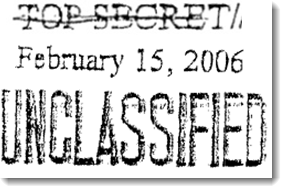
Zelikow first revealed the existence of his secret memo, dated Feb. 15, 2006, in an April 2009 blog post, shortly after the Obama administration disclosed many of its predecessor’s legal opinions blessing torture. He briefly described it (.pdf) in a contentious Senate hearing shortly thereafter, revealing then that “I later heard the memo was not considered appropriate for further discussion and that copies of my memo should be collected and destroyed.”
At least one copy survived in the files of the department’s Bureau of Intelligence and Research. The State Department has now disclosed it to Danger Room, mostly without redactions — three years after this reporter filed an official request for it. You can read the memo for yourself, below. Click Each to Enlarge


Zelikow’s memo was an internal bureaucratic push against an attempt by the Justice Department to flout long-standing legal restrictions against torture. In 2005, he wrote, both the Justice and State Departments had decided that international prohibitions against “acts of cruel, inhuman, or degrading treatment or punishment which do not amount to torture” do not “apply to CIA interrogations in foreign countries.” Those techniques included contorting a detainee’s body in painful positions, slamming a detainee’s head against a wall, restricting a detainee’s caloric intake, and waterboarding.
Zelikow wrote that a law passed that year by Congress, restricting interrogation techniques, meant the “situation has now changed.” Both legally and as a matter of policy, he advised, administration officials were endangering both CIA interrogators and the reputation of the United States by engaging in extreme interrogations — even those that stop short of torture.
“We are unaware of any precedent in World War II, the Korean War, the Vietnam War, or any subsequent conflict for authorized, systematic interrogation practices similar to those in question here,” Zelikow wrote, “even where the prisoners were presumed to be unlawful combatants.”
Other “advanced governments that face potentially catastrophic terrorist dangers” have “abandoned several of the techniques in question here,” Zelikow’s memo writes. The State Department blacked out a section of text that apparently listed those governments.
“Coercive” interrogation methods “least likely to be sustained” by judges were “the waterboard, walling, dousing, stress positions, and cramped confinement,” Zelikow advised, “especially [when] viewed cumulatively.” (Most CIA torture regimens made use of multiple torture techniques.) “Those most likely to be sustained are the basic detention conditions and, in context, the corrective techniques, such as slaps.”
Zelikow’s warnings about the legal dangers of torture went unheeded — not just by the Bush administration, which ignored them, but, ironically, by the Obama administration, which effectively refuted them. In June, the Justice Department concluded an extensive inquiry into CIA torture by dropping potential charges against agency interrogators in 99 out of 101 cases of detainee abuse. That inquiry did not examine criminal complicity for senior Bush administration officials who designed the torture regimen and ordered agency interrogators to implement it.
“I don’t know why Mr. Durham came to the conclusions he did,” Zelikow says, referring to the Justice Department special prosecutor for the CIA torture inquiry, John Durham. “I’m not impugning them, I just literally don’t know why, because he never published any details about either the factual analysis or legal analysis that led to those conclusions.”
Also beyond the scope of Durham’s inquiry: The international damage to the U.S. reputation caused by the post-9/11 embrace of “cruel, inhuman and degrading” interrogation methods; and the damage done to international protocols against torture.
Update, 12:15 p.m.: This post has been updated to reflect Danger Room’s interview with Zelikow.
CIA Committed 'War Crimes,' Bush Official Says | Danger Room | Wired.comJoin our efforts to Secure America's Borders and End Illegal Immigration by Joining ALIPAC's E-Mail Alerts network (CLICK HERE)
-
04-05-2012, 12:36 AM #2Senior Member
- Join Date
- May 2007
- Location
- South West Florida (Behind friendly lines but still in Occupied Territory)
- Posts
- 117,087
Maddow relays censored memo on CIA ‘war crimes’ during Bush Administration
By Eric W. Dolan
Thursday, April 5, 2012 0:05 EDT

Topics: bush administration ♦ Bush State Department ♦ rachel maddow
MSNBC host Rachel Maddow on Wednesday night explained a legal memo that advised the Bush Administration that so-called enhanced interrogation techniques were torture and therefore illegal.
Wired reporter Spencer Ackerman obtained the memo, written by State Department counselor Philip Zelikow, through a Freedom on Information Act request.
Bush told NBC’s Matt Lauer in 2010 that he authorized the use of enhanced interrogation techniques like waterboarding because his “lawyer said it was legal, said it did not fall within the Anti-Torture Act.” But Zelikow’s memo warned the Bush Administration in 2006 that the interrogation techniques used on terror suspects by the CIA were “a felony war crime.”
“As a top lawyer at the Bush State Department, Philip Zelikow circulated the memo within the Administration that said, essentially, that the Administration was kidding itself in trying to say that there was some way around the law,” Maddow explained. “They were trying to give a legal green light to CIA interrogator to torture people, but that green light, he said, was a sham.”
In 2009, Zelikow said that the Bush Administration attempted to collect and destroy all copies of the memo.
“If the Republican Party were the still the party of John McCain, this would open up a whole new can of political worms,” Maddow said, “because the Obama Administration, remember, looked into Bush Administration ordered torture and they decided not to prosecute any of it.”
Upon taking office in 2009, President Barack Obama abolished CIA secret prisons, banned the use of torture and promised to close the detention center at Guantanamo Bay. In doing so, he vowed not to prosecute former Bush Administration officials, saying it was a “time for reflection, not retribution.”
Watch video, courtesy of MSNBC, below:
Visit msnbc.com for breaking news, world news, and news about the economy
With reporting by David Edwards
Maddow relays censored memo on CIA ‘war crimes’ during Bush Administration | The Raw Story
Join our efforts to Secure America's Borders and End Illegal Immigration by Joining ALIPAC's E-Mail Alerts network (CLICK HERE)
-
04-05-2012, 11:22 AM #3Senior Member
- Join Date
- May 2007
- Location
- South West Florida (Behind friendly lines but still in Occupied Territory)
- Posts
- 117,087
Apr 4, 2012
A newly released document showcases the United States Defense Department's torture techniques. The 37 page report details ways officials can torture detainees suspected of having ties to terrorism. In 2002, the document was handed to Bush administration officials, but is just now seeing the light of day. Now the particulars of the report are being called war crimes. Jason Leopold, lead investigative reporter for Truth-Out.Org, joins us for more.
Join our efforts to Secure America's Borders and End Illegal Immigration by Joining ALIPAC's E-Mail Alerts network (CLICK HERE)
-
04-05-2012, 05:30 PM #4Senior Member
- Join Date
- May 2007
- Location
- South West Florida (Behind friendly lines but still in Occupied Territory)
- Posts
- 117,087
Serious Business: President Bush and VP Cheney Should Take the Stand on War Lies
Posted: 04/ 3/2012 6:20 pm
Nine years ago, I encountered a man from Ohio on a flight from LaGuardia to the Akron-Canton Airport just as the Iraq War was starting. I wish I could talk to him again.
While sharing armrests but diverging on political leanings, we had a rather heated tête-à-tête about war in Iraq. He was firmly in favor of the war, and, in fact, wanted all the shock and awe the U.S. could deliver. He reasoned that Iraq was linked to al Qaeda and 9/11, and we couldn't let them get away with it.
I was fresh from the massive anti-war marches in New York and questioned the truth of any connection between Iraq and al Qaeda, although President Bush and Vice President Cheney had drawn the association with regularity. My seatmate's whole body leaned over to the right -- literally. "I feel so sorry for you," he said. "How cynical you must be to think that the president would lie."
Now, nine years later, I feel sorry for all of us. If only, like the Beatles' Revolution 9, played backwards by disc jockeys of the day, we could rewind this tune. The false statements and lies that were used by President Bush and his team to drive the nation to war and occupation in Iraq have caused immeasurable heartbreak with thousands upon thousands of lost and damaged lives -- U.S. and allies' personnel, Iraqi civilians and military, international journalists and bystanders. The financial costs to the U.S. have reached $800 billion, according to the American Progress Center's Iraq War Ledger, and the ticker is still going.
Now we know that President Bush and his team lied repeatedly -- investigative researchers at the Center for Public Integrity documented 935 false statements about Iraq in the two years after 9/11 (memorialized in a song by Harry Shearer). More than mere harmless "pants on fire" posturing, these statements violate the federal criminal law.
In Cheating Justice: How Bush and Cheney Attacked the Rule of Law, Plotted to Avoid Prosecution - and What We Can Do About It, I and co-author Elizabeth Holtzman describe a prima facie case for prosecuting President Bush and Vice President Cheney for conspiracy to deceive Congress under Sections 371 and 1001 of the federal criminal code.
Now that Bush and Cheney are now longer in office, the law can reckon with them on this and other outrageous incursions, such as wiretapping without warrants and torture. And prosecuting is a mighty good idea if we are to have a robust democracy down the road.
President Bush deceived Congress in two direct ways -- one was a speech; the other was a letter sent to Congress, stipulating that he had met the prerequisites set by Congress in order to launch a war into Iraq.
The speech came on January 28, 2003 : the State of the Union message personally delivered to both houses of Congress. Two-thirds of the speech was devoted to Iraq, and much of what the president said was simply false. It was here that President Bush asserted that Iraq was buying the uranium needed to build a nuclear weapon from a country in Africa. The "sixteen words," later retracted, were known to be untrue. Their deceptiveness was unmasked when former Ambassador Joseph Wilson wrote that he had traveled to Africa before the war at the behest of the Bush administration and had reported back that Iraq was not buying uranium. (As told in Fair Game, Wilson's statements spurred a vicious White House reaction targeting his wife, CIA agent Valerie Plame.)
President Bush also said that Iraq was procuring aluminum tubes for nuclear weapons, but that matter had already been dashed as wrong by the International Atomic Energy Agency, noted Joby Warrick in the Washington Post. Finally, President Bush said, as my Ohio seatmate parroted, that "Saddam Hussein aids and protects terrorists, including members of al Qaeda," but those connections that had been debunked immediately after 9/11 by counterterrorism expert Richard Clarke.
Things only got worse in the weeks after the State of the Union. Congress, as the branch of government charged with declaring war, had set stipulations in October 2002 that President Bush had to satisfy before a war could be launched in Iraq. Rather than meet them, the president flouted them. That is, he lied. On March 18, 2003, the president literally signed, sealed and delivered on letters stating that a war in Iraq was a "necessary" action against those who "planned, authorized, committed or aided the terrorist attacks that occurred on September 11, 2001." Not only was war not necessary, Iraq had not aided in the attacks of 9/11.
The president's letter also certified that Iraq posed a "continuing" threat to the U.S. As the president knew, it did not -- it had no weapons of mass destruction (WMD) and none were in development. The president admitted this to Prime Minister Tony Blair before the war, according to leaked British memos obtained by international lawyer and author Philippe Sands.
Piling on the false statements, the president stated in the letters, untruthfully, that "peaceful means" would not protect the U.S. But weapons inspectors were peacefully in Iraq and, while they had found no WMD, they were willing to continue to look. In addition, the president blew off the UN Security Council and refused to fulfill the requirement for a critical second resolution before going to war (it would have been vetoed). International lawyers objected vehemently to the rejection of this diplomatic process, and this has become an ongoing scandal in Britain, where the Iraq Inquiry has been taking testimony, much of it damning, on the start of the Iraq war.
Lying to the U.S. Congress is a federal crime under Section 1001 of the federal code, and working in concert with others to lie to Congress is prohibited by conspiracy laws under Section 371. These are not mothballed laws, but ones that are being used regularly to charge others with crimes. Former Yankees pitcher Roger Clemens was criminally charged for making a false statement to Congress in denying any use of steroids. The American League's 2002 Most Valuable Player Miguel Tejada pleaded guilty in 2009 to making a false statement to Congress about his knowledge of other players' use of banned substances. Of Tejada, Assistant U.S. Attorney Steve Durham said, "People have to know that when Congress asks questions, it's serious business. And if you don't tell the truth -- and we can prove you haven't told the truth -- then there will be accountability." Tejada was placed on probation, ordered to do 100 hours of community service and required to pay a fine of $5,000.
Not even that modest level of accountability has been applied to President Bush. Lying about knowledge of steroids is obviously a blip on the scale compared to lying about 9/11, WMD and the need for war. We still have had no clear explanation of why President Bush and his team drove the nation to war and occupation in Iraq; in fact, in his book, Decision Points, the former president said that he had no apologies even though no WMD were found, and he thought the world was better off for the war. He was completely oblivious to the suffering of so many who lost loved ones or were injured, displaced, tortured and permanently harmed.
We need to put any future president on notice -- now -- that lying to Congress about the need for war is serious business. Prosecution under the criminal laws of the United States is the best way to hold President Bush accountable. I'd like to find that man from Ohio; I think he'll agree -- we can't let him "get away with it."
http://www.alipac.us/f19/cia-committ...l-says-254456/Join our efforts to Secure America's Borders and End Illegal Immigration by Joining ALIPAC's E-Mail Alerts network (CLICK HERE)
-
04-12-2012, 02:01 AM #5Senior Member
- Join Date
- May 2007
- Location
- South West Florida (Behind friendly lines but still in Occupied Territory)
- Posts
- 117,087
The Unclassified Zelikow Torture Memo as Evidence of Crimes
Michael Collins
Information Clearing House
Wed, 11 Apr 2012 20:04 CDT
© n/a
"My colleagues were entitled to ignore my views," he [Zelikow] continued. "They did more than that: The [2006] White House attempted to collect and destroy all copies of my memo. I expect that one or two are still at least in the State Department's archives." Phillip D. Zelikow, State Department Counselor, 2005-2007, to Congress, May 13, 2009
Former legal counsel to the Department of State, Phillip Zelikow, produced a convincing and elegant argument for the immediate cessation of anything that looked like torture in February 2006. The government declassified the memo last week and National Security Archive released it on April 3.
The failure to follow Zelikow's clear statement of the law, withholding the memo without justification, and the failure to prosecute those responsible for the previous acts represent evidence of crimes.
Zelikow's memo
Phillip Zelikow is the ultimate establishment insider. He took leave from his academic appointments at the University of Virginia to assist in the 2001 presidential transition. He helped Condoleezza Rice develop the doctrine of preemptive war after 9/11, and served as executive director of the 9/11 Commission. In that role, Zelikow shielded the Bush administration from responsibility for their epic failures associated with the attack.
When it came to blatant violations of laws that any rational person could understand, Zelikow had finally reached his limit.
Zelikow began by noting that prior to the McCain Amendment, Justice and State had agreed on the conduct of CIA interrogations outside the United States. Through some distorted logic, the government concluded that it could violate the UN Convention Against Torture even though it clearly prohibits enhanced interrogations activities committed by signatories wherever they may occur.
"The situation has now changed. As a matter of policy, the U.S government publicly extended the prohibitions against cruel, inhuman, degrading treatment to all conduct worldwide. And then, as a matter of law, the McCain Amendment extended the application of Article 15 of the Convention Against Torture to conduct by U.S. officials anywhere in the world." Phillip Zelikow, The McCain Amendment and U.S. Obligations under Article 16 of the Convention Against Torture, Feb 15, 2006
There was no argument on the geographical reach on the McCain amendment's ban on "cruel, inhuman, and degrading" treatment of any prisoners of the U.S. government anywhere. The amendment is clear: "Nothing in this section shall be construed to impose any geographical limitation on the applicability of the prohibition against cruel, inhuman, or degrading treatment or punishment under this section." McCain Amendment No. 1977, October 2005
Zelikow made a point of writing that the new standards "apply directly to the enhanced interrogation techniques employed by the CIA." From the date of this memo, the political and permanent employees of the State and Justice Departments knew clearly that enhanced interrogations had been thoroughly stripped of any legal justification.
Zelikow elaborated on restrictions created by the cruel and unusual standard for prisoner treatment by pointing out that courts "used terms like serious deprivation of human needs or conditions which deprived inmates of the minimal civilized measure of life necessities."The standard also restricted the use of "methods of interrogation that shock the conscience." Citing U.S. Supreme Court cases, shocking the conscience includes holding prisoners incommunicado, prolonged questioning, and threatening to kill the prisoner.
This was drawn directly from the McCain Amendment with incorporates the Fifth, Eighth, and Fourteenth Amendments to the Constitution as the criteria for against cruel, inhuman, degrading. Zelikow's memo drives home the restrictions on prisoner treatment and abuse: "Under American law there is no precedent for excusing treatment that is intrinsically cruel even if the state asserts a compelling need to use it."
Zelikow didn't have to write this memo or even get seriously involved in the prisoner treatment issue. He was counsel to the Secretary of State and Justice had the lead on this issue. However, his conscience must have been shocked when he saw the administration's plan to defy the law in such a blatant way. The Bush signing statement attached to the law was meaningless since the Amendment could only be modified by Congress.
The Bush administration had no intention of following the law. By November 2006, the American Civil Liberties Union unearthed orders by Bush for the very practices that were outlawed as clearly outlined by Zelikow's memo.
Criminal acts arising from the Zelikow memo
Zelikow's memo was an argument to dissuade illegal behavior that he saw endorsed by the 2006 Department of Justice. The memo is also a clear description of the law. It outlines the case for prosecuting those involved at any point after their acts to defy the law.
The memo makes clear that successive Justice Departments to this day have ignored their obligation to prosecute those responsible for outlawed interrogations. This would make all those responsible but failing to prosecute eligible for charges under the honest services fraud law of 1988. That law makes it a federal crime for government officials to fail to do their jobs since citizens have an "intangible right to honest services" (in this case, the expectation that federal officials violating prisoner treatment laws be prosecute).
Finally, Zelikow's charge that the Bush administration hid and tried to destroy his memo shows a conspiracy to withhold evidence. Withholding or destroying evidence can be used as a proof of guilt in criminal and civil cases.
We would be unwise to lose any sleep over the prospects of prosecutions. This is all part of the looking forward policy used by President Obama as an excuse to avoid investigating the Bush administration (and now his own) for any violations of law from prisoner interrogation to the lies that were used to manipulate the people into briefly tolerating the Iraq invasion and occupation .
Also see:
National Security Archive, April 3, 2012 The Zelikow Memo: Internal Critique of Bush Torture Memos Declassified
Phillip D. Zelikow statement to Congress, May 13, 2009
Murder Trumps Torture Says Bugliosi - an Interview, Michael Collins, April 8, 2009
The Unclassified Zelikow Torture Memo as Evidence of Crimes -- Puppet Masters -- Sott.net-Join our efforts to Secure America's Borders and End Illegal Immigration by Joining ALIPAC's E-Mail Alerts network (CLICK HERE)
-
04-21-2012, 04:33 PM #6Senior Member
- Join Date
- May 2007
- Location
- South West Florida (Behind friendly lines but still in Occupied Territory)
- Posts
- 117,087
Leaked CIA Memo: Bush knew US torture was 'war crime'
Water boarding and stress positions... just two of the torture techniques used by the U.S. against terror suspects. Now, a secret memo has been leaked which brands them "war crimes", and shows the Bush administration was warned against their use. As RT's Marina Portnaya explains, many feel President Obama isn't doing enough to make up for America's past mistakes
Leaked CIA Memo: Bush knew US torture was 'war crime' - 12160Join our efforts to Secure America's Borders and End Illegal Immigration by Joining ALIPAC's E-Mail Alerts network (CLICK HERE)


 Reply With Quote

Alabama Case Spotlights Reality of Noncitizens Voting in U.S....
07-08-2026, 05:59 AM in Non-Citizen & illegal migrant voters